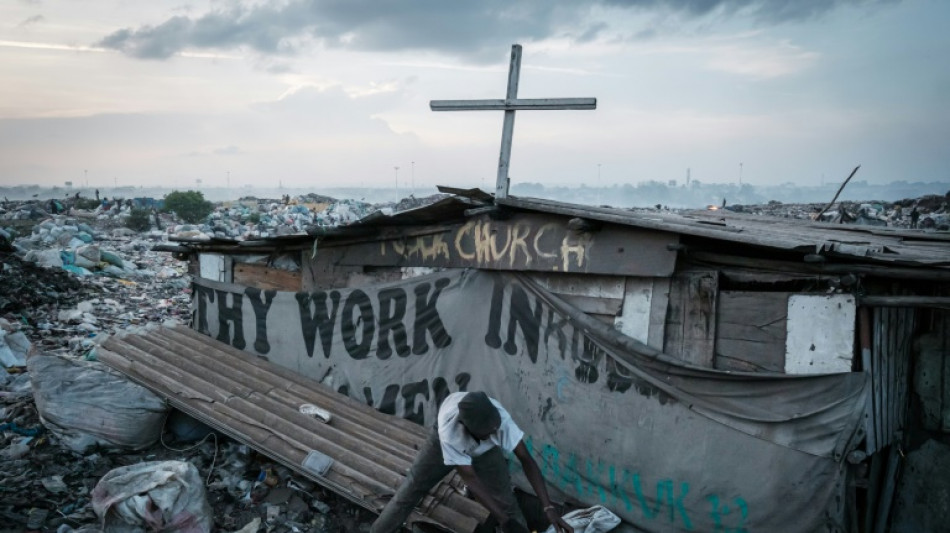
Donated clothing worsening Kenya's plastic pollution: report / Photo: © AFP

 South African election results renew debate over identity-based voting

 South African voters report smoother local election but declining IEC trust

 Dolly Parton museum and Nashville hotel open after singer’s death

 George and Amal Clooney attend New York political-comedy reading

 British buyers pay substantial premiums for period-home appearance

 Thomas Markle released to house arrest after child-abuse-image charge

 Dawn of War 4 developers chose Adeptus Mechanicus for tactical variety

 Italy face unbeaten South Africa in Turin Nations Championship match

 ChatGPT interactive interface feature tested across six custom tools

 Freshways milk-price cut deepens pressure on UK dairy farms

 Labour and National remain virtually tied as New Zealand vote count advances

 The Good Daughter adapts Karin Slaughter thriller with Rose Byrne and Meghann Fahy

 Heavy-lift drone evacuates wounded Ukrainian soldier from frontline kill zone

 Morrison says West Brom recovered after pressure from successive derby losses

 Britain considers 2027 state visit for Ukraine’s Zelensky

 Arizona Democrats Secure Historic Trifecta with New Legislative Leadership

 Carney Welcomes U.S. Trade Reversal After Democratic Midterm Victory

 Armenian FM Discusses EU Accountability for Palestinian Rights in Madrid

 Trump and Vance Pursue Secret Diplomacy with Iran Amid Military Pressure

One third of all second-hand clothing shipped to Kenya in 2021 was "plastic waste in disguise", creating a slew of environmental and health problems for local communities, a new report said Thursday.
Every year, tonnes of donated clothing is sent to developing countries, but an estimated 30 percent of it ends up in landfills -- or flooding local markets where it can crowd out local production.
A new report shows that the problem is having grave consequences in Kenya, where some 900 million pieces of used clothing are sent every year, according to the Netherlands-based Changing Markets Foundation.
Much of the clothing shipped to the country is made from petroleum-based materials such as polyester, or are in such bad shape they cannot be donated.
They may end up burning in landfills near Nairobi, exposing informal waste pickers to toxic fumes. Tonnes of textiles are also swept into waterways, eventually breaking down into microfibres ingested by aquatic animals.
"More than one in three pieces of used clothing shipped to Kenya is a form of plastic waste in disguise and a substantial element of toxic plastic pollution in the country," the report said.
The research was based on customs data as well as fieldwork by non-profit organisation Wildlight and the activist group Clean Up Kenya, which conducted dozens of interviews.
Some of the clothing items were stained with vomit or badly damaged, the report found, while others had no use in Kenya's warmer climate.
"I have seen people open bales with skiing gear and winter clothes, which are of no use to most Kenyans," Betterman Simidi Musasia, Clean Up Kenya founder, told AFP.
- 'Enormous waste problem' -
Between 20 and 50 percent of all donated clothing was not of a sufficient quality to be sold on the local secondhand market, the report found.
Unwearable items might be turned into industrial wipes or cheap fuel for peanut roasters, swept into the Nairobi river, scattered around the market or sent to immense plastic graveyards outside the capital, such as the Dandora landfill.
Several waste pickers working at Dandora said they contracted breathing and asthma issues by inhaling smoke from burning plastic at the site, according to the report.
Musasia said items should be better sorted at the point of donation before being shipped to Kenya, instead of being blindly passed on, to try and prevent the problem at the source.
Experts say the problem of clothing waste has been exacerbated by the fast fashion boom in wealthier nations, where items -- many made from synthetic fibres -- might be worn only a few times before being discarded.
The report called for the use of non-toxic and sustainable materials in textile manufacturing, and the establishment of more robust extended producer responsibility schemes around the world.
"The Global North is using the trade of used clothing as a pressure-release valve to deal with fast fashion's enormous waste problem," it said.
N.Fournier--BTB