Top UN court says right to strike protected in key labour treaty / Photo: © AFP

 Google-parent Alphabet beats expectations, cloud revenue nearly doubles
 US announces civilian nuclear deal with Saudi Arabia

 Tesla shares dip after profit misses expectations
 Red Sox tie club record with 15th straight MLB win

 US eyes offshore nuclear reactors

 The Sterling Announces Luxury Cocktail Lounge Concept and Investor Showcase in Orlando
 Inter Miami signs Brazil veteran Casemiro but MLS probes deal

 White House accuses China's Moonshot of stealing Anthropic AI
 Pogacar sweating on Yates's fitness ahead of Tour Queen stage

 Ukrainian soldiers and civilians welcome new army commander
 UK fintech Revolut valuation soars to $115 bn: source

 German FM, on Africa tour, eyes business ties amid US, China pressure
 Rubio says at ASEAN meeting he expects 'positive' US visit by China's Xi
 Philipsen wins Tour de France 17th stage
 DonnaPro Introduces AI-Trained Executive Assistants for European CEOs
 Happy birthday, George! UK prince becomes a teenager
 Oil prices jump on Mideast war, stock markets diverge

 US hits Iranian island, says war cost at $37.5 bn

 Metal mining's carbon footprint far larger than thought: study

 TokenInsight Q2 2026 Report: TradFi Momentum Lifts MEXC to No. 2 in Commodity Perpetuals

 Leonardo chief sees potential for Germany to join GCAP fighter jet project
 Louvre heist gallery reopens to public, but with nothing to steal

 Ukraine's new army chief: who is Mykhailo Drapaty?

 India student protests keep up pressure on Modi government

 Italian FA chief says in touch with Guardiola over coaching vacancy

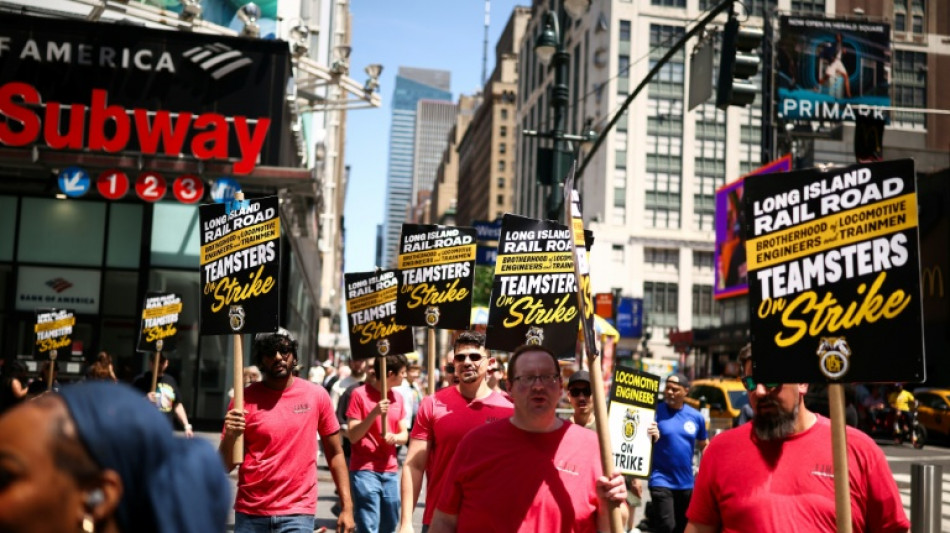
The top United Nations court ruled Thursday that the right to strike was protected in a key treaty of the International Labour Organisation (ILO), a decision that could have profound implications for global labour relations.
The International Court of Justice had been asked to deliver a so-called advisory opinion on whether an ILO treaty from 1948, known as Convention 87, implicitly enshrined workers' right to strike.
ICJ president Yuji Iwasawa said the court was "of the opinion that the right to strike of workers and their organisations is protected" under that convention.
However, judges said their opinion, which is not binding, should not be understood as laying out any other ground rules for strike action.
The conclusion "does not entail any determination on the precise content, scope or conditions for the exercise of that right", said Iwasawa.
ILO Convention 87 is an agreement between unions and employers including the right "in full freedom, to organise their administration and activities".
- Heated legal battle -
Unions at the ILO had argued that this by extension enshrined the right to industrial action, but employers disagreed, so they took the fight to the ICJ.
Behind the dry legal interpretation of a decades-old treaty lay a heated battle between unions and employer groups at the ILO, which played out in hearings in October 2025.
"This case is about more than legal abstractions," Harold Koh, representing the International Trade Union Confederation (ITUC), told the judges.
"It will affect the real rights of tens of millions of working people around the world," he added.
Koh warned that if the ICJ ruled the right to strike was not inherent in the Convention, companies and governments could start to unpick labour deals around the world.
"National employer groups would contest the right to strike country by country, focusing first on nations with compliant courts, weak civil societies and ineffective media," said Koh.
- 'Inflammatory and alarmist' -
On the other side of the argument, Roberto Suarez Santos, from the International Organisation of Employers, said the 1948 convention "neither explicitly nor implicitly covers the right to strike."
Santos noted that the rules surrounding industrial action varied widely from country to country -- whether emergency services were excluded, for example.
These differences "cannot be resolved by simply reading an abstract right to strike into Convention No.87 and trying to impose it on employers, workers and governments", said Santos.
Rita Yip, also representing the employers' groups, dismissed the union arguments as "inflammatory and alarmist".
The right to strike is still protected in national laws, argued Yip, and does not need to be enshrined in "boilerplate norms, imposed at the highest level".
Urging the court to answer "no" to the question before it, Yip said the case "goes to the credibility of the entire international labour system".
Both sides at least agreed on the importance of the case for labour relations.
"At first blush, this case may not seem momentous," said Koh from the trade union confederation.
"But your decision here will affect every worker in the world," he told the judges.
R.Buehler--VB