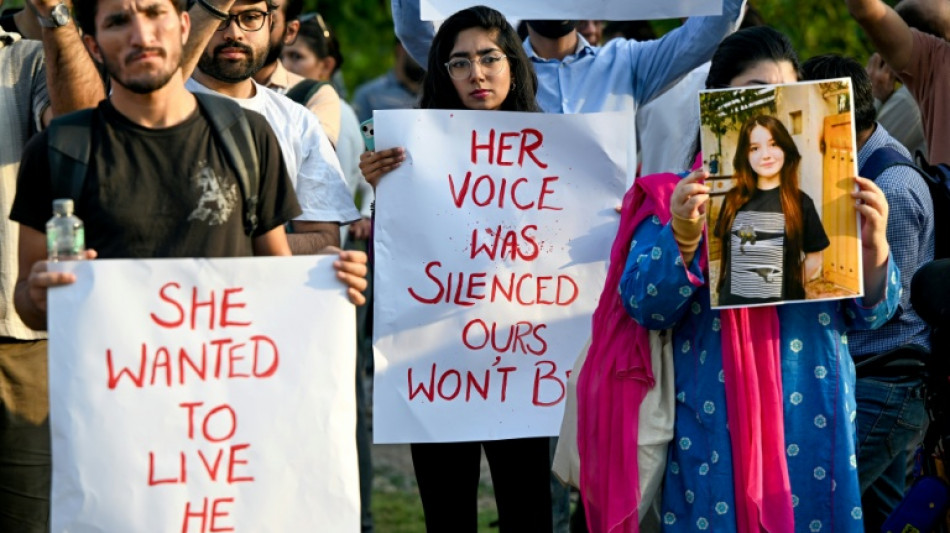
Pakistan court sentences man to death for killing teen influencer / Photo: © AFP

 Tesla shares fall as Musk touts ambitious -- and costly -- plans

 Houthis claim Red Sea tanker strikes as US hits Iran again

 Wildfires ravage parts of southern France, Italy and Spain

 Alphabet beats expectations in second quarter, cloud revenue nearly doubles

 Trump threatens Iran infrastructure, Tehran vows 'eye for eye'

 US teen withdraws lawsuit against Meta over social media addiction

 Lebanon PM says Beirut working for 'complete Israeli withdrawal'

 EU conditionally clears Paramount bid for Warner Bros.

 Philipsen snaps 'horrible' drought with Tour de France stage 17 victory

 US trial of Venezuela's Maduro set for June 2027

 New UK PM Burnham gets early boost as inflation dips

 Samsung launches new, more expensive foldable smartphones

 Philipsen ends 'horrible' drought with Tour de France 17th stage victory

 Hungary's Orban says graft case is 'pretext' to target his party

 South African tycoon Motsepe rules out presidential bid

 Trump threatens Iran bridges, power as payback for Hormuz attacks
 Germany's Merz replaces leader ousted over surrogacy row
 CAF chief Motsepe backs Infantino despite criticism

 Evacuees from Spain's wildfire struggle with scale of devastation

 Ancient Lebanese city of Tyre added to heritage danger list

 Extreme heatwave grips Tunisia as wide power cuts fuel frustration

 'Beautiful game' provides Venezuelans with welcome distraction in wake of tragedy
 Oil prices surge on Mideast war, stock markets diverge

 Fury says 'best yet to come' ahead of Thailand fight

 Japan suffers heat 'disaster as cities hit by 'cruelly hot' days
A Pakistani court sentenced a man to death on Tuesday for murdering a teenage influencer last year after she had repeatedly rejected his advances.
Sana Yousaf's murder in June drew nationwide condemnation and reignited debate over women's safety, after some online comments -- alongside condolences -- blamed her for her own death.
A judge announced to a cramped Islamabad courtroom on Tuesday afternoon that 22-year-old Umar Hayat was sentenced to death and fined $7,200, an AFP reporter saw.
"This verdict is a lesson for anyone who commits such acts, showing that they should never be repeated," Yousaf's father told journalists outside the courtroom, alongside her mother.
Hayat shot 17-year-old TikTok star Yousaf at her home in the capital after she repeatedly rejected him, according to police and the teenager's family.
Yousaf had millions of followers on social media, where she posted videos about food, fashion and skincare.
She also spoke openly about relationship problems, a topic still considered taboo in the Muslim majority country.
News of her killing triggered an outpouring of comments under her final post, a video celebrating her 17th birthday in which she blew out candles on a cake just days before her death.
Alongside condolence messages, some users blamed the teenager for her own murder, writing comments such as: "You reap what you sow" and "It's deserved, she was tarnishing Islam".
In her Instagram profile picture, she is smiling and holding sunflowers.
- Widespread violence -
Surveillance footage shown during the investigation captured the killer fleeing the influencer's house with her phone.
The victim's mother and paternal aunt were eyewitnesses to the murder.
The 22-year-old confessed to the murder but later retracted his statement.
Under Pakistan's legal system, the convicted man can still challenge the verdict in a higher court.
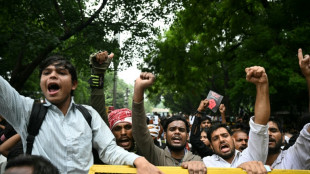
Women's rights activists, including some of Yousaf's friends, staged protests in Islamabad following her killing.
Violence against women remains widespread in deeply conservative Pakistan, according to the country's Human Rights Commission, and attacks on women after rejecting men are not uncommon.
The case revived memories of Qandeel Baloch, dubbed Pakistan's "Kim Kardashian" and one of the country's first breakout social media stars, who was murdered in 2016 after her online fame drew controversy.
In 2021, 27-year-old Noor Mukadam was beheaded by her Pakistani-American boyfriend, Zahir Jaffer, after rejecting his marriage proposal in a case that sparked nationwide outrage.
Jaffer was sentenced to death last year.
In 2016, law student Khadija Siddiqui survived being stabbed 23 times by a former boyfriend after refusing his advances.
TikTok is hugely popular in Pakistan, partly because its video format is accessible in a country with relatively low literacy levels.
The platform has also provided many women with both an audience and a source of income -- rare opportunities in a country where fewer than a quarter of women participate in the formal economy.
"This is justice not only for Sana, but for society as a whole," Yousaf's father said, his eyes teary and his voice cracking.
T.Germann--VB