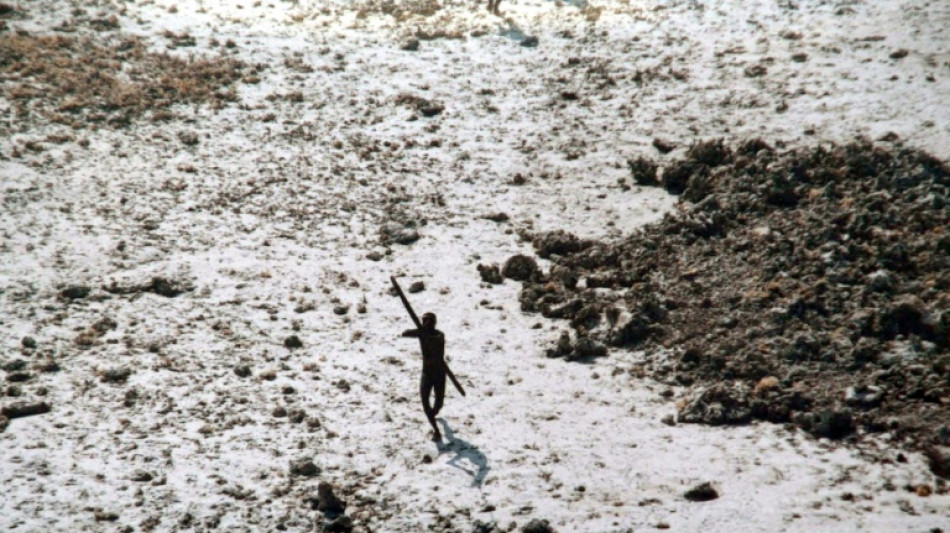
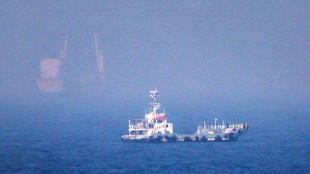
Encroaching world threatens India's last 'uncontacted' tribe / Photo: © Indian Coast Guard/AFP/File

 Tesla shares fall as Musk touts ambitious -- and costly -- plans
 Houthis claim Red Sea tanker strikes as US hits Iran again

 Wildfires ravage parts of southern France, Italy and Spain

 Alphabet beats expectations in second quarter, cloud revenue nearly doubles

 Trump threatens Iran infrastructure, Tehran vows 'eye for eye'

 US teen withdraws lawsuit against Meta over social media addiction
 Lebanon PM says Beirut working for 'complete Israeli withdrawal'

 EU conditionally clears Paramount bid for Warner Bros.

 Philipsen snaps 'horrible' drought with Tour de France stage 17 victory

 US trial of Venezuela's Maduro set for June 2027

 New UK PM Burnham gets early boost as inflation dips
 Samsung launches new, more expensive foldable smartphones

 Philipsen ends 'horrible' drought with Tour de France 17th stage victory

 Hungary's Orban says graft case is 'pretext' to target his party
 South African tycoon Motsepe rules out presidential bid

 Trump threatens Iran bridges, power as payback for Hormuz attacks
 Germany's Merz replaces leader ousted over surrogacy row
 CAF chief Motsepe backs Infantino despite criticism
 Evacuees from Spain's wildfire struggle with scale of devastation
 Ancient Lebanese city of Tyre added to heritage danger list
 Extreme heatwave grips Tunisia as wide power cuts fuel frustration

 'Beautiful game' provides Venezuelans with welcome distraction in wake of tragedy
 Oil prices surge on Mideast war, stock markets diverge
 Fury says 'best yet to come' ahead of Thailand fight
 Japan suffers heat 'disaster as cities hit by 'cruelly hot' days
One of the last outsiders to make authorised visits to India's only "uncontacted" tribe says it may be time to reconnect with the isolated people -- in order to shield them from an encroaching world.
Anthropologist Anstice Justin, 71, took part in the government's limited contact missions to the restricted North Sentinel island in the Andaman Sea between 1986 and 2004.
The island's inhabitants are famously resistant to engaging with outsiders, and even killed a US missionary who made an illegal visit in 2018.
What little is known about the Sentinelese -- who live on the 10-kilometre (six-mile) wide island, covered in rainforest and ringed by coral reefs -- comes from the government missions.
But even those trips resulted in extremely limited understanding of the people. "We don't even know how they identify themselves," Justin told AFP on the main Andaman Island -- a different world, but just two hours away by boat.
Justin, himself from another group in the Andaman and Nicobar archipelago, recounted his first trip in 1986 to North Sentinel.
- 'Eyes on, hands off' -
He waded through lagoon waters with saltwater crocodiles, landing on a white sand beach, carrying a sack of coconuts as a sign of goodwill.
"We saw smoke curling, emitting from the forest," said Justin, a former deputy director of the government's Anthropological Survey of India.
"After a few minutes, we saw the Sentinelese emerging from the forest," he added.
The islanders, who government estimates put at 50 people and are designated a "Particularly Vulnerable Tribal Group", made headlines in 2018 when they used bows and arrows to shoot dead an American missionary, John Allen Chau.
Chau broke the government "tribal reserve" exclusion limit stretching five kilometres out to sea, dodging coastguards and marine police.
But Justin, who visited the islands more than 30 times, said his experience was very different.
"What we observed was that there was no sign of unfriendliness, of, allow me to use a term, ferociousness," Justin said.
Observations show the people use narrow outrigger canoes, live in large communal huts, carry spears, bows and arrows, and wear fibre waistbelts, as well as necklaces and headbands.
Justin said that the government's protection policy was well-intentioned -- but that the modern world was not allowing the Sentinelese to be left on their own.
"The present policy that the Andaman and Nicobar administration has adopted is 'eyes on, hands off' -- that means distant observation," Justin said, speaking in the archipelago's capital Sri Vijayapuram -- formerly known as Port Blair, a city of more than 100,000 people.
Outside contact with other islanders had a "devastating impact" in the past with diseases brought in, according to rights group Survival International, noting populations of the Great Andamanese peoples collapsed by as much as 99 percent.
"The Sentinelese have made it clear that they do not want contact," Survival International argues.
- 'Fool's paradise' -
Andaman police chief HGS Dhaliwal said his officers were doing everything possible to protect the island from outsiders, but Justin warned that social media–driven publicity seekers were increasingly difficult to deter.
"It is sometimes a challenge to be able to prevent any kind of incident in totality," Dhaliwal added.
"We do have surprise patrols, but still there have been a couple of incidents where poachers came within five kilometres of the island, and there have been other detections and detentions."
Police in February arrested two fishermen who entered the waters around the island, and last year arrested US citizen Mykhailo Viktorovych Polyakov, who landed for five minutes carrying a can of Diet Coke and a coconut in a bid to become a YouTube star.
"We would be living in a fool's paradise if we assume they are living in their own insulated world," Justin added.
"The self-contained community survived for several thousand years, but with some kind of peaceful situation -- unlike the present day's disturbing situation, where everyone is keen to 'glorify' themselves by seeing the Sentinelese."
Fame-seeker Polyakov, who was arrested in March 2025, pleaded guilty to breaking the protected zone, and was allowed to return to the United States after serving a 25-day jail term and paying a 15,000 rupee ($161) fine.
Justin said that highly-regulated meetings may help the Sentinelese by giving them warnings.
"In the long run, self-contained people may not be able to survive in this competitive world," he said. "We'd at least be able to tell them, 'there are other people who are trying to disturb you'."
C.Stoecklin--VB