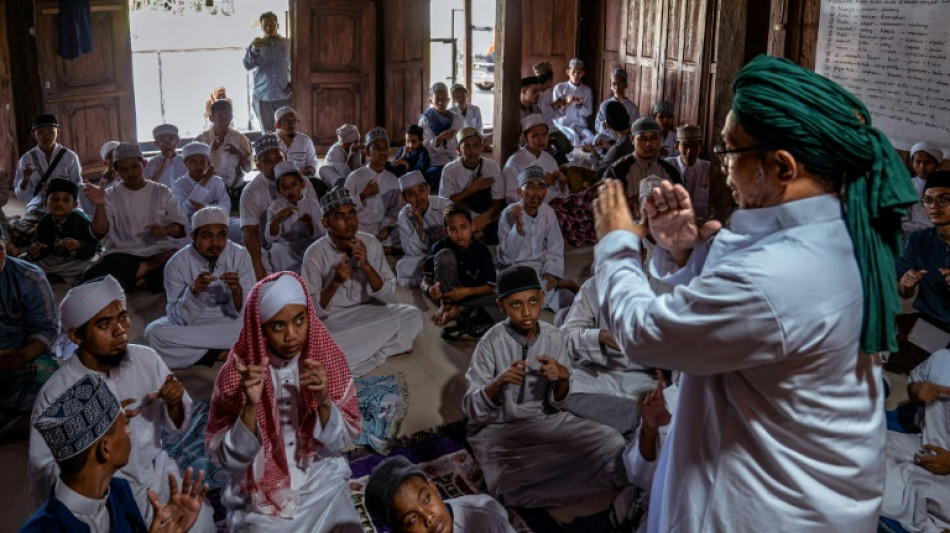
Inside Indonesia's Islamic boarding school for deaf children / Photo: © AFP

 Bayeux tapestry to arrive in London in secret, high-stakes operation
 Messi World Cup magic masks familiar penalty frailty

 Trump lashes out at allies as key NATO summit begins

 Swiss party into the night after reaching World Cup quarter-finals

 Trump says Iran ceasefire 'over' after fighting flares

 Thai beer dynasty mother drops 'ungrateful child' case against son
 France v Morocco rematch as World Cup quarter-finals get under way

 Modi visits Australia for minerals talks and rockstar welcome
 Sensors, early starts: how Spain keeps working when heat hits
 Kenya Rastafarians hope for freedom to smoke
 Pacific nation of Tuvalu condemns Chinese missile launch into Pacific

 How a viral post sparked India's Gen-Z protest

 Cambodia wants to bring tigers back, but should it?
 Chinese repairwomen smash stereotypes with power tools
 Ecuador's Death Canal: watery grave for victims of gang violence
 'Unique event': Solar eclipse fever fills empty Spain

 Venezuela says Caracas airport to reopen to commercial flights 'soon as possible'

 World Cup: Eight teams remain in the hunt for glory
 'A nice surprise': Marathon man Djokovic revels in Wimbledon epic

 Switzerland beat Colombia on penalties to reach World Cup quarter-finals

 Djokovic survives Wimbledon's longest quarter-final to book Sinner blockbuster

 'Flunked': US soccer seeks answers as World Cup dream shattered

 Mbappe revels in captain's role for France at World Cup

 Iyer's India 'atrocious' in record 125-run T20 defeat by England
 Rain hands West Indies series win over Sri Lanka
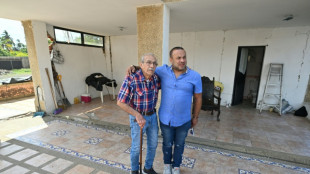
At an Islamic boarding school in a sleepy neighbourhood on the outskirts of the Indonesian city Yogyakarta, the sound of Koranic recitation is nowhere to be heard.
This is a religious school for deaf children, and here the students gesture rapidly with their hands, learning to recite the Koran in Arabic sign language.
Islamic boarding schools are an integral part of life in Indonesia, with about four million students residing in 27,000 institutions across the country, according to the religious affairs ministry.
But this Islamic boarding school is one of a handful that offer religious education for deaf students in the world's largest Muslim-majority country.
"It all came from my restlessness when I found out deaf children in Indonesia did not know their religion," school founder Abu Kahfi told AFP.
The 48-year-old set up the school in late 2019 after befriending several deaf people and realising they had no access to Islamic education.
It now hosts 115 deaf boys and girls from across the archipelago who share the dream of becoming a hafiz, a person who can memorise the Koran by heart.
The children sit cross-legged on the floor, moving their hands expressively while looking down at their textbooks.
The air is only punctured by yelps and high-fives after they recite a passage correctly to Kahfi when he calls them to the front of the class.
It is a daunting religious education for children who have never learned about religion or the Koran, and whose mother tongue is Indonesian.
"The difficulty is enormous," Kahfi said.
- 'No longer ashamed' -
In a room 100 metres (330 feet) from the boys, a group of girls in conservative Islamic dress sit separated from their male counterparts, carrying out the same practice in rows.
For 20-year-old student Laela Dhiya Ulhaq, studying at the school has brought joy and pride to her parents.
"I want to go to heaven with my mother and father... I also don't want to leave this place. I want to become a teacher here," the school's oldest student told AFP.
While others can memorise syllables to recite the text out loud, the hearing-impaired must painstakingly memorise every single character of the holy book's 30 sections of verses.
Muhammad Rafa, a 13-year-old student who has been enrolled at the school for two years, rolls his thumbs and fingers into different signs, laser-focused on learning the verse in front of him.
"I'm very happy here. It's very quiet at home, there is nobody to talk to because nobody is deaf, everyone is normal," Rafa, who has memorised nine Koranic sections, told AFP through an interpreter.
Both Kahfi and donors provide funding for the school, and children from poor families who cannot afford the 1 million rupiah ($68) enrollment fee that pays for books, uniforms and toiletries are allowed to study for free.
The children also study Islamic law, mathematics, science and foreign languages so they can continue their education at a higher level.
But another impact of the school is boosting the children's confidence as hearing-impaired members of society.
"My son used to have very low self-esteem, he knew he was different," Zainal Arifin, whose 11-year-old son Arfi studies at the school, told AFP.
"Since he came (here) he's no longer ashamed of signing in public. He told me God made him this way, and he has fully embraced who he is."
J.Horn--BTB