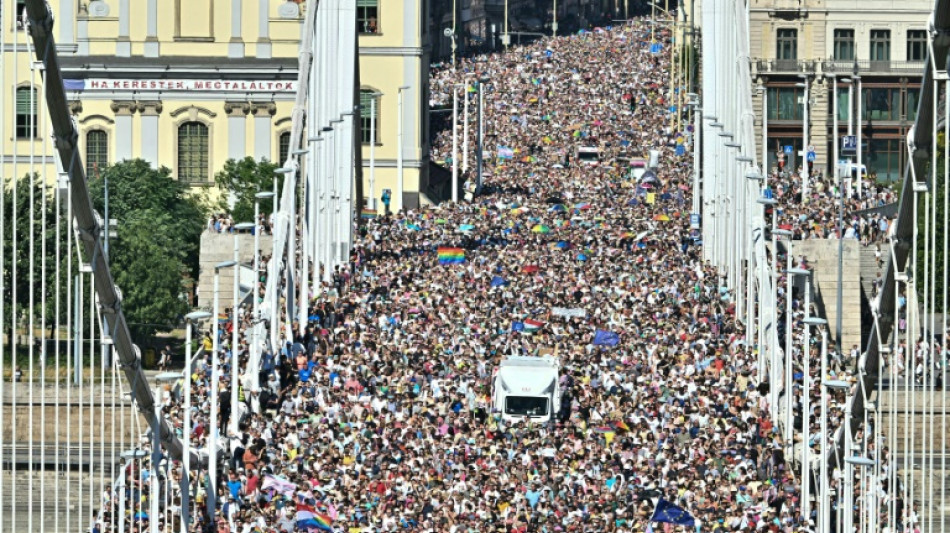
Major turnout as Budapest Pride defies Orban's ban in Hungary / Photo: © AFP

 New mum Sjostrom wins 50m butterfly for 18th European gold
 Solar eclipse darkens Arctic Russia on course for Spain
 Russian economy rebounds in second quarter despite Ukrainian strikes

 NBA's Los Angeles Lakers to be sold for $12.5 bn: ESPN
 Trump sued over sale of access to Truth Social posts

 Europe looks to the skies as solar eclipse cast its shadow
 At least 44 drown after ferry overturns on Zimbabwe's Lake Kariba

 Grieving Argentine icon Messi unsure about playing on 'much longer'
 Nigeria kidnap victims escape 'hellfire' captivity beaten, malnourished

 Google unveils finder tag, new AI smartphone features
 US equities gain as inflation report eases fear of rate rise

 Colombia declares three days mourning for quake victims

 44 lives lost after ferry capsizes on Zimbabwe's Lake Kariba

 WallStreetPR Releases Report on China’s Gold Purchases and African Mining Investment
 Former Chinese premier Zhu Rongji dies aged 97

 Markets steady awaiting US inflation data
 WHO says Trump vaccine shake-up goes against evidence

 Eclipse chasers flock to Spain for 'breathtaking' experience

 'To make the civilians leave': Russia pummels Ukraine's petrol stations
 Japan brushes off Australian PM's melon drama
 Rod Stewart cancels tour dates after heart surgery

 How Britain's mapmakers track climate change

 Australian delivery drivers win 'world-leading' pay rise

 Meta meets its own 'tobacco' moment in court
 Art or medicine? Japan's cosmetic tattoo artists in limbo
With rainbow flags flying high, tens of thousands of people began marching Saturday for the Budapest Pride parade, defying a government ban that marks a major pushback against LGBTQ rights in the European Union.
Organisers expect a record turnout of more than 35,000 people for the 30th edition of the Pride march in the Hungarian capital, despite a police ban imposed by Prime Minister Viktor Orban's nationalist government.
"Many, many tens of thousands" are participating, organisers said on social media after the march started, as AFP journalists saw the festive crowd filling squares and streets along the route.
"I am proud to be gay... and I am very scared that the government wants to bring us down. I am very surprised that there are so many people, I want to cry," a 66-year-old participant, who gave only his first name, Zoltan, told AFP.
Orban's governing coalition amended laws and the constitution this year to prohibit the annual celebration, justifying his years-long clampdown on LGBTQ rights on "child protection" grounds.
Orban said Friday that while police would not "break up" the Pride march, those who took part should be aware of "legal consequences".
- Newly installed cameras -
Parade organisers risk up to a year in prison, and attendees can face fines up to 500 euros ($590).
The latest legal changes also empower the authorities to use facial-recognition technology to identify those who take part, and newly installed cameras have appeared on lamp posts along the parade route.
But participants were defiant as the march began chaotically under a scorching sun.
Marchers repeatedly had to pause to wait for police to stop traffic, according to AFP journalists at the scene.
Akos Horvath, an 18-year-old student who came to Budapest from a city in southern Hungary, said it was "of symbolic importance to come".
"It's not just about representing gay people, but about standing up for the rights of the Hungarian people," he told AFP on his way to the march.
Dozens of European lawmakers also attended in defiance of the ban.
"Freedom and love can't be banned," read one huge poster put up near city hall, the gathering point for the march.
Earlier this week, EU chief Ursula von der Leyen called on the Hungarian authorities to reverse the ban, while EU equalities commissioner Hadja Lahbib travelled to Hungary and spoke in support of the parade on Friday.
Thirty-three nations, including most EU countries, have also released a statement in support of the march.
At a press conference Saturday, several French MEPs called on the EU to take tougher measures against Orban's government over the crackdown on civil rights and other rule of law issues.
Budapest's opposition mayor Gergely Karacsony has insisted that no attendee should face any reprisals as the march is a municipal event that does not require police approval.
Some people also gathered along the route to protest against LGBTQ rights at the urging of far-right groups, including by putting up a wooden cross adorned with protest messages.
A woman who gave only her first name, Katalin, told AFP she agreed with the ban though she hoped there would be no clashes.
"Disgusting... it's become a fad to show off ourselves," she said.
- 'Polarising society' -
Since Orban's return to power in 2010, the country of 9.6 million people has been steadily rolling back LGBTQ rights.
But it is the first to ban a Pride march, with Orban saying he has been emboldened by the anti-diversity push by US President Donald Trump.
"Orban is employing a tried-and-tested recipe ahead of next year's election by generating a conflict," political analyst Daniel Mikecz told AFP, saying that Orban was "polarising society".
L.Stucki--VB