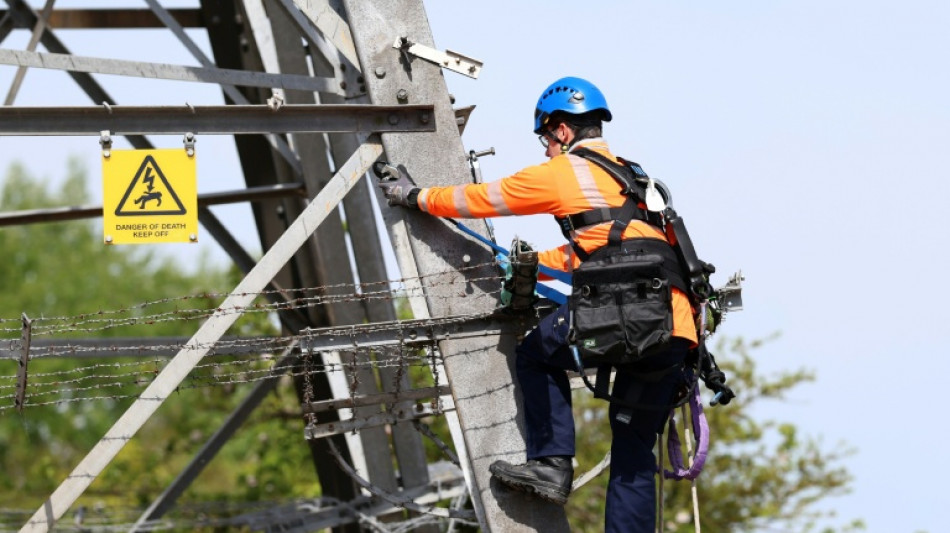
High-flying young electricians wire UK energy switch / Photo: © AFP

 Arsenal primed for Premier League title defence as rivals face questions

 Zverev advances at Cincinnati while Williams sisters fall

 Copper powers profit rise at mining giant BHP

 Whales spark joy in New York but face threats from boat traffic

 Premier League's new bosses brace for battle

 Zambia's Hichilema: 'cattle boy' and two-time president

 Elderly far more at risk from rising heat than thought: study

 Brazil's Lula hails new oil find as 'passport to the future'

 Rybakina slogs through double rain delays in Cincinnati win

 Two largest US reservoirs hit record lows amid western drought

 Colombian minister under fire over beach holiday post-quake

 Lamour leaves key FIFA position after criticising Infantino

 Buss family sells 17.8% stake in Lakers to Iger group

 Mangione state murder trial postponed after federal guilty plea

 Trump envoy says Hamas disarmament could begin within 30 days

 US pauses construction of border project in Texas national park

 Thousands mourn dead black academic in London vigil

 South Africa Test series a lot tougher than a World Cup says All Blacks coach Rennie

 Coventry sign Nigeria striker Awoniyi from Forest

 TripleDart tops $7 million ARR with AI-led growth, reports 50 per cent EBIT margin

 Bipartisan backlash as Trump scales back US-South Korea drills

 'Never seen one like it': German pensioners flee wildfire
 Ipswich sign Enciso and Ouattara in double raid on Strasbourg

 UN laments 'unacceptable' toll of 350 aid workers killed in 2025

 Former child star actress Hayden Panettiere dead at 36

Perched 45 metres (148 feet) high, young apprentice electricians replace a connection atop a pylon. In the UK, National Grid recruitment is at full power as its electricity network adapts for renewables.
As new production sites multiply, particularly for wind and solar power, the privately-run company that owns the high-voltage pylons and cables in England and Wales said it is implementing "the largest overhaul of the electricity grid in generations".
"It's quite fun and exciting really," Becky Hodgson, an overhead lines trainee, enthused at the prospect of "connecting" the UK's future energy needs.
At the National Grid training centre in Eakring, a village in central England, 25-year-old Hodgson unwinds rope from a winch at the foot of a large pylon.
To the sound of an engine and pulleys, a suspended walkway rises towards her classmates.
Hailing from near Newcastle in northeast England, a region famous for its coal mining heritage, Hodgson is delighted to be part of the nation's new energy chapter.
"It's ticking all the boxes for me," said the apprentice whose grandfather mined coal, which up until recently was used to fire British power stations.
"From a young age I've always been really into climbing, and adventurous pursuits," Hodgson, sporting a fluorescent orange vest and blue hard hat, told AFP.
- 'Massive challenge' -
With the UK one of the most advanced countries in Europe in terms of renewable energy, National Grid plans to invest £35 billion ($47 billion) by 2031 to transform its electricity network.
The installation of new pylons, often favoured over underground or submarine cables owing to their lower cost, is causing friction among local residents across the country.
Faced with growing demand for electricity and the need to source energy where it is produced, "we need more wires", insisted Zac Richardson, chief engineer at National Grid.
The company has seen the number of training days surge 75 percent over three years, driven largely by growth in staff.
"Will we be able to train enough? It's a massive challenge," said Richardson.
"There's advanced investment going in, not just here, but with our key contractors as well, to ensure that the workforce is ready."
National Grid estimates that 55,000 new hires will be needed in the coming years, across various trades, both within its own ranks and among its partners and subcontractors.
- Explosion -
A siren suddenly sounds in a substation, close to large machines bristling with lightning arresters.
Then an explosion -- signalling a test of a pyrotechnic circuit breaker, a device that can quickly cut a high-voltage circuit.
"You have to cover your ears automatically... when you work in a substation," laughed Lara Eken, a graduate substation engineer.
The 23-year-old said she has come to learn about the workings of "a really in-depth technical system", whose number is multiplying with the expansion of the network.
Cables extending from the large pylon are lost in the distance -- but they lead nowhere. For safety reasons, the training facilities are disconnected from the network.
A power line apprenticeship lasts three years.
"Everything crunches around the safety aspect first, so it's baby steps," training instructor Tom Norris, easily identifiable by his red helmet, told AFP.
"You get them just climbing the tower first" before tackling more complicated tasks like hoisting equipment, he added.
Norris said finding recruits is not a problem.
"We're taking on more apprentices than we ever have. We've always got lots of interest on the recruitment day so we're picking from lots and lots of good candidates."
D.Bachmann--VB