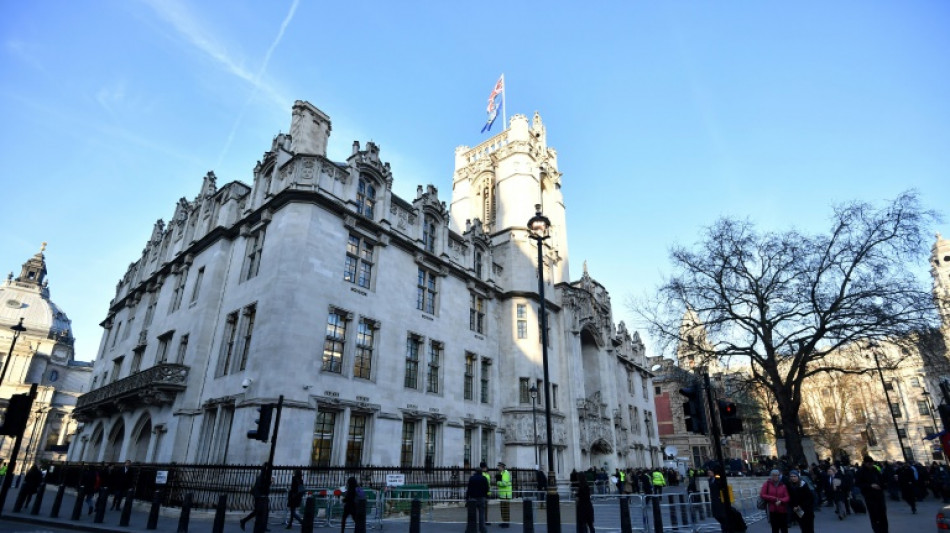
UK top court rules definition of 'a woman' based on sex at birth / Photo: © AFP

 Canada's Carney stands up to Trump, despite risks

 Lens hammer Auxerre thanks to Thauvin penalty double

 No singles for Serena, but she joins Alcaraz for US Open
 Joao Pedro extends Chelsea stay with new long-term deal

 Yamaguchi to face An in hunt for fourth badminton world crown

 Norris clinches pole for Dutch GP

 Norris clinches pole for Dutch Grand Prix

 Pope Leo calls for courage in Rimini visit after stop in tiny San Marino

 Man Utd must learn from 'frustrating' defeat at Hull: Carrick

 Yamaguchi on course for fourth badminton world crown

 Man Utd humiliated by Hull in dismal start to Premier League season

 Anthropic market debut could break SpaceX IPO record: media

 Pope's 'couturier of the sacred' fueled by faith

 Duplantis locked in on 'grinding' for big bars

 Stokes says decision to leave Headingley off Ashes roster 'shambolic'

 New arrival Rodri to miss Elche opener: Barca's Flick

 Atletico's Alvarez to return against Villarreal: Simeone

 Dozens of civilians killed, kidnapped as jihadists clash in Nigeria

 Former envoys urge joint French, UK action on Palestinian territories

 Australia lead by 101 in 2nd Bangladesh Test as 18 wickets fall on day one

 'Aura' battles leap from social media to Latin America streets

 US, Canada fail to reach trade pact to avert Trump tariffs

 Sudan farms lie barren as El Nino leaves Nile banks dry

 Arctic shipping a daunting prospect in hotly contested region

 In US, rare earths extracted from coal mine wastewater

Britain's Supreme Court ruled Wednesday the legal definition of a "woman" is based on a person's sex at birth, a landmark decision with far-reaching implications for the bitter debate over trans rights.
In a win for Scottish gender-critical campaigners who brought the case to the UK's highest court, five London judges unanimously ruled "the terms 'woman' and 'sex' in the Equality Act 2010 refer to a biological woman, and biological sex".
However, the court underlined that the Equality Act also protected transgender people from discrimination.
The act "gives transgender people protection" through the protected characteristic of gender reassignment, but also protecting against discrimination in their acquired gender, Justice Patrick Hodge said handing down the verdict.
It is the culmination of a years-long battle between the Scottish government and campaign group For Women Scotland (FWS) -- which launched an appeal to the Supreme Court after losing pleas in Scottish courts over an obscure legislation aimed at hiring more women in public sector bodies.
Dozens of FWS and other gender critical campaigners, who argue that biological sex cannot be changed, cheered with joy after the ruling, hugging and crying outside the court.
"This has been a really, really long ride," said Susan Smith, co-director of For Women Scotland, adding the campaigners were "enormously grateful for this ruling".
"Today, the judges have said what we always believed to be the case: that women are protected by their biological sex," she said, adding "women can now feel safe that services and spaces designated for women are for women".
Ahead of the verdict, trans rights activists raised concerns that a ruling in favour of FWS could risk discrimination against trans people in their chosen gender.
"The court is well aware of the strength of feeling on all sides which lies behind this appeal," Hodge said, recognising the fight of women against sex discrimination, as well as a "vulnerable" position of the trans community.
- Single-sex spaces -
At the heart of the legal battle were clashing interpretations of the Equality Act.
While the Scottish government argued that the Equality Act (EA) afforded trans women with a Gender Recognition Certificate (GRC) with the same protections as a biological female, FWS disagreed.
In its judgement, the Supreme Court ruled that the devolved Scottish government's "interpretation is not correct" and that the Equality Act was inconsistent with the 2004 Gender Recognition Act which introduced GRC certificates.
According to the judges, allowing for the Scottish government's interpretation would "cut across the definitions of man and woman" in the Equality Act "in an incoherent way".
And, single-sex spaces and services including changing rooms, hostels and medical services "will function properly only if sex is interpreted as biological sex", the judgement added.
Despite underlining protections from discrimination, the ruling will be a blow for transgender women and their ability to access single-sex spaces -- a significant contention in the polarised debate on trans rights.
- Online discourse -
The debate has been particularly vicious in the UK, pitting gender critical activists against trans rights campaigners and often resulting in bitter, even hateful discourse.
One of the most prominent supporters of gender critical campaigns is "Harry Potter" author JK Rowling, who lives in Scotland and has been the target of hate but also been accused of transphobia.
The ruling also comes at a time when transgender rights are under threat in the United States under President Donald Trump.
Since retaking office, Trump has declared the federal government would recognise only two sexes, male and female, sought to bar trans athletes from women's sports and curbed treatments for trans children.
The latest UK ruling could pile pressure on Prime Minister Keir Starmer's government -- which has remained largely silent on trans issues since coming into power last July -- to further clarify legislation.
The opposition Conservative administration had blocked Scottish legislation to make gender change easier in 2022 and has supported the clarification of sex as biological sex rather than assumed gender.
D.Schaer--VB