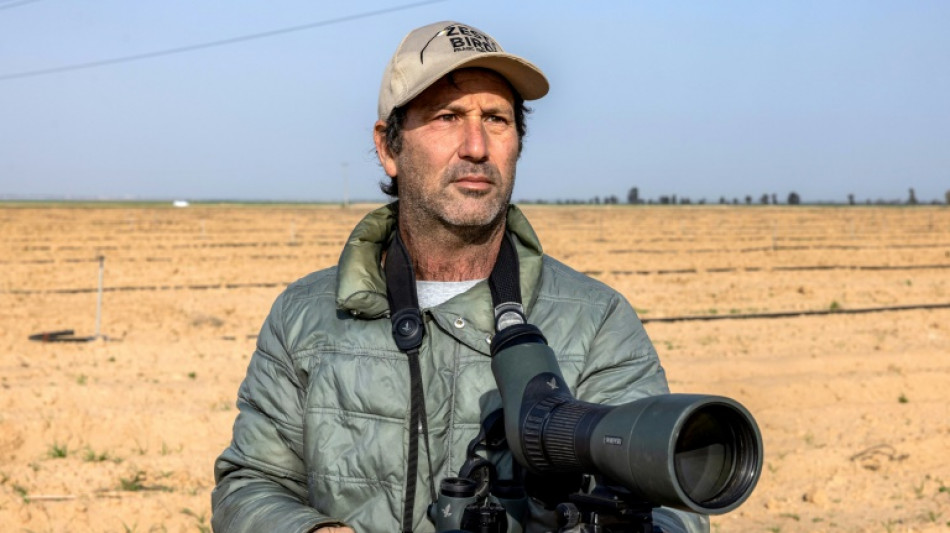
The watchers who prey on Israel's falcon poachers / Photo: © AFP

 Dolly Parton: Country music's dolled up but deserving queen

 US robotaxi firm Waymo plans to launch in Germany

 'Here to win': Xavi vows to restore pride in Dutch football

 Cameroon's Baleba joins as Man United boost midfield options

 'Shocking' book about Putin's private life wins French literary prize

 Pogacar storms to Vuelta a Espana stage four solo triumph

 Canada unveils counter-tariffs of 15-50% on US goods

 Volkswagen boss braces German workers for more job cuts
 Olympic champion Brignone to undergo new knee operation

 The summer climate change became scorching reality for Europe

 Root angered by England's off-field 'stupid mistakes'

 Welsh rugby league 'giant' Boston dies, aged 92

 Root annoyed by England's off-field 'stupid mistakes'

 One million Afghan children suffer 'life-threatening' malnutrition: UN

 Sri Lanka trail India by 238 runs in second Test
 West Bank settlers attack AFP journalists

 MEXC Kicks Off MOVE Carnival With 0-Fee Trading and 1M USDT in Rewards

 Human rights in Myanmar hitting a 'new low': UN

 Son of Luxottica founder quits after succession row

 One million Afghan children suffering 'life-threatening' malnutrition: UN

 Real Madrid's Mourinho happy with squad despite losing out on Rodri
 Sri Lanka slump to 216-7 at tea in second India Test

 US delays Lockerbie bombing trial over new evidence

 Rohingya refugees protest dire conditions in Bangladesh camps

 Lego net profit up 32% in first half, 'stronger than expected': CEO to AFP

For the volunteer watchers scanning southern Israel's wheatfields, protecting migratory falcons from poachers is a highly coordinated security operation.
The raptors may top the food chain in the wild, but here the predators can themselves become the prey.
Many protected species of migratory birds spend their winters in this agricultural area close to the Gaza Strip.
And some species are big business. A single falcon can fetch up to tens of thousands of dollars on the black market, especially in Gulf countries where falconry is a treasured tradition.
Meidad Goren, director of the Ramat Hanegev Birding Center, told AFP that poaching has soared in recent years.
Falcons are captured alive by Bedouin Arabs living in Israel's Negev desert to be domesticated or smuggled to neighbouring countries, he said.
Using binoculars to observe one bird perched on a nearby pylon, Goren noted: "It has a ring. It's a peregrine falcon that was captured and escaped."
The raptors feed on small birds attracted to the wheat, waiting motionless and watching from power lines that cross the fields.
The number of cases of birds of prey, especially falcons, found with ties around their legs, sometimes tangled in power lines, led Goren to set up groups of volunteer watchers.
The area is also patrolled by rangers from the Israel Nature and Parks Authority.
- 'Like watching a child' -
This winter, a saker falcon took up residence around Kibbutz Urim.
The saker falcon is an endangered species popular with falconers in eastern Europe, Central Asia and Arab states.
After observing several attempts by poachers to capture the bird, Goren put in place what he calls a "special surveillance system".
"Dozens of people, ornithologists, nature lovers, retirees, guides, farmers," responded to his appeal for help to reinforce regular volunteer patrols, said Goren.
His centre operates under both the Israel Nature and Parks Authority and the Society for the Protection of Nature in Israel.
Mirit Keshales is 47 and a regular "falcon guardian" volunteer.
"It's really like watching a child, a very methodical organisation with a well-defined schedule... we make sure someone is always there during the day," she said.
The poachers come mostly from Bedouin villages, said Ofir Bruckenstein, a ranger with the Israel Nature and Parks Authority.
"For them, hunting with falcons and owning falcons are cultural practices rooted in their traditions," he said.
"Owning a falcon and displaying it in their living space is a symbol of status and prestige."
- Sold for $19,000 -
Bruckenstein criticised what he called lenient penalties for poaching, in particular of falcons, saying fines were of "a few thousand shekels", even if repeat offenders faced jail terms.
The especially lucrative black market for falcons smuggled via Jordan and Egypt to the Gulf encourages the illegal trade, he added.
"Saker falcons and peregrine falcons are easily sold for 50,000 or 70,000 shekels ($14,000 to $19,000)," he said.
Falconry is inscribed on UNESCO's list of Intangible Cultural Heritage, and is hugely popular in the Gulf.
In the United Arab Emirates, passports for falcons were introduced in 2002 in an effort to combat smuggling, and tens of thousands have since been issued.
But poaching remains a regional problem in the Middle East, and the demand for falcons captured from the wild has exploded in recent years, with the growth in clubs which stage contests for beauty and falconry.
While falcons are farmed, especially in the UAE which permits only captive-bred and registered birds to be used in sport falconry, wild falcons are considered better hunters and are thus more desirable.
"They lack falcons because those that arrive (in the Gulf region) in winter have nearly all been caught. That's why they are now trying to capture them elsewhere," said Goren.
AFP contacted several international falconry organisations based in Europe, but they declined to comment on the illegal trade to Gulf countries, citing the "sensitivity of the issue".
Meanwhile, the watchers in southern Israel do what they can to prevent more of these beautiful birds from falling into human hands.
D.Bachmann--VB