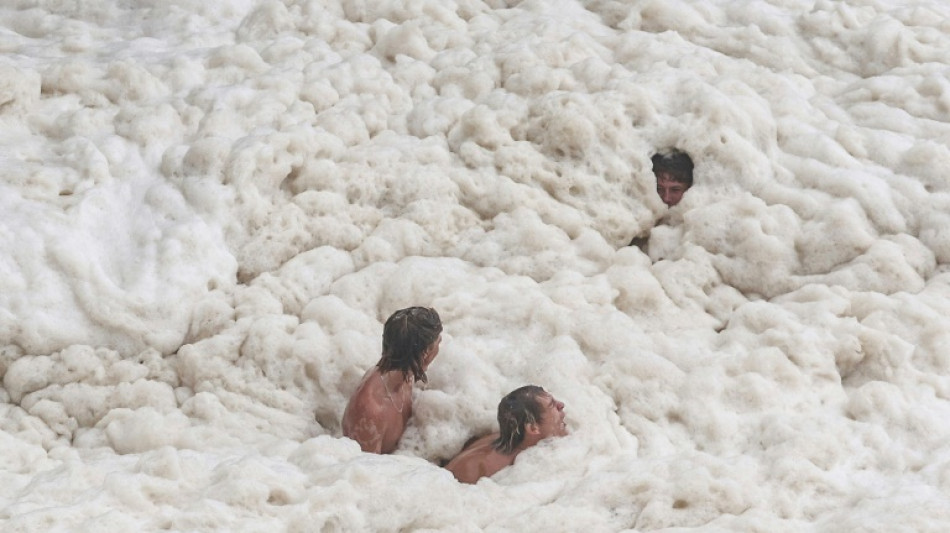
Australians told 'prepare for worst' as tropical cyclone nears / Photo: © AFP

 Barca sign Croatia goalkeeper Livakovic

 Rain delays England's bid to put off-field incidents behind them
 World record holder Sawe withdraws from Berlin Marathon

 Driven by faith, activists stand up to fellow Jews to protect Palestinians

 Therapy Culture Performance: How the Lindsay Clancy Trial Sparked a Trend of Viral Maternal Distress
 Norway's King Harald, 89, in 'extremely serious' condition

 How a glacier collapse may have caused Nepal-Tibet disaster

 Harmovest Capital Strengthens Global Financial Services Through Technology and Compliance

 Nvidia to buy AI platform Hugging Face for $12.9 bn: report
 Palace intrigue in Uganda as succession battle heats up
 'Housing First' approach gets Swedish city's homeless off streets
 Czech duo Muchova and Mensik win US Open mixed doubles title

 Japan's 'polka dot queen' artist Yayoi Kusama dies aged 97
 Nepal-Tibet disaster: what we know

 China deploys record number of ships around Taiwan as pressure grows

 Ruthless Bayern target treble as rivals reboot on Bundesliga return

 What experts know so far about Nepal's deadly floods

 UEFA set to withdraw FIFA boycott threat ahead of Champions League draw
 Sumo moves to beat Japan summer heat as temperatures rise
 'Be more honest': Markets crave clarity from cryptic Fed chair

 Climate change leaves its mark on America's largest reservoir
 CIA director warned Russia not to attack NATO members: US media

 Search for missing after Nepal-Tibet floods kills at least 160

 Meta, US states agree $18 bn settlement in landmark teen safety case

 What scientists know so far about Nepal's deadly floods

Violent winds toppled power lines Friday as a tropical cyclone inched towards Australia's eastern coast, sparking evacuation orders and leaving more than 50,000 homes without electricity.
Tropical Cyclone Alfred was 165 kilometres (100 miles) east of Brisbane city on Friday morning, crawling towards the densely populated coastline at "walking speed", government forecasts said.
Some four million people were in the firing line along a 400-kilometre (250-mile) stretch of coastline straddling the border of Queensland state and New South Wales.
It is a region rarely troubled by typhoons -- it has been more than 50 years since a tropical cyclone made landfall in that part of Queensland.
More than 50,000 homes were without power on Friday morning as damaging winds brought down power lines, officials and utility companies said.
Queensland Premier David Crisafulli said the storm already "packed a punch", warning conditions would get worse as it approached land late on Friday or early Saturday.
Emergency response officials said they had issued evacuation orders for some 10,000 people in the flood-prone northern rivers region of New South Wales.
There was particular concern for the town of Lismore, which was engulfed by record 14-metre (45-feet) floodwaters after heavy rains in 2022.
Many residents have spent the past three days fortifying their homes with sandbags, tying down loose furniture and stocking up on food and water.
"A lot of people are feeling a bit anxious, for sure, because we don't know what's going to happen," said Paul Farrow from Coolangatta, a coastal suburb better known for its sun-splashed beaches.
"Yeah, we could all lose our houses. Who knows," the 62-year-old told AFP.
"The pubs might be shut for a week or two. Who knows."
Farrow said he had stashed a "couple of peaches", a "couple of cartons of beer", and "a bag of grapes" to get him through.
"So I'll be right," he said.
- 'Prepare for the worst' -
Prime Minister Anthony Albanese said the region should "hope for the best, but prepare for the worst".
"When nature does its worst, Australians are at our best. We rally. We lift each other up. We look out for our neighbours," he told reporters.
Tropical Cyclone Alfred would likely cross the coast "early Saturday morning", the Bureau of Meteorology said, although its path was becoming difficult to predict.
It was forecast to make landfall around 60 kilometres (40 miles) north of Brisbane.
Drenching rains, "destructive" wind gusts, and "abnormally high tides" would pummel the coast as it crept nearer, the bureau said.
More than 900 schools across Queensland state and neighbouring parts of northern New South Wales were closed on Friday, education department officials said.
While cyclones are common in the warm tropical waters lapping Australia's northern flank, it is rarer for them to form in cooler waters further south.
Alfred would be the first to make landfall in that part of Australia since 1974, the Bureau of Meteorology said.
Researchers have repeatedly warned that climate change amplifies the risk of natural disasters such as bushfires, floods and cyclones.
R.Flueckiger--VB