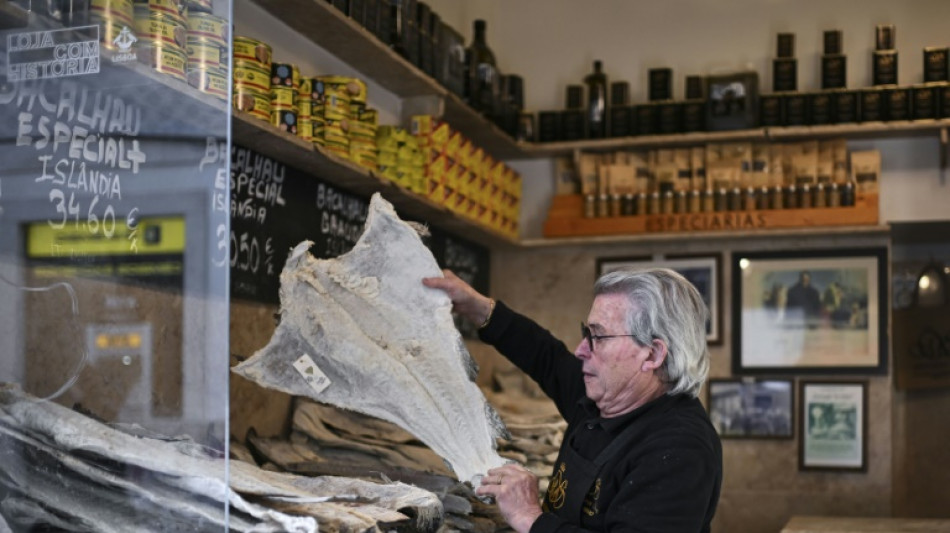
Cod is king in Portugal at Christmas / Photo: © AFP

 Cyberattack ruled out in UK air traffic glitch as more flights axed

 Ekiden Launches Canton Network’s First Order Book-Based Derivatives Exchange

 Germany's Merz accuses AfD of promoting 'ethnic cleansing'

 Japanese director Kore-eda's manga film charms critics in Venice

 As African space race heats up, Senegal pursues homemade satellites

 UK's little-known Bayeux Tapestry replica steps into spotlight

 Shelton stuns Alcaraz in 3:34 am US Open finish, Sabalenka battles on

 Alcaraz falls to Shelton in epic latest-ever US Open finish

 Tradition Announces Partnership With Affin Moneybrokers to Support Malaysian Market Data

 Protesters urge South Korea to stay out of Iran war

 Africa's informal economy: a burden and lifeline

 Kenyan start-up makes robotic limbs to sign for deaf kids

 Iran, US trade blows as Hormuz impasse deepens

 The round-the-clock monitors protecting Bhutan from glacier risk

 'Hell': Father of surfers killed in Mexico testifies at trial

 Travellers in UK face more chaos after air traffic control glitch

 Crude pushes towards $100 on Mideast flare-up, fanning inflation fears

 Record rain forces Asian Games athletes to evacuate accommodation

 Amusing or addictive? The algorithms powering our social feeds

 Norway bids farewell to King Harald V, 'grandfather' of the nation

 NFL breaks new ground as 100,000 set to pack MCG in Australia

 EU faces revolt over social media ban for children

 Canada eyes researchers looking to leave 'hostile' US

 Tiafoe escapes Michelsen to reach US Open semi-finals

 Carney touts Canada 'pivot' away from US as Trump levels new threat

Salt cod has long been a national staple in Portugal, where it is said there are as many recipes for this humble fish as there are days in the year.
And at Christmas the dried and salted fish is central to meals at family gatherings in Portugal, the world's biggest consumer of "bacalhau" as it is called here, just as turkey is at Thanksgiving in the United States.
The most traditional way to prepare salt cod is to bake it in the oven and serve it with boiled potatoes.
But it can also be grilled, turned into fritters or even used to replace meat in a lasagna.
"When I'm asked to come up with a menu for Christmas, I am bound to suggest a salt cod recipe," said chef Ricardo Simoes of the Federico restaurant located at a luxury hotel in central Lisbon.
"We have an incredible culture" around the preserved fish, the 42-year-old added, saying he "likes to play" with traditional recipes to give them a touch of sophistication.
This year he has designed a cod confit matched with prawns and drizzled with coriander juice.
Portugal consumed nearly 55,000 tonnes of salt cod last year, an average of around six kilos (13 pounds) per inhabitant, according to the Cod Industry Association (AIB).
Roughly one-third of cod sales happen around Christmas, according to the group.
As the holiday season approaches, supermarkets across the country of around 10 million people prominently display hundreds of salt-encrusted cod piled high.
- 'Meat of the poor' -
The central role of cod in the country's cuisine is surprising since the fish, which thrives in deep icy waters such as those around the North Atlantic, has never existed in Portuguese seas.
Introduced to the country in the 16th century, salt cod represented a nutritious and non-perishable food source for Portuguese sailors on their long sea expeditions to the Americas and Asia.
At first this fish was a food exclusive to the aristocracy but it gradually became popular as well among lower classes as supply increased, bringing down prices.
Salt cod started being regarded as "the meat of the poor". It is also referred to as "o fiel amigo" or "the faithful friend".
Consumption boomed in the 20th century during the decades-long dictatorship of Antonio de Oliveira Salazar, which subsidised cod fishing expeditions off Canada's eastern coast and Greenland, the director of a Lisbon museum dedicated to the history of cod, Claudia Gomes, told AFP.
Today salt cod dishes are often sought out by tourists who visit the country.
"Coming to Portugal and not tasting salt cod is like going to Brazil without visiting Rio de Janeiro," said Jessica Baptista, a 33-year-old Brazilian tourist, as she left the D'Bacalhau restaurant in Lisbon.
Specialising in traditional cod recipes, the eatery cooks "a minimum of eight tonnes of cod every month," said its owner Julio Fernandes, 68.
- Youth losing interest -
Portugal accounts for almost 20 percent of the world's consumption of this fish, which is caught mainly in Iceland and Norway.
The sector employs more than 2,500 people in Portugal, with sales worth 500 million euros ($519 million) last year, according to AIB figures.
Producers predict a fall in consumption this year due to a rise in price which jumped nearly 15 percent to hit nearly 14 euros a kilo in 2024.
They also find younger generations are losing interest, in part due to the time it takes to prepare salted cod.
The fish must be soaked in several changes of cold war before cooking.
"Reaching out to young people is our big challenge," said Vera Xavier, head of production at the Riberalves cod processing plant near Lisbon.
U.Maertens--VB