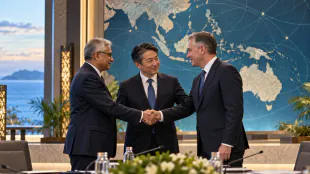
Globalization isn't dead, just 'transformed,' says IMF chief economist / Photo: © AFP

 Japanese star Forever Young goes for rare Breeders Cup Classic repeat

 Wesley Fofana under scrutiny after Chelsea penalty miss in Carabao Cup

 Russell admits absence of rivalry because he cannot match Antonelli

 DR Congo says Rwanda flouting pact, US sanctions justified

 Brazil's Flavio Bolsonaro isolated, ridiculed after self-exile
 Asian equities diverge after mixed technology earnings and Fed rate decision

 Zverev 'on top of the world' after securing No. 1 ranking

 Clash of styles as Vikings, Lions prepare for NFL showdown

 After a long slog to the top, Zverev leaps to No. 1 ranking

 GCC legislative officials review ways to deepen regional cooperation

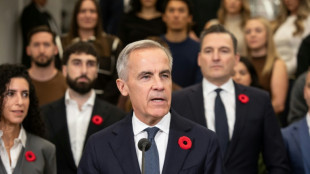 Canada buying stake in AI firm Cohere to bolster tech sovereignty

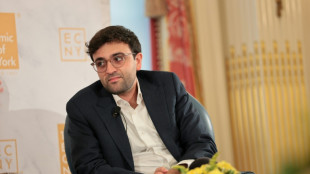 Utah files criminal charges against prediction market Kalshi

 Grieving Spain demands answers for latest rail disaster

 Judges to rule on Australian mushroom killer's appeal

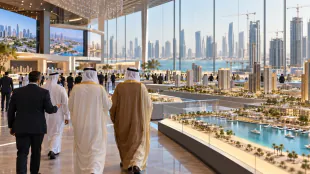 Qatar prime minister tours Cityscape Qatar 2026

 Bugatti CEO to stop leaving keys inside cars after Chiron theft

 Starc, Lyon leave South Africa reeling

 Arsenal lose appeal against Dowman red card in shock Fleetwood defeat

 French court rules Meta must negotiate over rights payments

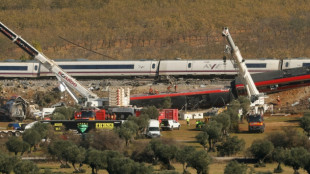 Spain demands answers as rail disaster toll rises

 Garcia bids for Ryder Cup return as he confirms LIV exit

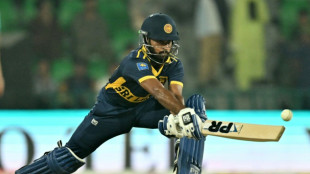 England outlast Sri Lanka despite Rathnayake's hundred in dead rubber

 Starc strikes twice as Australia push for victory

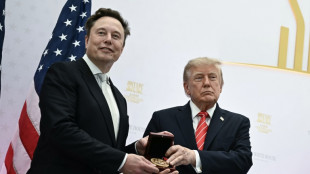 Does White House ask AI to shape policy? Democrats want the receipts

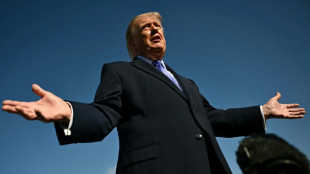 Trump tees up Alaska election challenge over same-name candidate 'fraud'

While the global economy has faced shocks and trade turmoil, globalization is not dead -- it is simply being "transformed," the International Monetary Fund's chief economist told AFP Friday in an exclusive interview.
The world's lender of last resort will release an update to its World Economic Outlook on July 8, with all eyes on whether -- or how far -- it revises down growth estimates from its April update due to the economic fallout of the US-Israeli war on Iran.
By then, however, Chief Economist Pierre-Olivier Gourinchas will have moved on after completing a four-and-a-half year tenure that saw the IMF grapple with the economic fallout from the Covid-19 pandemic, Russia's invasion of Ukraine, Washington's upending of global trade through tariffs and the recent war on Iran.
Reflecting on a tumultuous time for the world economy, Gourinchas remains confident that recent upheaval in global trade caused by US President Donald Trump's tariffs are not necessarily ending globalization -- just adjusting certain bilateral relationships.
"Well, it's certainly not dead," he told AFP in his office at the IMF's headquarters in Washington, pointing to solid global trade-to-GDP ratios.
"We haven't experienced de-globalization," he said. "We have experienced (that) it's being transformed."
Gourinchas, a 57-year-old Frenchman, said the latest movements should be seen mainly as "a desire to reduce the bilateral level of trade between the US and China. I don't think that is something that is a mystery for anyone."
Since returning to office for a second term, Trump has targeted US friends and foes alike with punishing tariffs, saying he intends to rebase manufacturing to the homeland and to address what he terms unfair trade practices.
Treasury Secretary Scott Bessent and US Trade Representative Jamieson Greer have described globalization as having taken economic integration too far, causing economic pain for American households while benefiting those abroad.
For Gourinchas, however, the latest trade turmoil -- which has seen major US trading partners retaliate with tariffs of their own -- has provided opportunities, too.
"Other actors have stepped in," he said. "The supply chains have adapted, the Mexico's, the Vietnam's of the world have stepped in... the connector countries that have been able to grow on the back of this."
Still, it depends on how far Washington and other advanced economies push this fragmentation of the global economy, he said.
"If the strategy is not just to disengage from China, but it's to disengage more globally -- which I don't think it is, by the way -- I don't think it's sustainable," he said.
He is skeptical, too, on whether the drive to move industries to the United States will end up boosting employment, saying it is "very, very hard" to see that happening. New factories in advanced economies are expected to rely heavily on technology and employ fewer workers.
- 'Middle-income trap' -
For the world's emerging market countries, there is another challenge in a fragmenting world economy: What will drive their own growth, if not demand from larger economies?
The last decade has seen growth in developing countries stall, with the World Bank's Chief Economist Indermit Gill referring to it as a "lost decade" for many.
Gourinchas said that emerging economies had shown remarkable resilience through the shocks of the last five years, mainly due to greater supply-chain integration -- but that resilience was not infinite.
"There is this concern about potentially having a middle-income trap for many emerging market economies," he said, pointing to limited sources of growth in a world where advanced economies were turning inwards.
Since the 1990s, China has been seen as a shining example to be emulated by developing nations -- an economy that capitalized on cost disparities to create an export-oriented growth model that it rode to vast success.
But in a world where advanced economies are potentially "closing up," while China continues to provide cut-throat competition on manufacturing costs, can any of these emerging economies use the same path Beijing did?
"That leaves a very narrow space for them to actually enter into an export-led growth model, which has been the recipe for development and success for many, many countries," Gourinchas said.
"A country like India, for instance, is very unsure whether it can follow in the footsteps of China," he said.
After the IMF, Gourinchas will be headed back to a career in academia at the University of California, Berkeley.
B.Wyler--VB