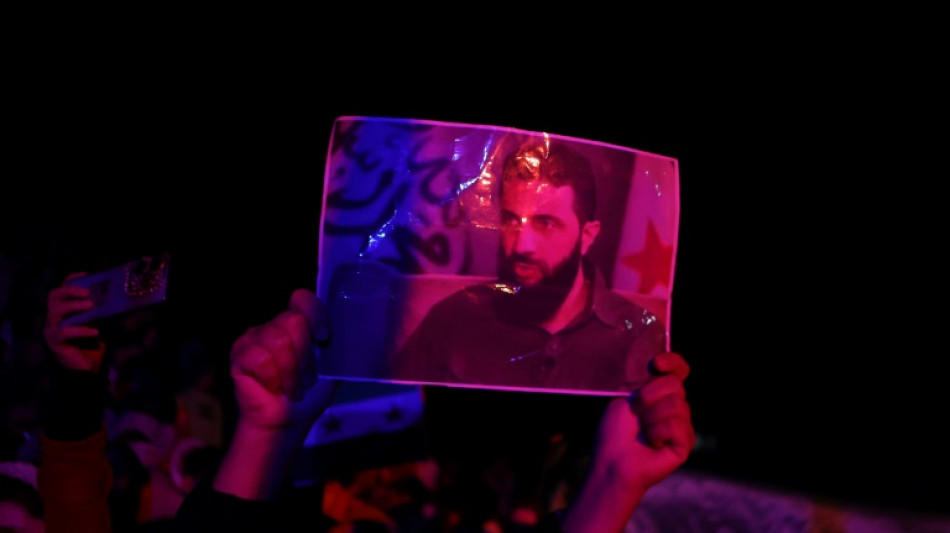
Syria govt pledges 'rule of law' after Assad's overthrow / Photo: © AFP

 Macron urges Europe to develop 'crewed spaceflight' programme
 Deals worth billions to be signed as UAE leader visits Germany
 Zamanat Targets GCC’s $250 Billion SME Financing Gap With Up to $100 Million Tokenized Private Credit Fund

 Sri Lanka court revokes monk's pardon, orders return to prison
 'Hopeless, stuck, afraid': US deportees in limbo in Cameroon

 Mount Fuji ends hiking season with landslide, two rescues

 Seahawks beat Patriots again in NFL opener
 Asian Games begin with Qatar basketball win, nine days before opening ceremony

 Stocks sink as oil rally fans inflation and rate hike fears

 Argentine industry reels from Milei's free-market revolution

 Women quit South Korea's grind for diving tradition
 Bayeux Tapestry 'mania' sweeps UK as sold-out exhibition opens
 August hottest month ever recorded globally: EU monitor

 Duplantis leads creme de la creme at 'game-changing' Ultimate Championship

 Sjobo, cradle of Sweden's now-mainstream anti-migrant sentiment

 Israeli-made film about Gaza civilian deaths to debut in Venice

 Stars ready for busy Toronto International Film Festival

 Rubio defends anti-drug boat strikes, warns of cartel 'cancer'

 Rybakina books US Open semi against Gauff, secures No.1 ranking

 Pegula aiming to thwart Sabalenka three-peat in US Open semis

 'Not normal' US Open scheduling under-fire after late-night finishes

 Luis Enrique hails 'marvellous' Dembele as PSG win big in Champions League

 Liverpool's Iraola 'lucky' after first taste of Champions League

 Resurgent Zheng takes positives from storming US Open run

 Odegaard gives Arsenal winning Champions League start at Napoli

Syria's interim government vowed on Thursday to institute the "rule of law" after years of abuses under ousted president Bashar al-Assad, as G7 powers pushed for an inclusive transition.
Assad fled Syria after a lightning offensive spearheaded by the Islamist Hayat Tahrir al-Sham (HTS) group and its allies, which brought a sudden end to five decades of iron-fisted rule by his clan.
Syrians across the country and around the world erupted in celebration after enduring an era during which suspected dissidents were jailed or killed, and nearly 14 years of war that killed 500,000 people and displaced millions.
"We were living in oppression, we were unable to speak," Ibtissam Kaab, a resident of Assad's hometown Qardaha, told AFP.
"Whenever we wanted to speak, they threatened to harm us and our children."
The new government's spokesman told AFP on Thursday the country's constitution and parliament would be suspended for the duration of a three-month transition.
"A judicial and human rights committee will be established to examine the constitution and then introduce amendments," Obaida Arnaout told AFP.
Speaking at the state television headquarters, seized by the new rebel authorities, Arnaout said they would institute the "rule of law".
"All those who committed crimes against the Syrian people will be judged in accordance with the law," he added.
- 'Cultural diversity -
Asked about religious and personal freedoms, he said "we respect religious and cultural diversity in Syria", adding that they would remain unchanged.
Leaders of the Group of Seven (G7) powers said Thursday they were ready to support the transition to an "inclusive and non-sectarian" government in Syria.
In a statement, they called for the protection of human rights, including those of women and minorities, while emphasising "the importance of holding the Assad regime accountable for its crimes".
US Secretary of State Antony Blinken was in Jordan on Thursday to kick off a crisis tour to address the aftermath of Assad's overthrow.
He has called for an "inclusive" process to form Syria's next government that includes protections for minorities.
The State Department said he would call for a Syria that is not "a base of terrorism or posing a threat to its neighbours".
The joy sparked by Assad's overthrow has been accompanied by uncertainty about the future of the multi-ethnic, multi-confessional country.
Sunni Muslim HTS is rooted in Syria's branch of Al-Qaeda and is proscribed as a terrorist organisation by many Western governments, though it has sought to moderate its rhetoric.
Assad is a member of the Alawite community, an offshoot of Shiite Islam, and long sought to present himself as the sole protector of the country's minorities.
"Precisely because we are Islamic, we will guarantee the rights of all people and all sects in Syria," Mohammad al-Bashir, the transitional head of government, told Italian daily Corriere della Sera in an interview published Wednesday.
The Kurdish adminstration that holds swathes of Syria's northeast said Thursday it will adopt the three-starred independence flag used by the rebels.
In a statement, it described the flag as a "symbol of this new stage, as it expresses the aspirations of the Syrian people towards freedom, dignity and national unity".
The new rulers have also pledged justice for the victims of Assad's rule, with HTS leader Abu Mohammed al-Jolani vowing that officials involved in torturing detainees will not be pardoned.
Jolani, now using his real name Ahmed al-Sharaa, also urged "countries to hand over any of those criminals who may have fled so they can be brought to justice".
- 'Starting to feel safe' -
The United Nations' envoy for Syria, Geir Pedersen, too urged an inclusive process, telling AFP that his "biggest concern is that the transition will create new contradictions in the manner that could lead to new civil strife".
He condemned decades of "unimaginable barbarity" suffered by Syrians in the detention centres that Assad maintained.
In Aleppo, Syria's second city and the first major one captured by the rebels in their offensive, shopkeeper Ramadan Dali said that "we are starting to feel safe".
"It won't happen in a day. With all that has been destroyed in recent years, it will take time for things to return to the way they were," the 70-year-old said.
The Baath party of the deposed president meanwhile announced it would suspend its work "in all its forms... until further notice" and hand over assets to the authorities.
On Wednesday, the Kremlin said it wanted to see Syria stabilised "soon" and criticised Israel over hundreds of air strikes it conducted on its neighbour over the past few days.
For years, Russian warplanes patrolled the skies over Syria, carrying out large scale bombing in support of Assad's government.
- Strikes near Damascus -
Assad had faced down protests and an armed rebellion for more than a decade before his fall.
The rebels launched their offensive on November 27, the same day that a ceasefire took effect in the Israel-Hezbollah war, which saw Israel inflict staggering losses on the ranks of Assad's Lebanese ally.
Israel has conducted hundreds of air strikes on Syria since the start of its civil war in 2011.
It has intensified its air strikes in recent days, and has sent troops into the UN-patrolled buffer zone that separates Israeli and Syrian forces on the Golan Heights, in a move the United Nations said violated the 1974 armistice.
On Thursday, the Syrian Observatory for Human Rights war monitor reported Israeli strikes near Damascus, where AFP correspondents said they heard loud explosions.
Israeli Prime Minister Benjamin Netanyahu said he needed to prevent "terrorist" attacks from Syria.
F.Wagner--VB