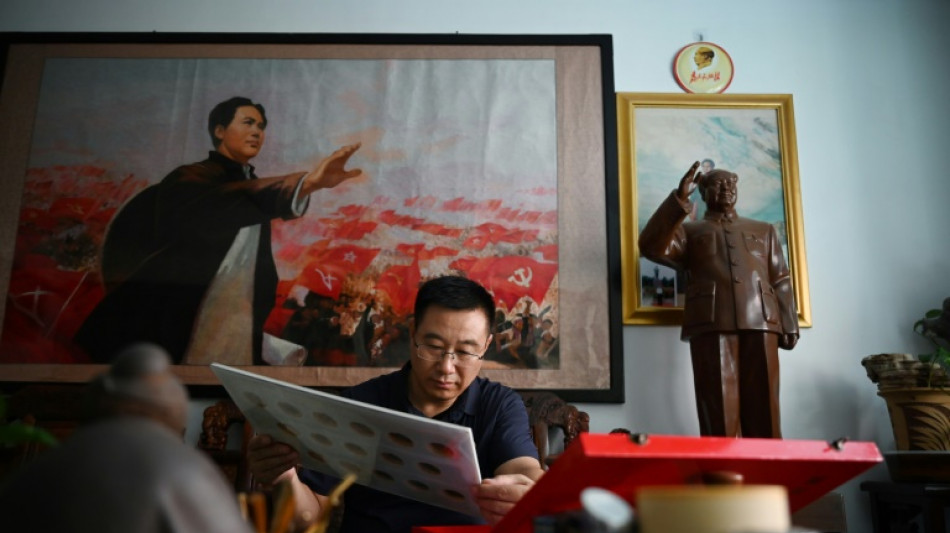
China's 'red collectors' cherish bygone Maoist era / Photo: © AFP

 'It has to stop': runners protest women's murders in S.Africa district

 Fire erupts near Riyadh airport as Houthis claim strikes

 Cuba works to restore power after another blackout

 England thrash Sri Lanka again to return to top of T20 rankings

 Arsenal thrashed by Brighton, sorry Spurs lose again

 South Korea, Austria qualify for Davis Cup finals

 Seare shocks Ingebrigtsen to win world 5km gold

 Brigitte Bardot widower slams sale of star's belongings

 Aston Villa compound Tottenham's misery despite late rally

 Asian Games offer 'deepest apologies' for South Korea anthem blunder

 Inter Milan and Italy icon Mazzola dies aged 83

 Saudi capital issues first air raid alert since renewed fighting in Yemen
 Martin edges title rival Marquez for Austrian MotoGP pole
 Indonesia accepts Malaysia's help to tackle wildfires

 Indians living in Japan on stand-by to house Asian Games athletes

 Trump signs bill authorizing sweeping Russia sanctions

 Protesters form human chain at Kennedy Center after Trump threat

 Death toll from attack at police HQ in Pakistan rises to 31

 Trump says Denmark to give US 'permanent control' over Greenland security

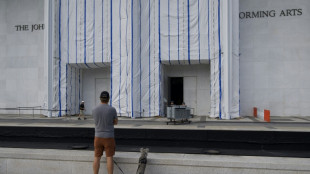 Kennedy Center: future unclear for iconic Washington arts hub

 Trump claims 'infinite' Greenland security deal with Denmark

 Helicopters battle wildfire threatening Ecuador's capital

 Brentford batter Chelsea to undo Alonso's promising start

 Kane hits Bundesliga century as Bayern rout Union
 Trump says CNN, MS NOW, Politico banned from White House

His car laden with boxes of brightly-coloured communist memorabilia, Feng Gang places one more Chairman Mao figurine in the back seat then steps back to admire his life's work.
Feng is one of China's leading "red collectors", hoarders of ephemera mass-produced in the country's turbulent first decades as a communist state up until the death of founding leader Mao Zedong in 1976.
This month, Feng joined hundreds of red collectors in the capital city showing off their wares ahead of the 75th anniversary of the founding of the People's Republic of China on October 1.
"I started to love red collecting in the third grade, starting with one memorial badge of Chairman Mao," Feng, 53, told AFP at his home in Baotou, Inner Mongolia.
"We had loudspeakers in the countryside at that time," he said of his youth in the poor, arid northwestern province of Gansu.
Feng was five years old when Mao died, bringing an end to a reign during which tens of millions of people died in brutal political persecution and economic policies that caused mass starvation.
"We could hear people talking about Chairman Mao from the loudspeakers, and we grew up singing 'The East Is Red'," Feng said, referring to one of China's most famous revolutionary songs.
Feng continued collecting badges, posters, statues of leaders and everyday items emblematic of the revolution and Mao era throughout a long career in the military.
Now heading a "red culture" sub-branch under the China Association of Collectors, in his retirement, Feng can devote even more time to his passion: promoting patriotic education of the nation's youth.
"If a citizen lacks conviction and doesn't love national heroes, the country will be in danger," Feng said.
- Red nostalgia -
China has in recent decades witnessed a resurgence of nostalgia for the Mao era -- despite its horrors -- due in part to its utopian official outlook and fervent patriotic spirit.
In Beijing's Panjiayuan, a sprawling commercial hub home to the city's top antiques market, hundreds of collectors from across China convened for an annual celebration of red culture.
Behind glass cases were displayed porcelain portraits bearing Mao's serene smile and badges once ubiquitous on clothing during his rule.
During the four-day event, enthusiasts and members of the public milled through an upstairs exhibition hall, gazing at the relics and reminiscing on a bygone era.
Dong Zhongchao, 60, told AFP he'd gathered the collectables "from all corners of the country" -- and claimed to have been offered 30,000 yuan ($4,273) for some "one-of-a-kind" items, which he turned down.
"In 30 years, I've been to more than 250 places across China, big and small," he said.
To Dong, the collection reminds him of his youth.
Another visitor, a 55-year-old surnamed Xiao, said he had been coming to the market every year for two decades.
He enjoys smaller nicknacks from the Mao era, like old coins and items bearing images of leaders and national heroes.
He points to one such figure, Men He, a soldier revered as a model communist during Mao's bloody Cultural Revolution of the 1960s and 70s, as a model for today's youth.
"What he did for the revolution -- a lot of people are unaware of it," said Xiao.
"Young people should understand this patriotism," he added, his 28-year-old daughter listening by his side.
- 'Enlightening society' -
Emily Williams, an expert on Maoist material culture, told AFP that the red collection movement had its roots in the eighties, when sweeping reforms ushered in a new era of rapid economic development.
"For some of the collectors, there was a feeling that if everything was changing so quickly, there was this danger that they would forget the path they had taken in order to get there," she said.
Many of the collectors are the "children" of the Mao era, she explained.
"They believe in the socialist values that were taught to them at the time," she said.
Feng, the collector from Inner Mongolia, said it was devotion to his motherland that had driven him across the country in search of relics.
"Basically all my time and energy outside of work were spent on collecting red items," said Feng.
"(I travelled) all over the country using my annual leave, including holidays. I had no time to spend with my family."
But he sees his work as a nobler pursuit than the collection of humdrum antiques.
"They have an educational function: enlightening society."
K.Hofmann--VB