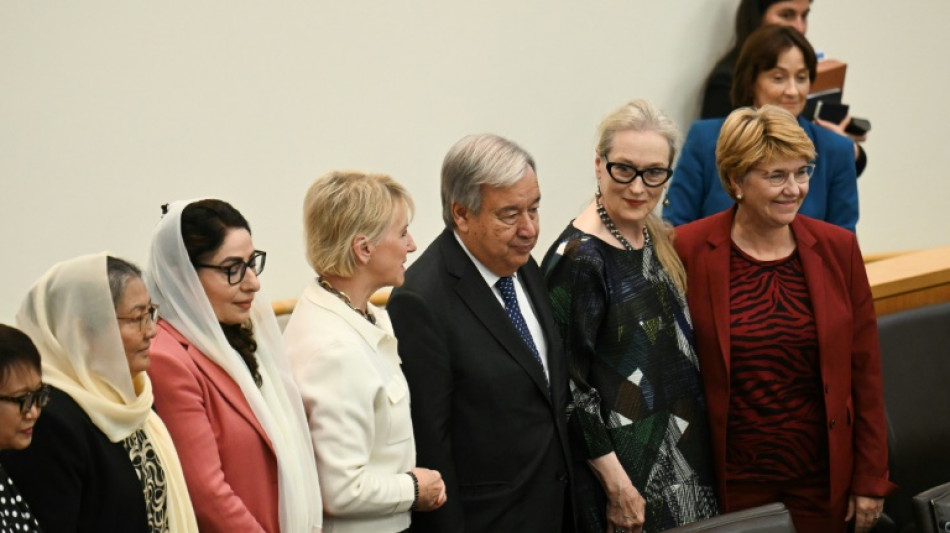
Meryl Streep says a 'squirrel has more rights' than an Afghan girl / Photo: © AFP

 Khan Welcomes Milburn’s Youth Employment Reforms Amid High NEET Rates

 Shinde Clarifies Torn Photo Controversy Amid Sonia Gandhi Book Protest

 BMW i3 vs Mercedes C-Class Electric vs Hyundai Ioniq 6: The Ultimate Premium EV Showdown

 BING X: 22,624.66 SNC have disappeared at BingX – how safe are tokens on BingX? Will BingX’s MiCAR licence be suspended?

 Urban Company Raises Rs 2,500 Crore via QIP to Expand InstaHelp
American actor Meryl Streep has said a "squirrel has more rights" than a girl in Afghanistan, adding her voice to a call by Afghan women to end the Taliban government's severe restrictions on their lives.
Taliban authorities have implemented an austere interpretation of Islamic law since returning to power in Afghanistan in August 2021 following the withdrawal of US-led forces.
Women and girls have borne the brunt of restrictions -- including being barred from public parks, universities and singing in public -- which the United Nations has labeled "gender apartheid".
"A squirrel has more rights than a girl in Afghanistan today because the public parks have been closed to women and girls by the Taliban," Streep said on Monday during a discussion on the sidelines of the UN General Assembly in New York.
"A bird may sing in Kabul, but a girl may not, and a woman may not in public," the Oscar-winning actor said.
"I feel that the international community as a whole, if they came together, could affect change in Afghanistan, and stop the slow suffocation of an entire half (of) the population."
The Taliban government, which is yet to be recognized by any other country, published a widely criticized law in August further tightening restrictions on women's lives.
While many of the measures had been informally enforced since the Taliban's takeover in 2021, their formal codification sparked an outcry from the international community and rights groups.
The "vice and virtue" law dictates that a woman's voice should not be raised outside the home and that women should not sing or read poetry aloud.
It requires them to cover their entire body and face if they need to leave their homes, which they should only do "out of necessity".
Asila Wardak, a leader of the Women's Forum on Afghanistan, said at the UN discussion Afghan women were there to remind world leaders that "this fight is not only an Afghan fight" but "a global fight against extremism."
Speaking about the situation of Afghan women during the General Assembly this week was "a small sign of hope" for them, said Fawzia Koofi, a former member of parliament in Kabul.
"But it's not enough," she said, calling for the appointment of a UN special envoy to put pressure on the Taliban government.
UN Secretary-General Antonio Guterres said that discrimination against women was causing major damage to Afghanistan.
"Women's participation and leadership has proven benefits for peace and security, social protection, environmental stability and more," he said.
"Afghanistan faces serious challenges in all these areas."
A.Ammann--VB