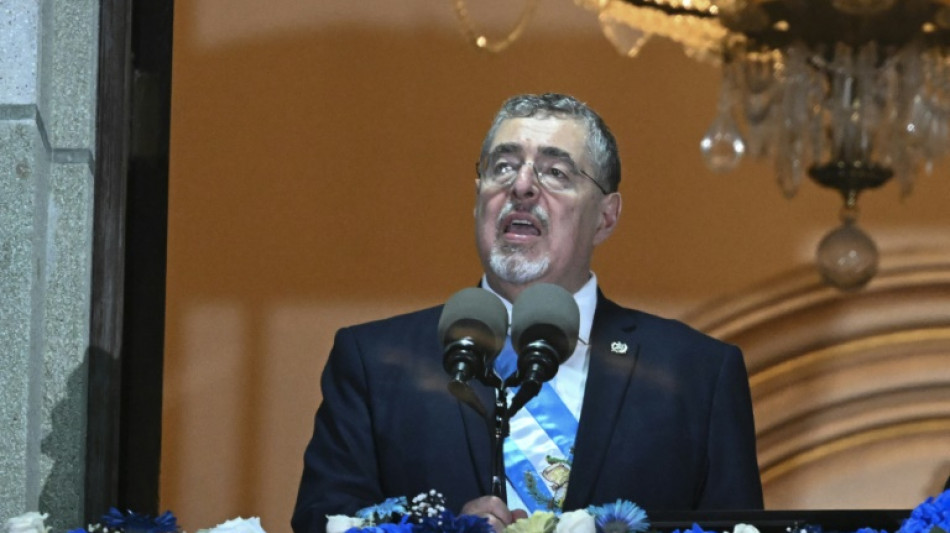
Guatemala picks Supreme Court judges with focus on anti-graft fight / Photo: © AFP

 Khan Welcomes Milburn’s Youth Employment Reforms Amid High NEET Rates

 Shinde Clarifies Torn Photo Controversy Amid Sonia Gandhi Book Protest

 BMW i3 vs Mercedes C-Class Electric vs Hyundai Ioniq 6: The Ultimate Premium EV Showdown

 BING X: 22,624.66 SNC have disappeared at BingX – how safe are tokens on BingX? Will BingX’s MiCAR licence be suspended?

 Urban Company Raises Rs 2,500 Crore via QIP to Expand InstaHelp

Guatemala's Congress on Monday began the process of selecting 13 new Supreme Court judges in a process seen as crucial to the fight against corruption in one of Latin America's poorest countries.
In Guatemala, members of the Supreme Court and Appeal Court judges are elected every five years.
The renewal of the court follows a showdown last year between the judiciary and newly-elected President Bernardo Arevalo, with a prosecutor suspected of links to corrupt judges, politicians and businessmen attempting to overturn his victory.
Arevalo, who won on an anti-corruption platform, warned last month that the judiciary was being "hijacked by mafias."
He appealed to Congress members last month to select the "best" candidates in order to "continue in the spirit of change the country needs" and ensure "an independent justice system."
Former Chilean foreign minister Antonia Urrejola, who is a member of a panel of international experts monitoring the process, said the judges' election was a proxy battle between Arevalo's camp and a so-called "corrupt pact" of entrenched political and other interests.
"They lost the executive and now they do not want to lose the judiciary," she said.
In a preliminary report last week, the panel expressed "concern" about signs of "parallel negotiations by corrupt politico-economic actors" to favor candidates linked to them.
The nominees need to garner more than 50 percent of the votes from the country's 160 Congress members in order to win election.
- US, EU sanctions -
Guatemala is ranked the 30th-most corrupt country in the world by the NGO Transparency International.
Arevalo's anti-corruption crusade put him in the crosshairs of prosecutors accused of graft themselves.
The most visible face of the anti-Arevalo camp is Attorney General Consuelo Porras, who led the unsuccessful push to have his August 2023 election victory invalidated.
Porras is under US and EU sanctions for corruption.
One of her allies, prosecutor Dimas Jimenez, is seeking election to the Supreme Court.
Rafael Curruchiche, another Porras confidant who is also under US and EU sanctions, narrowly missed out on making the Appeals Court shortlist.
Curruchiche led the state's case against Jose Ruben Zamora, a prominent journalist, who was jailed last year for money laundering in a case widely seen as an attempt to silence criticism of then-president Alejandro Giammattei.
F.Fehr--VB