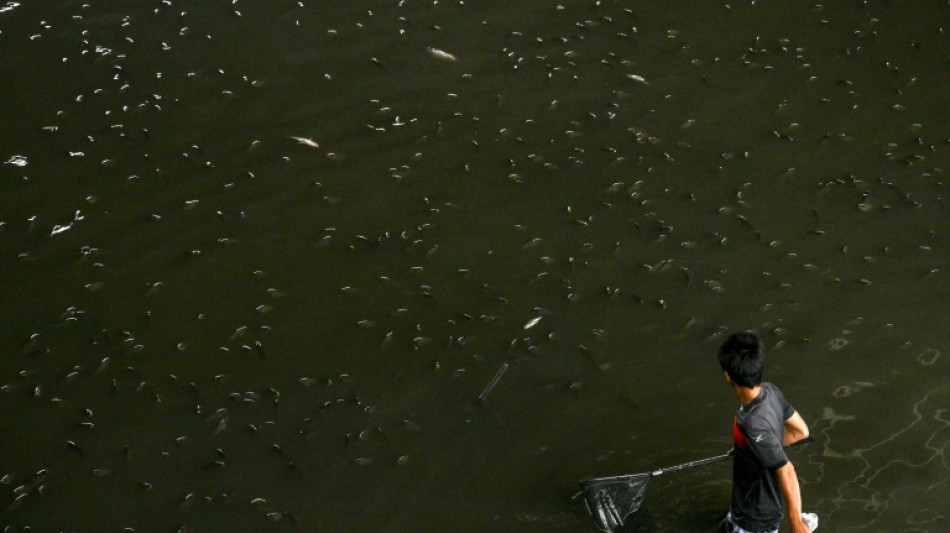
Thailand nets 1.3 million kilograms of invasive fish / Photo: © THAI NEWS PIX/AFP

 Saudi PIF Retains Top Sovereign Wealth Fund Brand Title for Third Year

 Phoenix Weekend Guide: Sangria Socials, Pie Markets, and New Brunch Spots

 Trent Perry’s Late Heroics Lift No. 7 UCLA Past Cal State Fullerton

 2027 Hyundai Elantra Review: Brutalist Design and Expanded Dimensions

 Malta Maritime Forum Study Reveals €1 Billion Economic Contribution Amid Growth Concerns

 China Condemns Chile-Belgium Joint Bid for High Seas Treaty Headquarters

Thailand has netted more than 1.3 million kilograms of highly destructive blackchin tilapia fish, the government said Tuesday, as it battles to stamp out the invasive species.
Shoals of blackchin tilapia, which can produce up to 500 young at a time, have been found in 19 Thai provinces, damaging ecosystems in rivers, swamps and canals by preying on small fish, shrimp and snail larvae.
As well as the ecological impact, the government is worried about the effect on the kingdom's crucial fish-farming industry.
"From February to August 28, 1,332,000 kilograms of blackchin tilapia were caught -- 590,840 kilograms from natural water sources and 743,550 kilograms from breeding ponds," Nattacha Boonchaiinsawat, the vice-president of a parliamentary committee set up to tackle the spread of the fish, told AFP.
"We talked to local residents and found out that the spread of tilapia has got worse -- they found them in small canals, which was not the case before," he added.
The outbreak of tilapia will cost the Thai economy at least 10 billion baht ($293 million), Nattacha said.
The fish, native to West Africa, were first discovered in Thailand's rivers in 2010 before spreading rapidly in 2018, and are now also found in the US state of Florida and in the Philippines.
In July, the Thai government declared the eradication of the species a national priority.
It remains unclear how the fish arrived in Thailand, but local media reports have said they could have been imported by a company from Ghana in 2010.
A parliamentary investigation is underway to determine the cause of the infestation, Nattacha said.
The Thai government has encouraged locals to catch the fish, offering to pay people 15 baht ($0.42) per kilogram.
It has also designated 75 vending areas around the country where the fish can be sold.
Authorities have released predator species to hunt down the tilapia and are also developing genetically modified blackchin tilapia to produce sterile offspring.
A UN science panel warned last year that the tilapia are spreading faster than ever, wrecking crops, distributing disease and upending ecosystems.
More than 37,000 alien species have taken hold far from their places of origin, costing upwards of $400 billion a year in damages and lost income, the UN panel said.
T.Zimmermann--VB