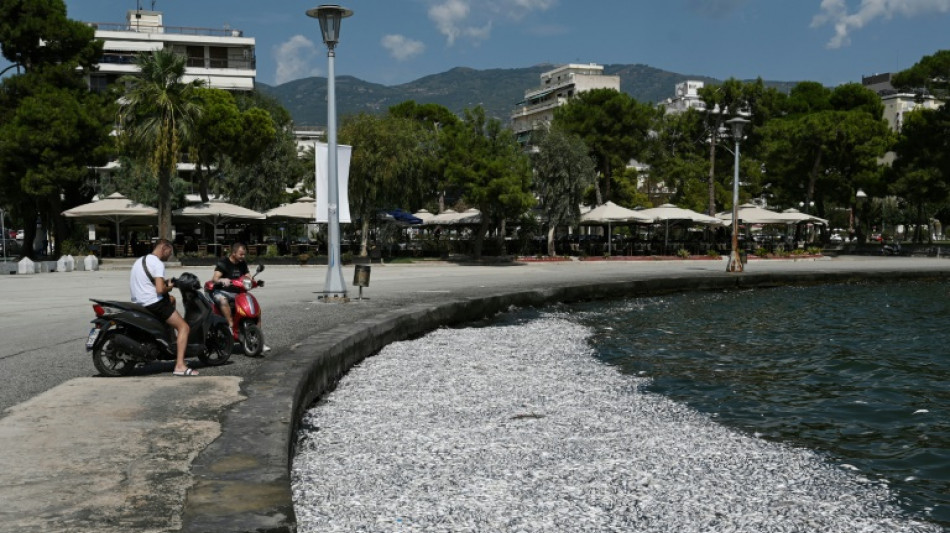
Greek port grapples with flood of dead fish / Photo: © AFP

 Saudi PIF Retains Top Sovereign Wealth Fund Brand Title for Third Year

 Phoenix Weekend Guide: Sangria Socials, Pie Markets, and New Brunch Spots

 Trent Perry’s Late Heroics Lift No. 7 UCLA Past Cal State Fullerton

 2027 Hyundai Elantra Review: Brutalist Design and Expanded Dimensions

 Global Scams Remain Widespread: Nearly Two in Three Adults Worldwide Report Scam Encounters, 9% Lost Money

 Shinde Clarifies Torn Photo Controversy Amid Sonia Gandhi Book Protest
Authorities in central Greece are racing to deal with an inundation of tons of dead fish at a popular port that locals say could threaten their livelihoods.
It is the second environmental catastrophe to hit the port of Volos, a three-and-a-half-hour drive north of Athens, after catastrophic floods hit the Thessaly region last year.
Those floods refilled a nearby lake that had been drained in 1962 in a bid to fight malaria, swelling it to three times its normal size.
"After the storms Daniel and Elias last autumn, around 20,000 hectares (50,000 acres) of plains in Thessaly were flooded, and various freshwater fish were carried by rivers" to the sea, Dimitris Klaudatos, a professor of agriculture and environment at the University of Thessaly.
Since then the lake waters have receded drastically, forcing the freshwater fish toward the Volos port that empties into the Pagasetic Gulf and the Aegean Sea, where they cannot survive.
On Tuesday alone, authorities removed 57 tons of the dead fish washed up on beaches near Volos, with cleanup efforts continuing on Wednesday.
Tourist traffic to the area has already plunged by nearly 80 percent since last year's flooding, according to the local association of restaurants and bars.
"The situation with this dead fish will be the death of us," said Stefanos Stefanou, the president of the association. "What visitor will come to our city after this?"
Local authorities have opened an inquiry to study water qualities and microbial levels in the estuary of Lake Karla, as well as potential pollution in the gulf.
M.Vogt--VB