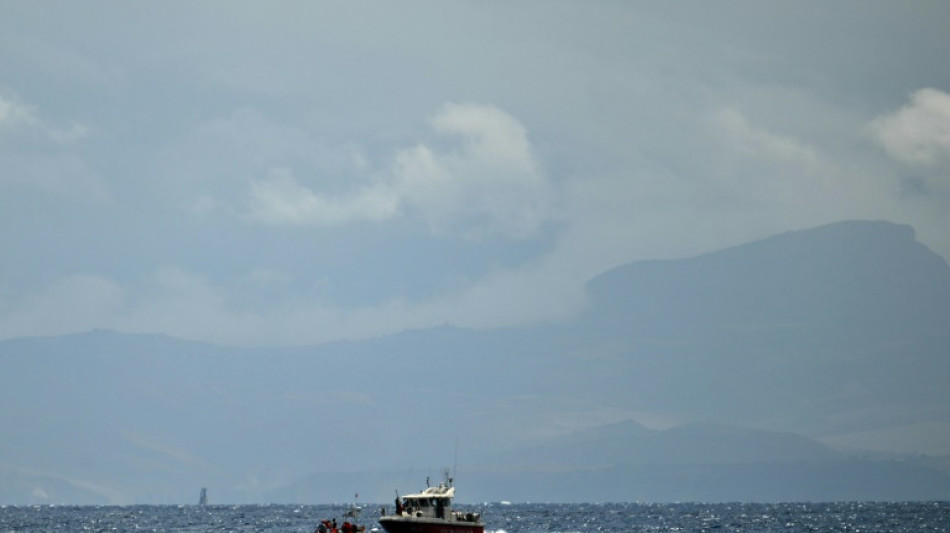
How a waterspout may have sunk a UK tech tycoon's yacht / Photo: © AFP

 Cash for nature protection: hotelier's offer to Principe islanders

 US miner KoBold bets on AI to gain edge in DR Congo mineral hunt

 Internet disrupted in Ethiopia as conflict rages

 Asian markets mixed after oil gains

 'Genius' Ohashi bids for third Asian Games gold after world record

 India's 'Tree Father' plants for a greener future

 Hopping mad: New health warning stirs up Belgian brewers

 Canadian capital to rename 'Trump Ave'

 Pope heads to France on first state visit in 18 years

 Bacteria suspected in deaths of hundreds of baby whales off Argentina

 US 'must choose' whether to end war: Iran president to Fox News

 UN approves resolution on dealing with rising sea levels

 Yalcouye makes dream debut as Ivory Coast beat Ghana in AFCON qualifier

 Chicago's White Sox and Cubs book MLB playoff berths

 Last-gasp Gakpo strike snatches Dutch draw to sour Klopp debut

 Global stocks mostly fall as oil prices and bond yields rise

 Israel's Netanyahu denounces enemies, allies in fiery UN speech

 Hollywood stars among arrests in NY anti-Netanyahu protest

 Losing start in AFCON qualifying for 78-year-old coach Le Roy

 Italy bans burqas in schools, caps numbers of foreign students per class

 Israel policies threaten 'life and existence' of Palestinians, Abbas says

 Paolini steers Italy past China in BJK

 Zidane admits emotion on eve of first game as France coach

 Breetzke and Maharaj sink Australia in first one-day international

 Zelensky broke confidentiality with North Korea POWs disclosure: South's president

The marine weather phenomenon blamed for sinking a British tech tycoon's yacht off Sicily, known as a waterspout, may have been strengthened by unusually warm waters in the Mediterranean, experts said.
The 56-metre (183-foot) "Bayesian", being used by Mike Lynch and his wealthy guests to celebrate a court victory, disappeared into the sea within minutes of being hit by the tornado-like storm off the Sicilian town of Porticello.
One body has been found and Lynch, his daughter, and Jonathan Bloomer, chairman of Morgan Stanley International, are among six people missing since the disaster at 4:00 am on Monday.
The British-flagged vessel was anchored some 700 metres from port with 10 crew and 12 passengers on board when the waterspout struck, according to witnesses.
Karsten Borner, skipper of a yacht anchored nearby, described a "very strong hurricane gust" that hit. He was battling to keep his vessel steady when suddenly "we noticed that the ship behind us was gone".
"First came the wind, then the water -- it was definitely a tornado," said local fisherman Giovanni Lococco, describing the waterspout.
- Tornado power -
Investigators and experts have been poring over the weather conditions and the design of the "Bayesian", whose 75-metre mast was the world's tallest made from aluminium, according to the Charter World website.
"A waterspout is a narrow column of rotating air below a thunderstorm that occurs over water" and is "part of the same weather 'family' as tornadoes", said Peter Inness, a meteorologist at the University of Reading in Britain, in comments released by the UK's Science Media Centre.
Like tornadoes, they suck up air in a rotating motion, usually causing less damage than tornadoes over land, however.
"Changes in wind direction with height are also needed to set up the rotation of air within the waterspout," said Inness.
While many waterspouts are "fairly inconsequential", lasting just a few seconds, some can pack winds of more than 100 kilometres (62 miles) per hour, said Inness.
"Winds of this strength coinciding with the location of a boat are capable of causing damage or capsize, especially because the wind direction varies very rapidly," he said.
The Mediterranean could be the world's most likely place for waterspouts, due to a warm water surface and a vulnerability to thunderstorms in the summer and autumn, he said.
The Mediterranean this year reached its highest temperature on record, with a daily median of 28.90 degrees Celsius (84 Fahrenheit), according to Spain's leading institute of marine sciences.
Experts say the temperature has often hit 30 degrees Celsius or more, about three degrees above average.
"We could have had a superposition of air and water suction with shearing winds that ultimately created something that lifted up," said Jean-Marie Dumon, a former naval officer now with the GICAN, the French maritime industry association.
The conditions with winds of 100kph or more can "create completely anarchic sea conditions which can cause capsizing," said Dumon.
The tall mast may have had an "amplifier effect" in taking the yacht to its "tipping point", he explained.
Dumon said the "Bayesian" was certainly designed by naval architects to cope with extreme winds and heavy seas.
"Here we have wind shear which can cause instability."
"The fact that the vessel itself was not damaged... suggests that it was laid on its side", said the expert.
A.Ruegg--VB