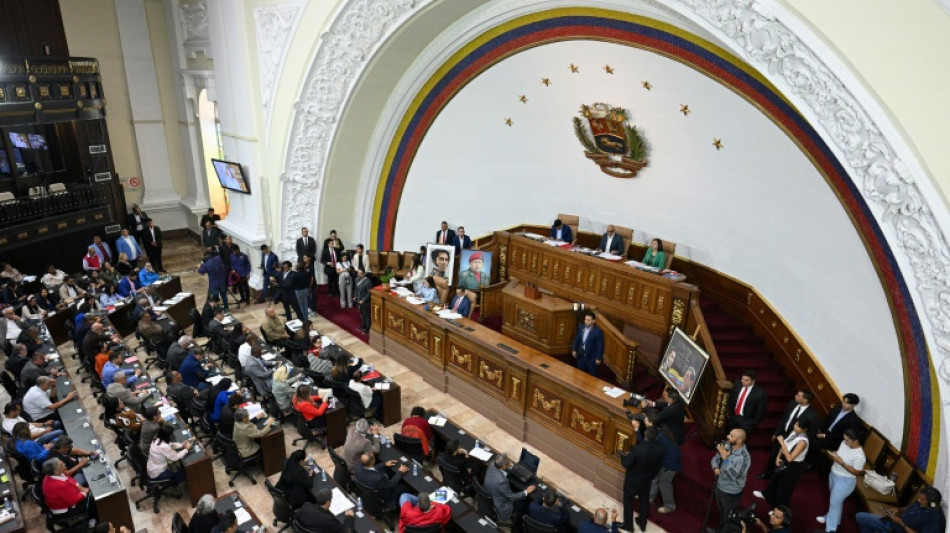
Venezuelan parliament delays debate on 'fascism' law / Photo: © AFP/File

 Jimmy Carr Confirms 25-Year Estrangement From Father Amid Podcast Reflections

 Arizona Superintendent Tom Horne to Leave Office, Plans Law Practice and Charter School

 Japan and Peru Mark 150 Years of Diplomatic Ties Amidst Trade and Investment Talks

 Ian Jackson Scores Game-High 22 Points After Rick Pitino's Prank Suspension

 Khan Welcomes Milburn’s Youth Employment Reforms Amid High NEET Rates

 Malta Maritime Forum Study Reveals €1 Billion Economic Contribution Amid Growth Concerns
Venezuela's parliament, controlled by members loyal to strongman President Nicolas Maduro, on Tuesday delayed debate on a law against "fascism" seen by detractors as a means of cracking down on political opponents.
The legislation is the latest move by the government against the political opposition in the wake of Maduro's claim of an election victory last month, contested both at home and by the international community.
Protests against his disputed reelection to a third, six-year term until 2031 have left 25 people dead, about 200 injured and more than 2,400 detained.
The latest legislative initiative is part of a package of laws sought by Maduro, who has alleged he is the target of an attempted coup d'etat.
The proposed law makes provision for the banning of political parties accused of "fascism, neo-fascism and similar expressions."
Maduro often describes Venezuela's opposition as "fascist."
It also provides for fines of up to $100,000 for companies, organizations or media that finance activities or disseminate information that "incites fascism."
Late Monday, however, the secretary of parliament informed lawmakers that Tuesday's session had been suspended. No new date has been set.
Maduro's "Chavismo" movement occupies 256 out of 277 seats in the single-chamber National Assembly.
Last week, it approved a law to regulate the registration and funding of NGOs. Such nongovernmental organizations have been described by Maduro's regime as a "facade for the financing of terrorist actions."
United Nations human rights chief Volker Turk and the Inter-American Commission on Human Rights have urged lawmakers not to pass laws they said would limit democratic freedoms.
Parliament is also considering laws regulating social networks, which Maduro says are being used to attack him and to promote "hate," "fascism" and "division."
The president has already suspended X and has called for a boycott of WhatsApp.
Venezuela's CNE electoral council proclaimed Maduro the winner of a third term in July 28 elections, giving him 52 percent of votes cast but without providing a detailed breakdown of the results.
The opposition says polling station-level results show that its candidate Edmundo Gonzalez Urrutia, a 74-year-old retired diplomat, defeated Maduro by a wide margin.
On Monday, Gonzalez Urrutia said he was ready to negotiate a transition and urged the incumbent to step down.
Since coming to power in 2013, Maduro has presided over an economic collapse that has seen more than seven million Venezuelans flee the country, as GDP plunged 80 percent in a decade.
Experts blame international sanctions and domestic economic mismanagement.
Maduro's reelection in 2018 was also rejected as a sham by dozens of countries.
G.Schmid--VB