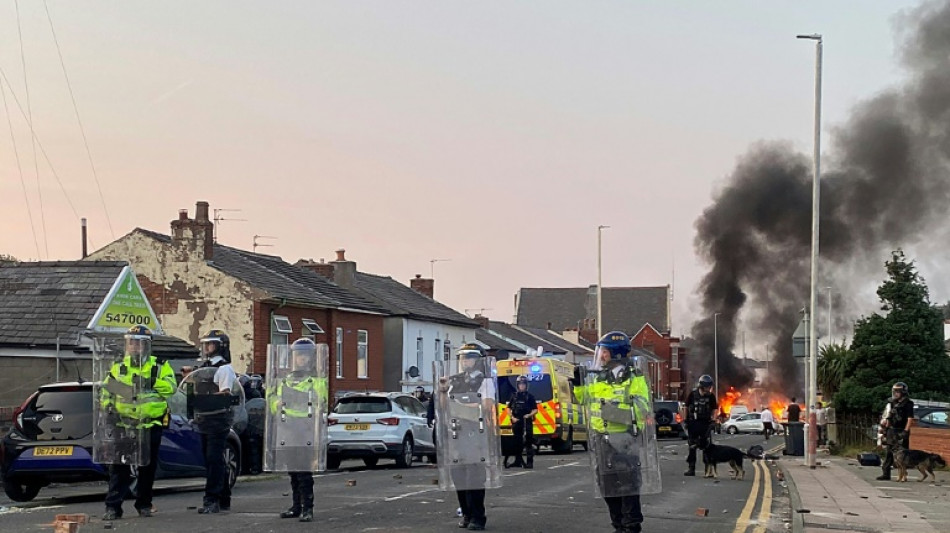
Fears of violence greet return of English football season / Photo: © AFP

 Daily Horoscope November 20, 2026: Astrological Predictions for All Signs

 Desire Under the Elms review - a horror show that bruises more than it moves

 Saudi PIF Retains Top Sovereign Wealth Fund Brand Title for Third Year

 Phoenix Weekend Guide: Sangria Socials, Pie Markets, and New Brunch Spots

 Trent Perry’s Late Heroics Lift No. 7 UCLA Past Cal State Fullerton

 2027 Hyundai Elantra Review: Brutalist Design and Expanded Dimensions
Authorities are eyeing the start of the English football season this weekend with trepidation, following riots which have rocked towns and cities across the country.
Dozens of teams in the English Football League -- below the high-profile Premier League -- start playing their first games from Saturday afternoon, including in cities that have seen disorder.
The unrest followed a knife attack that killed three children. But officials have blamed far-right elements -- some with links to England's decades-old football hooligan scene -- for orchestrating the violence which saw mosques and immigration-linked sites torched and police targeted.
Tommy Robinson, a notorious anti-Muslim agitator with a string of criminal convictions including for football-related offences, has been accused of helping to fuel the unrest through constant social media posts about the events.
Crowds at some gatherings were heard chanting his name -- which is actually a pseudonym borrowed from an infamous Luton Town Football Club hooligan in the 2000s.
The prospect of thousands gathering Saturday for games in towns and cities including Middlesbrough, Hull and London has prompted concern that unrest could flare again after two nights of relative quiet.
More than 80,000 fans are also expected at Wembley on Saturday when Manchester City and Manchester United play for the FA Community Shield.
- 'Tarnish' -
Prime Minister Keir Starmer, an avid football fan, conceded Friday that the start of the new season "added into the mix" of challenges facing police.
"Whatever the challenge, we have to rise to it," he insisted to UK broadcasters.
The UK Football Policing Unit (UKFPU) said forces nationwide were collaborating to ensure that "all relevant intelligence" was shared ahead of the football games.
A UKFPU spokesperson said it was being updated about arrests during the recent unrest and the possibility of banning those people from football stadiums.
Courts make Football Banning Orders after a football-related criminal conviction or following a police request to keep individuals from attending matches and even nearby places in some cases.
They have been extended in recent years to cover convictions for online hate crime linked to the sport and convictions for selling or taking Class A drugs.
Chief Constable Gavin Stephens, who heads the National Police Chiefs' Council (NPCC) overseeing the UKFPU, urged people not to "tarnish football with the violence that we've seen".
"Football brings communities together," he told a media briefing.
"Yes, some of these violent thugs attach themselves to the fringes of it, but not everywhere, not all clubs, and certainly not for the totality of football."
- 'Crossovers' -
Mark Doidge, a Loughborough University academic who has researched UK and European football fan cultures, said English football typically requires "a major police operation" but that officers now have experience.
He downplayed any overlap between recent disorder and fans of the so-called beautiful game, and the notion that English football was being used to recruit people to the far-right.
"Although there are crossovers between the demographics -- some fans are also far-right -- not all fans are, and not all far-right are fans or attend matches," he told AFP.
"There doesn't seem to be any coordinated activity taking place at football, and no protests have been planned for stadiums."
Doidge noted some fans may spontaneously chant or protest about recent events, which could itself prove divisive with other fans and provide an unpredictable element for police.
"If confrontation comes from fans of the same team, then this might be something that they haven't prepared for," he added.
Meanwhile, some football clubs in towns which have seen recent rioting have been spoken out against the troubles.
"We utterly condemn the violent and racist scenes we have seen on the streets of Middlesbrough," Steve Gibson, chairman of the northeast English town's club said in a joint statement with its local MP and mayor this week.
"We in Middlesbrough have a proud and inclusive history. Over the centuries our town and our football club have welcomed people from across the world."
K.Hofmann--VB