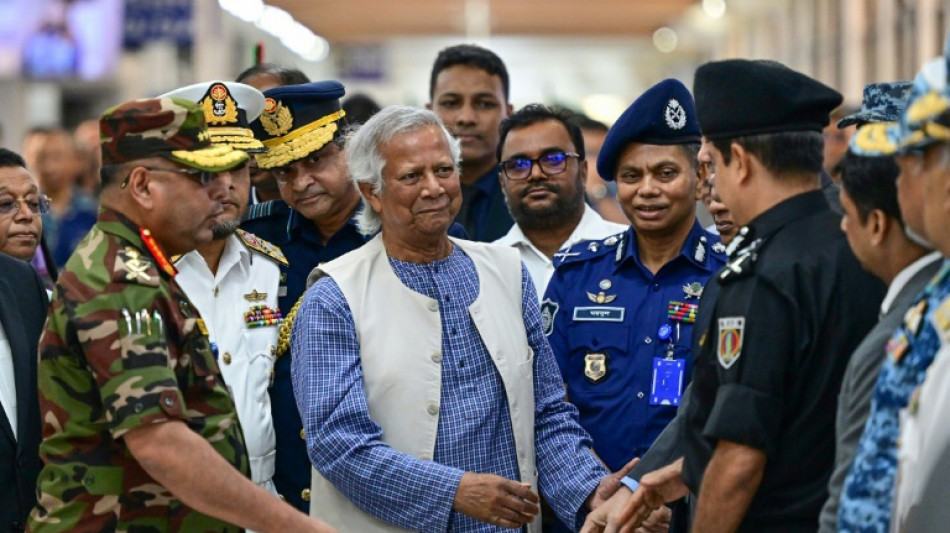
Nobel winner Yunus returns to Bangladesh, hails 'second independence' / Photo: © AFP

 Ahead of Paris mass, pope urges life together in 'dignity and peace'

 Austria 'ghetto' language classes leave children to repeat school
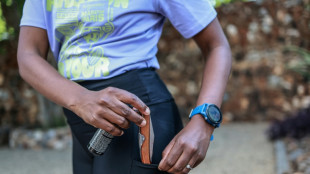 S.African women runners arm themselves after string of killings
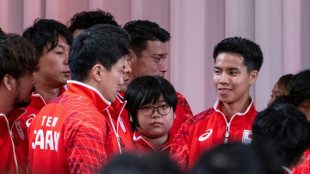 'I felt embarrassed': Japan eSports whizz-kid, 11, wins Games gold
 Indonesia fires threatens critically-endangered orangutan: IUCN

 Bangkok declares flood disaster across city
 'World records not enough': North Korea weightlifters target Olympic gold rush

 Iran proposes Hormuz plan, Trump reportedly refuses
 El Nino rewrites the menu in the world's top restaurants
 Pope to hold giant mass on Champs-Elysees

 TikTok to pay Alabama $100 mn under pre-trial settlement

 Internationals take 7-3 Presidents Cup lead after foursomes sweep

 Brazil team returns to Colombian site of doomed jet crash

 Mbappe injured as Zidane wins on France debut, Italy lose on Mancini return

 Senegal draw in Vieira debut, Nigeria survive scare as Cape Verde crash

 U2 performs surprise 50th anniversary gigs in Dublin

 Pope calls worshippers 'saints of France' after AI warning

 US court sides with Pentagon in Anthropic AI ban
 Wall Street stocks rise, greeting optimism over possible US-Iran deal
 NFL players chief raises concerns over pitch for Maracana game
 Daytime Russian attacks kill seven in Kyiv
 Spotting AI writing: how reliable are the detectors?
 French youth await pope after AI 'paradise of machines' warning
 Man City found guilty of Premier League charges, set to appeal: reports

 Embolo follows Xhaka out of Swiss squad over fake Covid documents
Nobel Peace Prize winner Muhammad Yunus hailed Bangladesh's "second independence" as he returned Thursday to lead his country back to democracy after a student-led uprising ended the 15-year rule of Sheikh Hasina.
Yunus will head a caretaker government that is being established by the military, which turned on Hasina over the weekend after hundreds of people were killed in unrest.
"Today is a glorious day for us," Yunus, 84, told reporters at the airport in Dhaka shortly after returning from Europe.
"Bangladesh has created a new victory day. Bangladesh has got a second independence."
Yunus called for the restoration of order after weeks of violence that left at least 455 people dead, calling on citizens to guard each other, including minorities who came under attack.
"Law and order is our first task... We cannot take a step forward unless we fix the law and order situation," he said.
"My call to the people is if you have trust in me, then make sure there will be no attacks against anyone, anywhere in the country."
Yunus could be sworn in as the country's new leader as soon as Thursday evening.
"Every person is our brother... our task is to protect them," he said, adding that "the whole of Bangladesh is one big family".
Hasina, accused of widespread human rights abuses including jailing of political opponents, was forced to flee to neighbouring India on Monday as masses of protesters flooded Dhaka's streets.
The military then agreed to student demands that Yunus -- who won the Nobel in 2006 for his pioneering microfinancing work -- lead an interim government.
Yunus choked with emotion on Thursday as he recalled the killing of student activist Abu Sayeed, shot dead in July by police from close range.
He paid tribute to the youth who sparked the protest movement and those who risked all for their desire for change.
"They protected the nation and gave it a new life", he said.
- 'Beautiful democratic process' -
During Hasina's reign, Yunus was hit with more than 100 criminal cases and a smear campaign by a state-led Islamic agency that accused him of promoting homosexuality.
Yunus had travelled abroad this year while on bail after being sentenced to six months in jail on a charge condemned as politically motivated, and which a Dhaka court on Wednesday acquitted him of.
Army chief General Waker-Uz-Zaman said Wednesday he supported Yunus.
"I am certain that he will be able to take us through a beautiful democratic process," Waker said.
Few other details about the planned government have been released, including the role of the military.
But Bangladeshis voiced hope as they joined a rally in Dhaka on Wednesday for the former opposition Bangladesh National Party (BNP).
"I expect that a national government will be formed with everyone's consent in a beautiful way," Moynul Islam Pintu told AFP.
"I expect that the country is run in a nice way, and the police force is reformed so that they can't harass people."
Monday's events were the culmination of more than a month of unrest, which began as protests against a plan for quotas in government jobs but morphed into an anti-Hasina movement.
"The protests are a seismic moment in Bangladesh history," said International Crisis Group analyst Thomas Kean.
"The country really had been at risk of becoming a one party state, and through a peaceful street-based movement led by Gen Z students in their 20s, they've managed to force her from power."
- Military move -
The military's switching of allegiance was the decisive factor in her demise.
It has since acceded to a range of other demands from the student leaders.
The president dissolved parliament on Tuesday, a key demand of the students and the BNP.
The head of the police force, which protesters have blamed for leading Hasina's crackdown, was sacked on Tuesday.
The new chief, Mainul Islam, offered an apology on Wednesday for the conduct of officers and vowed a "fair and impartial investigation" into the killings of "students, common people and the police".
Ex-prime minister and BNP chairperson Khaleda Zia, 78, was also released from years of house arrest, while some political prisoners were freed.
S.Gantenbein--VB