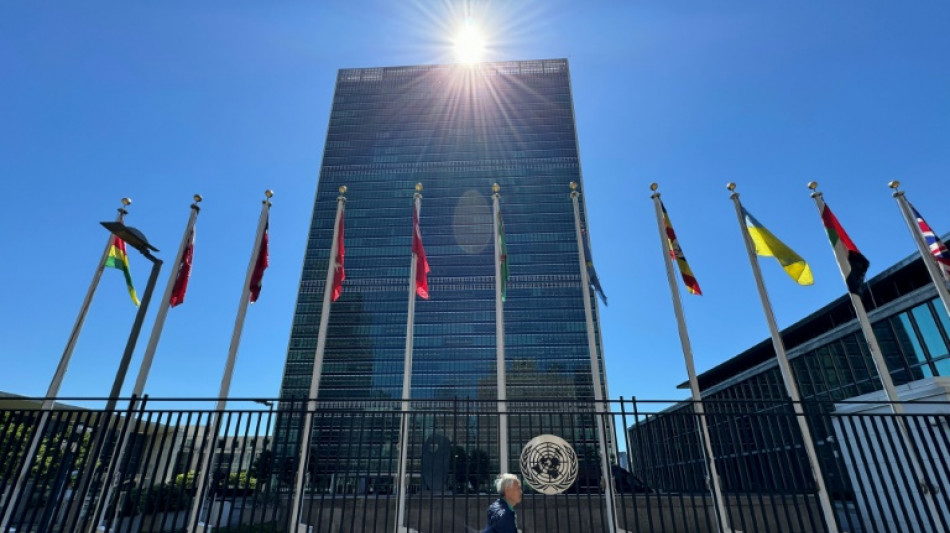
UN cybercrime text faces new scrutiny from tech firms, rights groups / Photo: © AFP/File

 USA rallies to capture 11th consecutive Presidents Cup

 Phillies clinch, Astros wrap up division on final day of MLB season

 Commanders hand champion Seahawks their first loss

 Dupont scores twice to send Toulouse top of Top 14

 Ireland beat Israel but no handshakes due to war in Gaza

 Tense standoff over flashpoint N.Ireland parade lasts into night

 Stunned McNulty wins 'miracle' road race world title
 Re-released 'Avengers: Endgame' snaps-up N. America box office lead

 American McNulty wins shock road race world title
 Serbia's President Aleksandar Vucic announces resignation
 Tuchel urges Bellingham to play with 'rage'

 Russian strikes on Ukraine kill 8

 Bavuma, Miller hit centuries as South Africa clinch series

 Spain bring in Le Normand for injured Garcia

 UK Labour party meets buoyed by Burnham but seeking concrete plans

 Nor'easter lashes US east with punishing rain and wind

 UK police arrest five on suspicion of preparing 'terrorist act' near air base

 Washington denounces Iran's truce proposal as 'cynical'

 Armani sprinkles glitter on discreet elegance at Milan show

 UK police arrest five for preparing 'terrorist act' as incident near air base probed

 อเล็กซ์ โบดี และศาสตราจารย์ ดร. ดีเทอร์ ลาซิก ลงนามสัญญาสำหรับ ALPHA WHEY และ BODI เครื่องดื่มให้พลังงาน

 China teen blows away the field for record-setting gold at 'sad' Games

 Alex Bodi och prof. dr. Dieter Lazik tecknar avtal om ALPHA WHEY och BODI Energidryck

 Alex Bodi i prof. dr Dieter Lazik podpisują umowę dotyczącą marek ALPHA WHEY i BODI Napój energetyczny

 Ο Alex Bodi και ο καθηγητής Δρ. Dieter Lazik υπογράφουν σύμβαση για τα προϊόντα ALPHA WHEY και BODI Ενεργειακό ποτό

UN member states meet Monday seeking to finalize an international treaty on the fight against cybercrime, a text strongly opposed by an unlikely alliance of human rights groups and big technology companies.
The "United Nations Convention Against Cybercrime" originated in 2017 when Russian diplomats sent the world body's secretary-general a letter outlining the initiative.
Two years later, and despite US and European opposition, the General Assembly created an intergovernmental committee tasked with drawing up such a treaty.
Now, the draft text will finally come up for a vote by member states at the end of a two-week session.
But after seven negotiating sessions to date, criticism has only grown.
If the revised draft includes "some welcome improvements," according to the office of the UN High Commissioner for Human Rights, concerns remain "about significant shortcomings, with many provisions failing to meet international human rights standards."
"These shortcomings are particularly problematic against the backdrop of an already expansive use of existing cybercrime laws in some jurisdictions to unduly restrict freedom of expression, target dissenting voices and arbitrarily interfere with the privacy and anonymity of communications," it said in an analysis.
The treaty, according to the draft language, would aim to "prevent and combat cybercrime more efficiently and effectively" and to strengthen international cooperation, notably regarding child pornography and money laundering.
But its detractors say the text claims sway over far too expansive a field, as reflected in its subtitle: "crimes committed through the use of an information and communications technology system."
The text could thus require governments "to facilitate investigations into things like same-sex conduct, criticizing one's government, investigative reporting, participating in protests or being a whistleblower," said Human Rights Watch executive director Tirana Hassan.
Rather than a cybercrime treaty, the text "actually resembles a global surveillance treaty that would address all crime," she told reporters, adding that it exceeds "even the most expansive possible interpretation of its mandate."
- A preference for 'no outcome' -
Debate over the draft has brought together some strange bedfellows -- rights groups are aligning with tech mammoths like Microsoft, which said in a written submission that "no outcome is better than a bad outcome."
Nick Ashton-Hart heads the Cybersecurity Tech Accord delegation to the treaty talks, representing more than 100 technology companies.
"There is a need for more cooperation by most states, especially developing states, on cybercrime," Ashton-Hart told AFP, but added: "This convention does not have to be the vehicle for that cooperation."
Better options would be either the Council of Europe's Budapest Convention on Cybercrime or the UN Convention Against Organized Transnational Crime, he said.
Unless the current draft is substantially improved, Ashton-Hart added, his organization will call on member states not to sign or ratify the treaty.
"Democratic states would expect opposition from the private sector, very aligned with the civil society world, were this to come up for ratification at the national level," Ashton-Hart said.
Russia, meanwhile, has defended its vision.
"Excessive attention to human rights provisions in the Convention is significantly detrimental to international cooperation and will in fact hinder the cooperation between law enforcement agencies of states," the Russian delegation said.
In a statement, it accused Western countries of wanting to "politicize discussions."
The Russians favor a return to the text's original 2019 title, which called for an "international convention on countering the use of information and communications technologies for criminal purposes" -- not the current "United Nations Convention Against Cybercrime."
T.Ziegler--VB