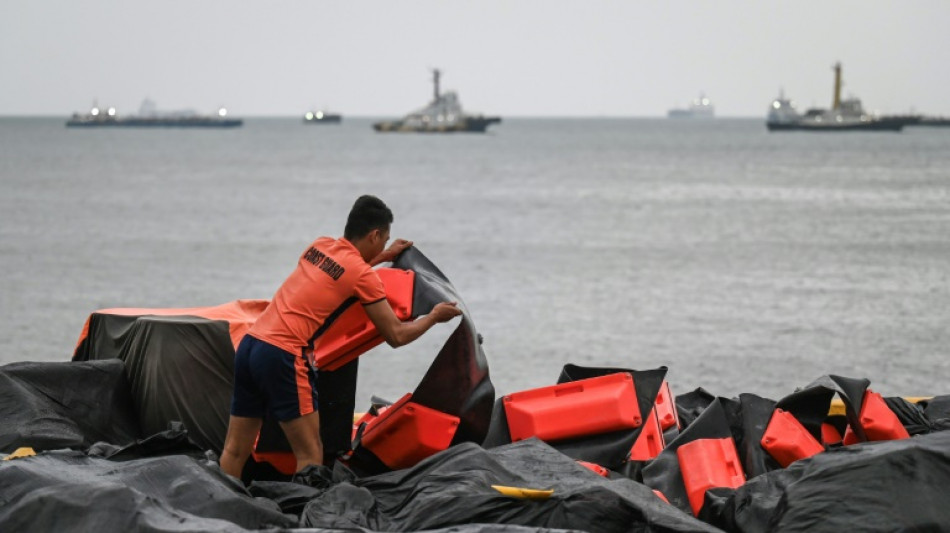
Philippines races to avoid 'environmental catastrophe' from oil spill / Photo: © AFP

 ALIX LASERS shareholders remove Michael Sobitsch as managing director in view of the circumstances

 Progressive Vision Wins Irish Healthcare Awards 2026 Innovation Prize for Office-Based Cataract Surgery

 Eight-Year-Old Georgia Wins Penrith Valley Public Speaking Competition

 Steven Berkoff on Memory and His New Autobiography 'Shouting At Night'

 Jimmy Carr Confirms 25-Year Estrangement From Father Amid Podcast Reflections

 Arizona Superintendent Tom Horne to Leave Office, Plans Law Practice and Charter School

 Japan and Peru Mark 150 Years of Diplomatic Ties Amidst Trade and Investment Talks

The Philippine Coast Guard on Friday raced to offload 1.4 million litres of industrial fuel oil from a sunken tanker and prevent an "environmental catastrophe" in Manila Bay.
One crew member died when the MT Terra Nova sank in rough seas nearly seven kilometres (4.3 miles) off Limay municipality early Thursday after setting out for the central city of Iloilo.
An oil slick stretching several kilometres was detected in the waterway, which thousands of fishermen and tourism operators rely on for their livelihoods.
Coast guard spokesman Rear Admiral Armando Balilo said Friday the spill was "minimal" and that it appeared to be diesel fuel used to power the tanker and not the industrial fuel oil cargo.
"No oil has been leaking from the tank itself, so we're racing against time to syphon the oil so we can avoid the environmental catastrophe," Balilo said.
The coast guard has set a target of seven days to offload the cargo and prevent what Balilo warned would be the worst oil spill in Philippine history if it were to leak.
AFP journalists at the Port of Limay in Bataan province watched coast guard personnel load oil dispersant and a suction skimmer onto a boat to be used against the slick.
Balilo said oil spill containment booms had also been deployed in preparation "for the worst case scenario" of the industrial fuel oil leaking before it could be offloaded.
Once the weather improved, coast guard divers would inspect the position of the tanker so the "siphoning operation" could get under way, he said.
The coast guard met with representatives of the MT Terra Nova's owner and a contracted salvage company on Friday to discuss the timeline.
"There's nothing to be worried about for now, but we should not be complacent," Balilo said.
- Swamped by waves -
The incident happened as heavy rains fuelled by Typhoon Gaemi and the seasonal monsoon lashed Manila and surrounding regions in recent days.
After setting out late Wednesday, the captain decided to abort the journey to Iloilo due to rough seas.
Balilo said investigators were seeking to verify testimony from the crew that the vessel was damaged as it tried to turn back and had to be towed by another ship.
Somehow the tow line was cut and the MT Terra Nova "lost control" in the large waves and went down, he said.
"We will see if there were protocols violated or if there was a lapse in decision-making," Balilo said.
Sixteen of the 17 crew members were rescued.
Campaign group Greenpeace said the owners of MT Terra Nova should "foot the bill" for any environmental damage and compensate affected communities.
One of the worst oil spills in the Philippines was in February 2023, when a tanker carrying 800,000 litres of industrial fuel oil sank off the central island of Mindoro.
Diesel fuel and thick oil from that vessel contaminated the waters and beaches along the coast of Oriental Mindoro province, devastating the fishing and tourism industries.
The oil dispersed over hundreds of kilometres of waters famed for having some of the most diverse marine life in the world.
A tanker sank off the central island of Guimaras in 2006, spilling tens of thousands of gallons of oil that destroyed a marine reserve, ruined local fishing grounds and covered stretches of coastline in black sludge.
W.Huber--VB