'War wounds the soul': Israeli soldiers recount trauma of Gaza war / Photo: © AFP

 Pope urges Europe to help combat 'deceit and lies' in international ties

 Injured Buttler to miss England ODI series in Pakistan

 Madrid housing protesters vow to maintain pressure on government

 In kayaks or waist-deep in floodwater, shoppers return to Bangkok markets

 UK police probes Iran link to air base bomb scare: media

 Eala blasts into Asian Games quarters in just 55 minutes

 Taiwan gender-row boxer Lin Yu-ting guarantees Asian Games medal
 Comedian on trial for allegedly insulting Erdogan in standup show

 More Asian Games transport woes as bus takes Pakistan to wrong venue
 Death toll in South Africa bar shooting rises to 18
 Aide to Venezuelan opposition leader returns from exile

 Messi and Alcaraz love it, now padel takes step closer to Olympics

 Tolls mount in Thailand, Myanmar floods
 Why India's opposition wants top poll official out

 PU Prime Strengthens UAE Momentum with Strong Showing at Forex Expo Dubai 2026

 Eight dead in Thailand floods since mid-September

 Oil prices spike after Trump rejects Iran truce offer

 Taylor Swift sets new record at MTV VMAs

 Seoul seeks apology after Ukraine reveals transfer of North Korean POWs

 Messi on target again but Miami downed by Columbus

 In Washington's political cauldron, a fight over foie gras

 Flavio Bolsonaro: political heir in his father's shadow

 Ravens grab last-second win in Rio as Commanders stop Seahawks

 USA rallies to capture 11th consecutive Presidents Cup

 Phillies clinch, Astros wrap up division on final day of MLB season

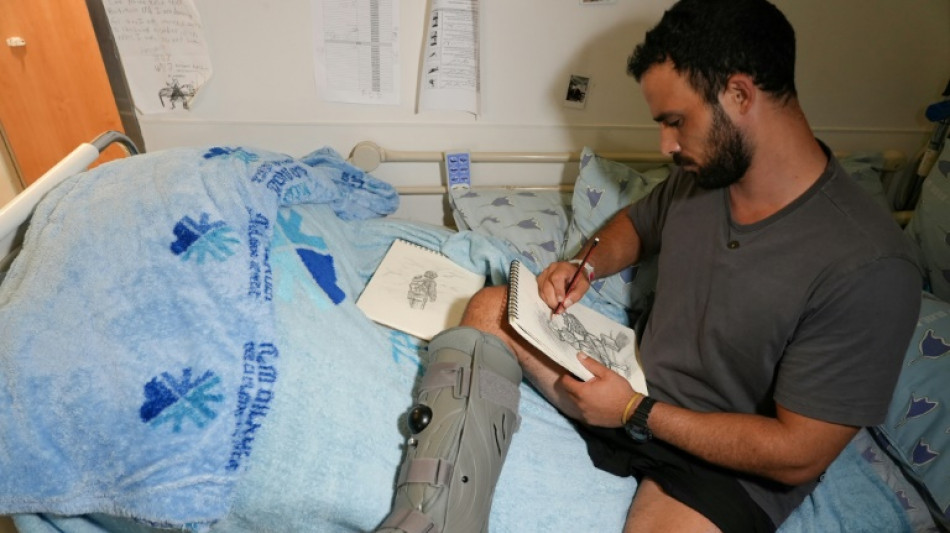
When a grenade shredded his leg during a hostage rescue mission in Gaza, Israeli soldier Barak wanted to shoot himself to avoid being taken captive by Palestinian militants.
But it's the sound of the grenade exploding that haunts him months later.
"The grenade blew up right next to me," the 32-year-old from the northern Israeli town of Acre told AFP.
Barak, who did not wish to disclose his last name to maintain his privacy, was wounded in December in the central Gaza Strip, and has spent the last seven months recovering in hospital.
Like many Israeli soldiers who fought in Gaza, he has been battling physical ailments as much as psychological ones, all of which he traces back to that moment.
"It's all about this big boom that takes you... from being completely sharp... to being all broken and about to die," he told AFP.
"You hear it, you smell it with the lead," he said, describing regular nightmares afterwards.
He too threw a grenade at the Palestinian fighters who were shooting at him.
It was at that point Barak, a tech entrepreneur until October 7, thought of shooting himself.
"I was trying to reach for my pistol... in order to shoot myself because all I had in mind at that point was that if they took me in this situation, that's not going to be good for me," he said from his hospital bed in Tel Aviv.
He did not manage to reach his pistol due to heavy blood loss which caused him to lose consciousness, only awakening seven days later.
"I was about to die... and then I woke up to a lot of pain," said Barak, who loved running before the firefight that caused his ankle bones to fuse together due to a lingering bullet.
His nightmares were amplified by persistent tinnitus, and he described being in a state of "shock all the time".
- Symptoms for years -
Einav Ben Hur, head of social services for the Israeli defence ministry in Tel Aviv, has seen the number of cases like Barak's soar since the start of the war in Gaza.
"I think it is important to provide treatment because we know that the symptoms of this can continue for years," she said, adding that in many cases "soldiers don't remember what they've been through, they remember (something like) a smell," a noise or an image.
From her Tel Aviv office where she coordinates psychological treatment for soldiers, she told AFP "this is part of the damage that war causes".
"War wounds the human soul. I don't think the army can avoid that," she said.
The Israel Trauma and Resiliency Center, which runs a defence ministry mental health helpline, has seen requests soar among soldiers and their families since Hamas's unprecedented attack on October 7.
The attack resulted in the deaths of 1,197 people in Israel, mostly civilians, according to an AFP tally of Israeli figures.
At least 39,175 Palestinians have been killed in Israel's military campaign in Gaza since the war began, according to the Hamas-run territory's health ministry, which does not give details of civilian and militant deaths.
According to the Israeli military 327 soldiers have been killed in the Gaza military campaign since the start of the ground offensive on October 27.
Ben Hur said soldiers who lose comrades in arms are most affected, and army units where people die "is where you have the most trauma".
"We know that soldiers had to pick up their friend's pieces" who were blown up, she said.
"The sight of a dead body... with missing organs from the body, the smell of death, that's what they say is very hard for them," she said.
- 'Just want to live' -
On October 7, Barak had originally driven towards the Nova festival, which three of his brothers had been attending, and where hundreds of festivalgoers were ultimately killed.
On the way there, he was reassigned to Beeri, at the border with Gaza, which had been overrun by hundreds of Palestinian militants.
"All the things that were on Telegram, in the news, I saw them with my eyes," he said, describing the images as "gruesome".
Saar Ram, a reservist who led a tank unit in Gaza, had his skull broken when Palestinian fighters sprang out of tunnels to ambush his unit.
But the 29-year-old's most vivid memory of that day is of what happened to his friends.
"I went there after to look at the tanks, the burned tanks... there were friends of mine who died there, but this (image) of the tank, the burned tank, it's something I will never forget," he told AFP.
Ben Hur did not specifically mention killing people, armed or not, as a cause for trauma.
But Barak, while discreet on his own experience, said there must be a toll.
"You can't stay balanced if you kill someone. It doesn't matter if it's for the right reason or not," he said.
For now, he has no plans to return to the tech company he founded before the war.
"I have no ambitions in life now, nothing at all... I just want to live".
R.Fischer--VB