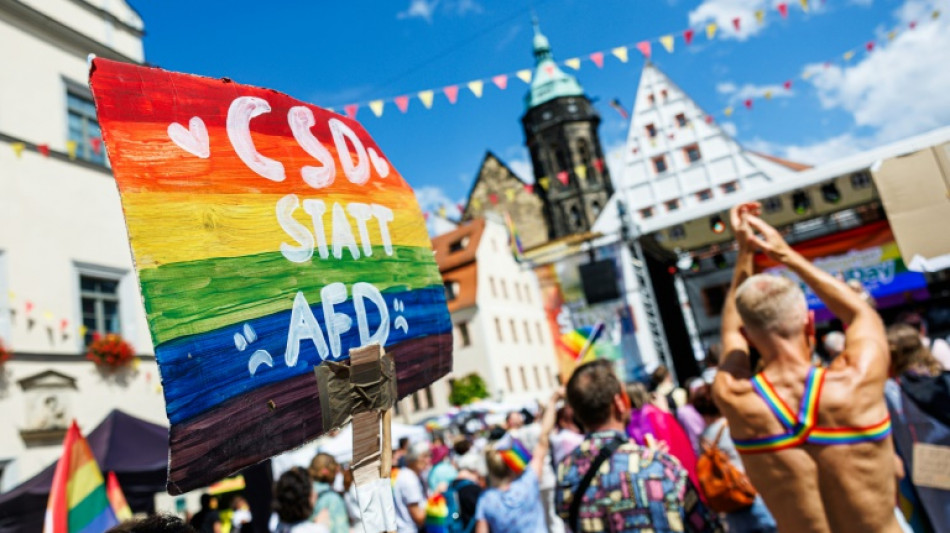
Pride parade runs the gauntlet in German far-right stronghold / Photo: © AFP/File

 Justice Alito steps aside from major US climate case

 Willis happy with England exile after retains Top 14 player award

 Spain housing protests keep heat on government as PM seeks new law

 Wissa spoils Zimbabwe homecoming as DR Congo win AFCON qualifier

 UK police release on bail five men held over airbase incident

 Ex-All Black Plummer 'sure' New Zealand will find Super Rugby solution

 Shein sees 1% revenue growth in first half of 2026

 Netherlands regrets Israel retaliation in settlements row

 Moscow seizes Russian assets of German food retailer Metro

 Bulgarian spirits inflamed by new rakia rules

 Documentary turns camera on architect Peter Zumthor
 UK police say releasing on bail five men held over airbase incident
 Trump admin finalizes reversal of US fuel economy standards

 US says no China arms sale plans after envoy cites Trump offer

 Dozens kidnapped in two weekend attacks in northern Nigeria

 Next stop the world: Pathirage wins Asian Games javelin gold

 Aster Launches Perpetual Grid Trading 2.0 with Up to 140,000 $ASTER Liquidity Mining Campaign

 Seoul says North Korean mines 'highly suspected' as cause of DMZ blast

 Russia pummels Kyiv in latest deadly daytime attack

 Wartime Ukraine works to keep its railways on track

 Boy among 3 dead in migrant Channel crossing accident: French authorities
 SGFX Creates a Standout Brand Experience at Forex Expo Dubai 2026

 Pope urges Europe to help combat 'deceit and lies' in international ties

 Injured Buttler to miss England ODI series in Pakistan

 Madrid housing protesters vow to maintain pressure on government

Before the Pride parade by LGBTQ activists in the east German town of Altenburg even started, a small group had been hurling insults and flashing middle fingers at those present.
Far from Germany's metropolises with their huge, exuberant Pride festivities, Altenburg's parade was a reminder of the struggles faced by the LGBTQ community in more remote parts of the country -- and their fears over the rise of the far-right.
In June's European elections the far-right Alternative for Germany (AfD) topped the poll in Altenburg constituency with 37 percent of the vote and is also widely expected to come first in September's election for the parliament of the surrounding Thuringia region.
Although the party's co-president Alice Weidel is a lesbian, the AfD is known for its opposition to LGBTQ+ rights including gay marriage and adoption for same-sex couples. Rather, it has promoted the view that families constitute a "father, mother and children".
For one of the organisers of Altenburg's parade, 25-year-old Torge Dermitzel, being out and proud is a way of pushing back against the AfD's rise.
"We still have a few weeks, we're going to do everything we can to be visible and block the AfD," he told AFP, shirt open and rainbow fan in hand.
After the first such event he helped organise in 2021, Dermitzel received several death threats.
"I hope we won't get physically attacked but I expect we'll get some insults along the way," Dermitzel said.
Sure enough, AFP saw three small groups of people trying to provoke the marchers as the column of around 200 people made its way briskly through Altenburg's picturesque old town at the weekend.
- 'Everyone knows everyone else' -
"In small towns everyone knows everyone else so it's tricky to demonstrate with the queer community," said 58-year-old Isolde Rolle.
Rolle, who works in a medical clinic, said she was moved to join the march in Altenburg for the first time by her "terror" of the AfD.
"When I had my first girlfriend at school here everyone started talking about my sexuality," Geraldine Streng, an 18-year-old geography student, told AFP as she marched along with several friends.
She admitted to avoiding certain parts of town when alone but added she hoped that "the next generation will be able to go where they want without any funny looks or comments".
Pride parades have multiplied in more rural parts of Germany in recent years, despite a sometimes challenging climate.
In Pirna, a town of some 40,000 in the neighbouring region of Saxony where the AfD recently won control of the town council, the mayor refused to fly the rainbow flag this year.
Nevertheless approximately 3,000 people turned out for Pirna's Pride parade in mid-July.
-'We exist too!'-
According to the VBRG association for the victims of far-right violence, there is "a correlation between the vote for the far-right and the rise in violent attacks" of a homophobic or transphobic nature.
Even last week's huge Pride march in Cologne, which organisers said brought together more than a million people, did not pass off without 13 men being detained for chanting far-right and homophobic slogans and grabbing rainbow flags from marchers.
In rural eastern Germany it's harder for victims of anti-LGBTQ hate crimes to get justice, said Heike Kleffner of the VBRG, citing a certain level of "social support" for the perpetrators and "delays or blockages in legal cases".
Altenburg's marchers also paid respects to a man who was killed in February 2020 in what many in the community perceived as a hate crime, even if it was not treated as such by the judicial system.
"We don't live in Berlin, Hamburg or Cologne but we exist too and we have the right to live in peace!" said Demitzel.
Political science student Lenard Pfeuffer said he is also worried about LGBTQ communities in big cities having a blind spot when it comes to their rural counterparts.
He came to Altenburg as part of "Pride Soli Ride", a Berlin organisation which coordinates groups from the capital to help swell the numbers of Pride marches in smaller towns in the east.
Pfeuffer said that while Berlin's Pride has become "more of a big party", Altenburg's march is "much more militant", a reminder that of Pride's political roots.
R.Kloeti--VB