Scramble to send aid after Ethiopia landslide kills over 200 / Photo: © AFP

 ALIX LASERS shareholders remove Michael Sobitsch as managing director in view of the circumstances

 Progressive Vision Wins Irish Healthcare Awards 2026 Innovation Prize for Office-Based Cataract Surgery

 Eight-Year-Old Georgia Wins Penrith Valley Public Speaking Competition

 Steven Berkoff on Memory and His New Autobiography 'Shouting At Night'

 Jimmy Carr Confirms 25-Year Estrangement From Father Amid Podcast Reflections

 Arizona Superintendent Tom Horne to Leave Office, Plans Law Practice and Charter School

 Japan and Peru Mark 150 Years of Diplomatic Ties Amidst Trade and Investment Talks

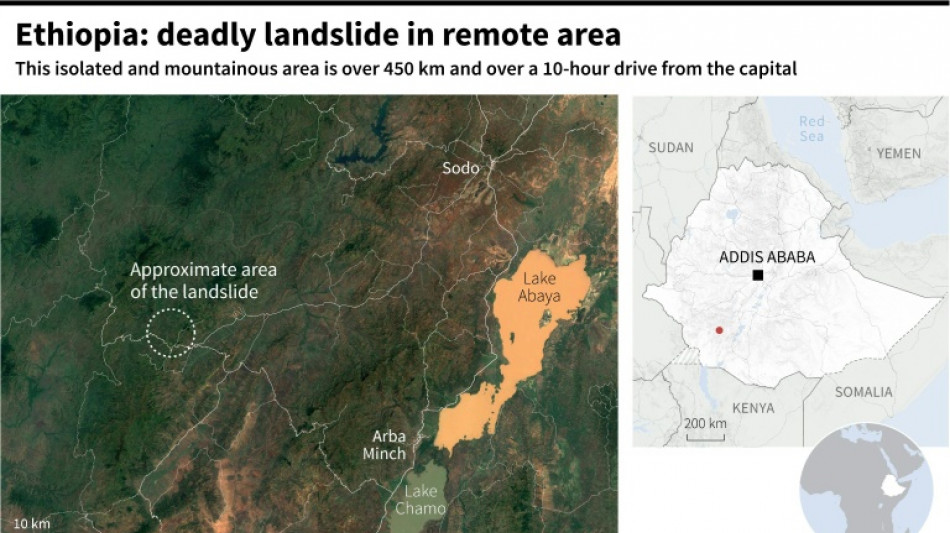
Humanitarian agencies were scrambling Tuesday to send desperately needed aid to a remote area of southern Ethiopia where a landslide has killed more than 200 people in the deadliest such disaster recorded in the Horn of Africa nation.
Crowds gathered at the site of the tragedy in an isolated and mountainous area of South Ethiopia regional state as residents used shovels or their bare hands to dig through mounds of red dirt in the hunt for victims and survivors, according to images posted by the local authority.
So far, 148 men and 81 women are confirmed to have died after the disaster struck on Monday in the Kencho-Shacha locality in the Gofa Zone, the local Communications Affairs Department said.
Images published on social media by the Gofa authority showed residents carrying bodies on makeshift stretchers, some wrapped in plastic sheeting.
Five people had been pulled alive from the mud and were receiving treatment at medical facilities, the government-owned Ethiopian Broadcasting Corporation reported earlier.
It quoted local administrator Dagemawi Ayele as saying that most of the victims were buried after they went to help local residents hit by a first landslide following heavy rains.
Dagemawi said that among the victims were the locality's administrator as well as teachers, health professionals and agricultural professionals.
The UN's humanitarian response agency OCHA said more than 14,000 people had been affected in the hard-to-access area, which is roughly 450 kilometres (270 miles) from the capital Addis Ababa, about a 10-hour drive.
It said support for those affected was mostly being shouldered by the local community but some initial relief items had been sent by federal and regional authorities and local partners, including four trucks of supplies dispatched by the Ethiopian Red Cross for 500 households.
"Agencies are ready to deliver critical supplies, including food, medical items, and water, sanitation and hygiene support," OCHA said, adding that agencies would be assessing the scale of the impact of the tragedy, including displacement and damage to livelihoods.
Ethiopia, the second most populous country in Africa with around 120 million people, is highly vulnerable to climate disasters including flooding and drought.
- 'Landslide engulfed them' -
"I am deeply saddened by this terrible loss," Ethiopian Prime Minister Abiy Ahmed said on X.
"Following the accident, the Federal Disaster Prevention Task Force has been deployed to the area and is working to reduce the impact of the disaster."
World Health Organization chief Tedros Adhanom Ghebreyesus, who is Ethiopian, sent a message of condolence on X and said a WHO team was being deployed to support immediate health needs.
African Union Commission chief Moussa Faki Mahamat also posted a statement on X, saying "our hearts and prayers" were with the families of the victims.
Firaol Bekele, early warning director at the Ethiopian Disaster Risk Management Commission (EDRMC), told AFP that residents had mobilised to try to save lives after four households were initially affected by a mudslide.
"But they too perished when the landslide engulfed them," he said, adding that the commission had sent an emergency team to the area, along with food and other aid for the stricken community.
He said there needed to be a "solid assessment and scientific investigation" into the cause of the landslide.
"An integrated, study-based solution is needed to address the risk permanently. This may include relocating the population."
- Seasonal rains cause havoc -
OCHA said Tuesday that a similar, but lower-scale landslide had occurred in May in the same area, where more than 50 people had died.
Seasonal rains in South Ethiopia state between April and early May had caused flooding, mass displacement and damage to livelihoods and infrastructure, it had said in May.
"This isn't the first time this type of disaster has happened," said an Ethiopian refugee living in Kenya who is from a district located near the site.
"Last year in a similar disaster more than 20 people were killed and before that almost every rainy season people die because of landslides and heavy rains in that area."
In another incident in 2017, at least 113 people died when a mountain of garbage collapsed in a dump in the outskirts of Addis Ababa.
The deadliest landslide in Africa was in Sierra Leone's capital in Freetown in August 2017, when 1,141 people perished.
Mudslides in the Mount Elgon region of eastern Uganda killed more than 350 people in February 2010.
M.Schneider--VB

