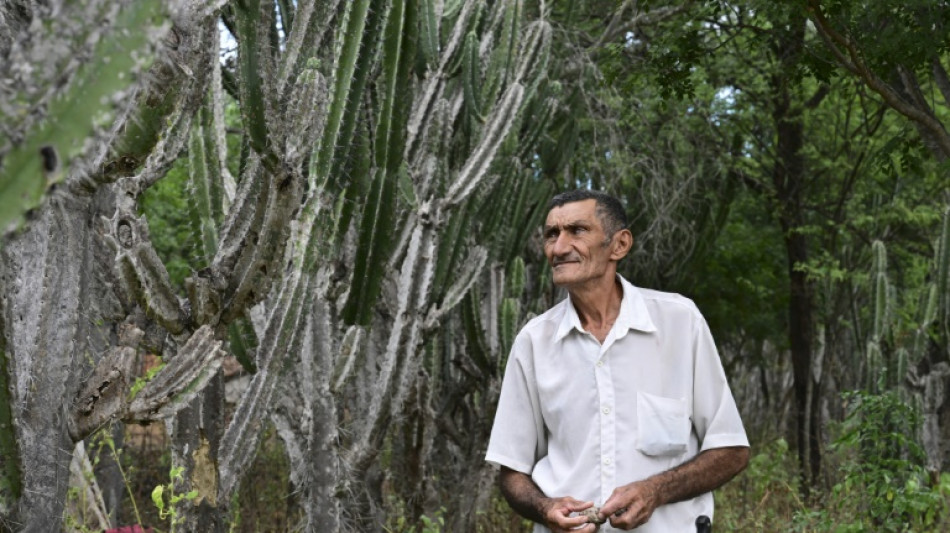
Planting giant cactus to stave off desertification in Brazil / Photo: © AFP

 Eala-conqueror Wang wins Asian Games tennis gold and Olympic berth

 'Kinda cool' Raygun made breakdancing famous, Asian Games B-girls say

 Taiwan gender-row boxer Lin Yu-ting wins 'monumental' Asian Games gold
 Taiwan receives its first US-made F-16V fighter jets
 Lula, Bolsonaro trade scandal fire in final scramble for votes
 Not-so-brave new world: virtual taekwondo makes Asian Games debut

 Arab Israeli candidate drops out of election race

 Israel courts Europe's far right, finding friends but also unease

 Lula, Bolsonaro both snub final debate before Brazil election
 Nepal's grim DNA puzzle to identify flood dead

 EU nations to hold emergency meeting on soaring diesel prices amid US pressure

 Anthropic's Dario Amodei: AI's most visible CEO and enigma

 OpenAI says three staffers fired for mishandling 'sensitive' info

 Nike plans job cuts as it forecasts lower sales

 Ireland game interrupted twice by Gaza protests

 Judge denies acquittal bid by US woman who killed her kids

 Klopp averts crisis with first win as Germany boss

 A saintly spat and debate snub: Brazil enters final campaign stretch

 US tells European allies to act 'immediately' to lower diesel prices

 G20 trade ministers fail to see consensus against overproduction

 Portugal edge Denmark in Ronaldo's absence

 US stocks edge higher as bond yields retreat for now

 US tells European allies to 'immediately' act to lower diesel prices

 Trump vows to hit Iran 'very hard' if linked to flydubai attack

 Williams leaves Spain camp with thigh knock

Giant spiky cacti tower over farmer Alcides Peixinho Nascimento, 70, one of the residents of Brazil's unique Caatinga biome who is on a mission to plant native vegetation in a bid to halt desertification.
"In the absence of laws, it is up to us to act," said Nascimento, who is trying to regenerate his land by planting mandacaru, an emblematic cactus from the region that grows up to six meters tall.
The Caatinga stretches across ten northeastern states, a unique area boasting a tapestry of thorny shrubs, twisty trees and succulents adapted to its semi-arid conditions.
Its plight attracts little interest compared to the lush Amazon, but the vegetation of this dry forest plays a key role in absorbing carbon emissions and is rapidly disappearing.
The MapBiomas NGO reports it has lost 40 percent of its original surface area due to agriculture, mining and the installation of wind farms.
It is in the Caatinga, which has been facing increasingly severe periods of drought, that scientists recently identified the first arid zone in Brazil.
"Preserving the Caatinga means keeping the land alive," said the farmer Nascimento.
Communities are adopting various sustainable farming methods to ensure their survival.
Nascimento's drought-resistant cacti grow fruit that can feed both animals and humans, and protect the soil from the extreme climate.
Their thorns repel predators and are often planted around other crops and native species.
Excess mandacaru production is sold to a French cosmetics brand to make creams and soaps.
- 'Guardians of the Caatinga' -
Luiz Almeida Santos, of the local agricultural NGO IRPAA said the Caatinga was being preserved in areas where "traditional communities live" who adopt sustainable farming practices.
"They are the guardians of the Caatinga".
A recent study predicted nine out of 10 species of fauna and flora in the Caatinga could disappear by 2060.
The IRPAA also teaches local communities how to stretch their water to last through severe drought.
On her land in northern Bahia, Maria Goncalves dos Santos, 60, shows how rainwater is collected and stored in a cistern.
"Here, all the water is reused," she said. Wastewater is filtered and used to water animal pastures.
Goncalves measures the level of the 16,000-liter tank with a ruler and logs her consumption in a notebook.
The government has set up nearly a million tanks like this in the region since 2003.
Installations slowed dramatically under far-right ex-president Jair Bolsonaro, but the program has recently been relaunched under President Luiz Inacio Lula da Silva.
Another threat to the Caatinga is the rural exodus, and the IRPAA has set up a training center where it has taught some 200 young people about sustainable farming methods.
"In our region, we do not have many opportunities, we have to travel to seek knowledge. I am happy to be able to contribute to the well-being of my community," said Anderson Santos de Jesus, 20, who traveled 200 kilometers (124 miles) to reach the training center.
M.Vogt--VB