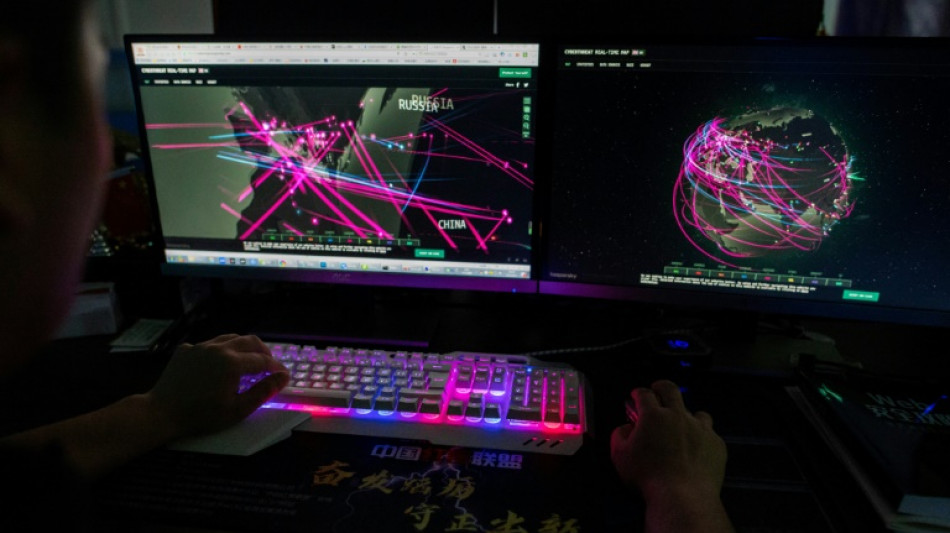
Canadian businesses scrambling to defend against cyberattacks uptick / Photo: © AFP/File

 Brazil's Lula turns 81, vows to work '24 hours a day'

 Boeing releases cautious growth plan as shares fall sharply
 Exiled Russian dissident Navalnaya warns dictators becoming 'more cunning'

 Bayern 'risk' reaps huge reward for Ballon d'Or winner Kane

 Record turnout as Israeli voters deliver verdict on Netanyahu
 Iraola says Isak 'feels the trust' after Liverpool scoring streak

 French media protest manhandling of journalists at far-right party rally

 EU seeks deportation powers for beefed up border agency
 Two charged with UK security offences over airbase plot: police

 Maresca defends Donnarumma, Guehi after Man City defeat
 Nordic leaders call Putin as local truce begins in Ukraine

 Osaka unveils crane outfit in Tokyo before win over Paolini

 Ronaldo in line for Portugal return after fallout with coach

 Norway media take legal action to block Meta from using content

 Bayern praise 'humble' Kane after Ballon d'Or win

 Colts retain Daniel Jones as starter despite continued offensive struggles

 Madushanka wrecks Pakistan as Sri Lanka press for final slot
 Destructive Abhishek 113 leads India to series win over New Zealand

 Norway, Finland leaders hold 'frank and substantive' talk with Putin

 Wall Street faces earnings and Fed tests after turbulent technology-led week

 Ukraine, Russia say US-brokered truce holding in ravaged city

 Police form SIT after vehicles in Rahul Gandhi convoy collide on expressway

 Delhi grants minimum monthly pay and DA to about 4,000 MCD health workers

 Ather Energy shares climb 14% after quarterly profit and expansion plan

 Gold ETF flows turn negative after 13 weeks as bullion loses 4%

Canada's governor general and foreign ministry, hospitals and an airline: a litany of recent cyberattacks has exposed poor defenses against hackers, despite warnings to be more vigilant since Russia's invasion of Ukraine.
Last week, Canada and four other Western countries, including the United States, warned that Russia was preparing to launch massive cyberattacks against Ukraine's allies in retaliation for support for Kyiv and sanctions imposed on Moscow.
On the rise for years and becoming increasingly sophisticated, "thousands" of cyberattacks, including by Russian hacker groups, target Canada every day, according to Cherie Henderson, a senior official at the Canadian Security Intelligence Service.
Canada was second behind Britain in number of reported victims of phishing, spoofing, extortion and other Internet-enabled frauds, according to an FBI report on Internet crimes in 2020. (The report excludes the United States in the list).
The most recent victim was the Canadian airline Sunwing. A cyberattack hit one of its suppliers, causing a breakdown of the airline's operations that left thousands stranded in vacation hotspots in the United States, Mexico and the Caribbean.
Companies may be "caught offguard and see their business activities considerably curtailed," commented Benoit Dupont, a cybersecurity researcher at the University of Montreal.
Some, especially smaller enterprises, "do not always have adequate resources and investing in cybersecurity is not always a top priority," he told AFP.
Just prior to the start of the war in Ukraine in late February, the government's Canadian Center for Cyber Security reminded of the need to protect critical infrastructure from Russian-sponsored cyber threats.
Whether it's industrial espionage, vandalism, theft of intellectual property or proprietary information, frozen accounting systems or even entire computer systems, the risks concern companies of all sizes.
- Finance, energy, telecom targets -
Evan Koronewski, a spokesman for the Communications Security Establishment, said the Canadian electronic eavesdropping agency monitors "cyber threat activity directed at critical infrastructure networks, including those in the financial, energy, and telecommunications sectors."
But, he added, that all sectors "are encouraged to take note and be aware of the possibility of increased cyber threat activity."
Some have taken action, according to Trevor Neiman of the Business Council of Canada, an association representing the nation's biggest employers.
"In the run-up to the to the Russian invasion of Ukraine, Canadian businesses have adopted a heightened state of awareness, and they've taken a number of proactive measures to bolster their cyberdefenses," he said.
Public utility Hydro-Quebec, for example, has stepped up "surveillance specifically for this threat," its spokesman Cendrix Bouchard told AFP.
In Canada, one in four companies reported being hit by cyberattacks in 2021 and more than half paid ransoms to hackers who infected their computer systems with malware, according to a Novipro-Leger survey last fall.
Ransom amounts have been climbing, and can reach several million dollars.
Ottawa announced last year Can$80 million (US$62.5 million) over four years to bolster the nation's cyberdefenses.
But the Canadian Chamber of Commerce said it was not enough, noting that it is a drop in the bucket compared to amounts spent by Canada's G7 peers.
"The United States, Israel, and the UK are investing billions" to boost their cyberdefenses, it said.
Since the start of the pandemic, which saw more people teleworking, ransomware attacks have increased exponentially around the world.
"Malicious cyber actors, whether state sponsored or otherwise, often seek to take advantage of crises," explained BlackBerry's Marjorie Dickman.
"We saw this during the pandemic when threat actors launched repeated Covid-19-themed attacks and sought to leverage security gaps in the work-from-home setting," she said, adding that hackers now use mentions of the war in Ukraine to lure victims.
"You only have to be successfully attacked one time to really hurt your business," warned Rocco Rossi, head of the Ontario Chamber of Commerce, describing it as "an ongoing battle."
"Even after the war in Ukraine ends," he said, "these cybersecurity issues won't go away."
Y.Bouchard--BTB