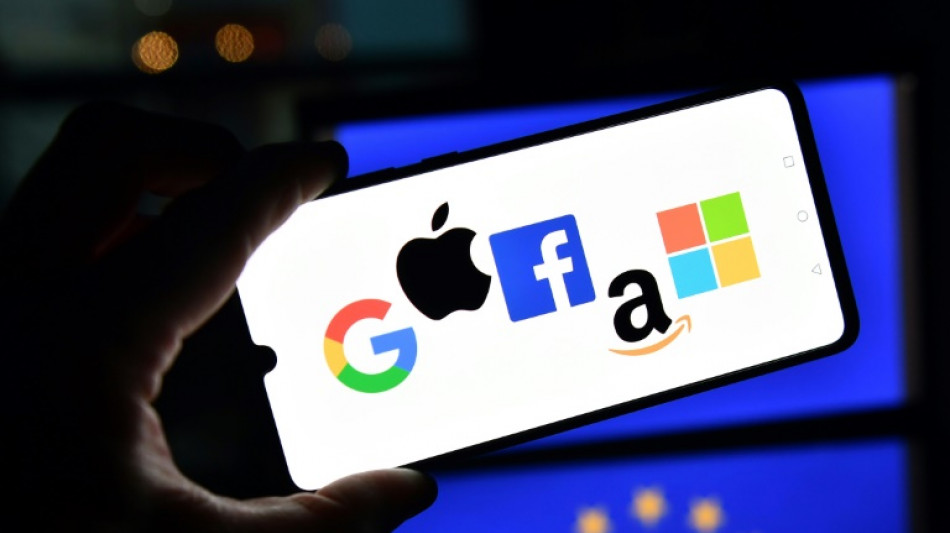
EU agrees deal to tame internet 'Wild West' / Photo: © AFP/File

 Brazil's Lula turns 81, vows to work '24 hours a day'

 Boeing releases cautious growth plan as shares fall sharply

 Exiled Russian dissident Navalnaya warns dictators becoming 'more cunning'

 Bayern 'risk' reaps huge reward for Ballon d'Or winner Kane

 Record turnout as Israeli voters deliver verdict on Netanyahu
 Iraola says Isak 'feels the trust' after Liverpool scoring streak

 French media protest manhandling of journalists at far-right party rally

 EU seeks deportation powers for beefed up border agency

 Two charged with UK security offences over airbase plot: police

 Maresca defends Donnarumma, Guehi after Man City defeat

 Nordic leaders call Putin as local truce begins in Ukraine

 Osaka unveils crane outfit in Tokyo before win over Paolini

 Ronaldo in line for Portugal return after fallout with coach

 Norway media take legal action to block Meta from using content

 Bayern praise 'humble' Kane after Ballon d'Or win

 Colts retain Daniel Jones as starter despite continued offensive struggles

 Madushanka wrecks Pakistan as Sri Lanka press for final slot
 Destructive Abhishek 113 leads India to series win over New Zealand

 Norway, Finland leaders hold 'frank and substantive' talk with Putin

 Wall Street faces earnings and Fed tests after turbulent technology-led week

 Ukraine, Russia say US-brokered truce holding in ravaged city

 Police form SIT after vehicles in Rahul Gandhi convoy collide on expressway

 Delhi grants minimum monthly pay and DA to about 4,000 MCD health workers

 Ather Energy shares climb 14% after quarterly profit and expansion plan

 Gold ETF flows turn negative after 13 weeks as bullion loses 4%

The European Union early Saturday finalised new legislation to require Big Tech to remove harmful content, the bloc's latest move to rein in the world's online giants.
The Digital Services Act (DSA) -- the second part of a massive project to regulate tech companies -- aims to ensure tougher consequences for platforms and websites that host a long list of banned content ranging from hate speech to disinformation and child sexual abuse images.
EU officials and parliamentarians finally reached agreement at talks in Brussels early Saturday on the legislation, which has been in the works since 2020.
"Yes, we have a deal!," European Commissioner for the Internal Market Thierry Breton tweeted.
"With the DSA, the time of big online platforms behaving like they are 'too big to care' is coming to an end. A major milestone for EU citizens," said Breton, who has previously described the internet as the "Wild West".
"Today's agreement on DSA is historic," European Commission chief Ursula von der Leyen tweeted.
"Our new rules will protect users online, ensure freedom of expression and opportunities for businesses. What is illegal offline will effectively be illegal online in the EU."
The regulation is the companion to the Digital Markets Act (DMA), which targeted anti-competitive practices among tech behemoths such as Google and Facebook and was concluded in late March.
The legislation had faced lobbying from the tech companies and intense debate over the extent of freedom of speech.
Tech giants have been repeatedly called out for failing to police their platforms -- a New Zealand terrorist attack that was live-streamed on Facebook in 2019 caused global outrage, and the chaotic insurrection in the US last year was promoted online.
The dark side of the internet also includes e-commerce platforms filled with counterfeit or defective products.
- Obligations for large platforms -
The regulation will require platforms to swiftly remove illegal content as soon as they are aware of its existence. Social networks would have to suspend users who frequently breach the law.
The DSA will force e-commerce sites to verify the identity of suppliers before proposing their products.
While many of the DSA's stipulations cover all companies, it lays out special obligations for "very large platforms", defined as those with more than 45 million active users in the European Union.
The list of companies has not yet been released but will include giants such as Google, Apple, Facebook, Amazon and Microsoft, as well as Twitter and probably the likes of TikTok, Zalando and Booking.com.
These players will be obliged to assess the risks associated with the use of their services and remove illegal content.
They will also be required to be more transparent about their data and algorithms.
The European Commission will oversee yearly audits and be able to impose fines of up to six percent of their annual sales for repeated infringements.
Among the practices expected to be outlawed is the use of data on religion or political views for targeted advertising.
Former Facebook employee Frances Haugen caused a huge stir last year when she accused her former bosses of prioritising profits over the welfare of users.
She hailed in November the "enormous potential" of the European regulation project, which could become a "reference" for other countries, including the United States.
However, the European Consumer Organisation (BEUC) fears the text does not go far enough.
It wants a ban on all advertising based on the surveillance of internet users, and random checks on online vendors' products.
L.Dubois--BTB