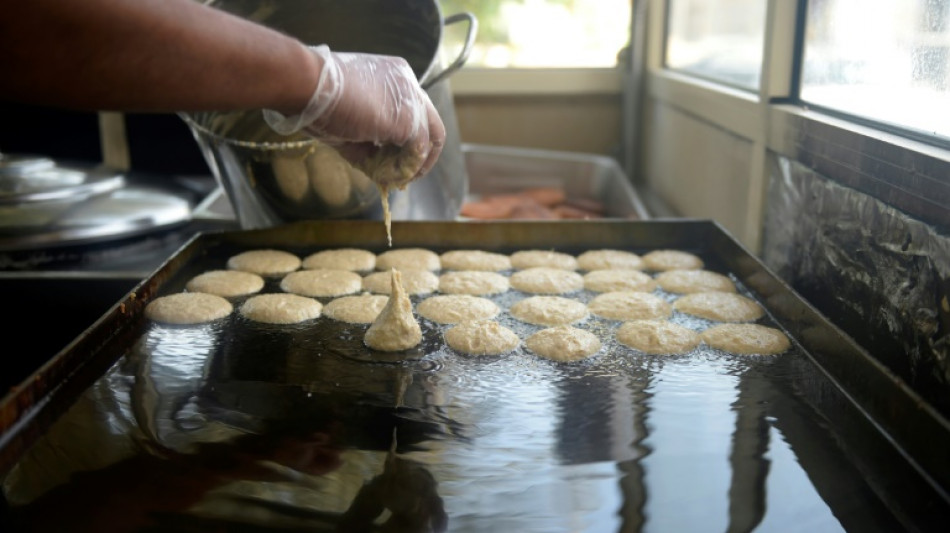
Bahraini artisans toil to preserve sugar-coated tradition / Photo: © AFP

 Brazil's Lula turns 81, vows to work '24 hours a day'

 Boeing releases cautious growth plan as shares fall sharply

 Exiled Russian dissident Navalnaya warns dictators becoming 'more cunning'
 Bayern 'risk' reaps huge reward for Ballon d'Or winner Kane

 Record turnout as Israeli voters deliver verdict on Netanyahu

 Iraola says Isak 'feels the trust' after Liverpool scoring streak

 French media protest manhandling of journalists at far-right party rally

 EU seeks deportation powers for beefed up border agency

 Two charged with UK security offences over airbase plot: police

 Maresca defends Donnarumma, Guehi after Man City defeat

 Nordic leaders call Putin as local truce begins in Ukraine

 Osaka unveils crane outfit in Tokyo before win over Paolini

 Ronaldo in line for Portugal return after fallout with coach

 Norway media take legal action to block Meta from using content

 Bayern praise 'humble' Kane after Ballon d'Or win

 Colts retain Daniel Jones as starter despite continued offensive struggles

 Madushanka wrecks Pakistan as Sri Lanka press for final slot

 Destructive Abhishek 113 leads India to series win over New Zealand

 Norway, Finland leaders hold 'frank and substantive' talk with Putin

 Wall Street faces earnings and Fed tests after turbulent technology-led week

 Ukraine, Russia say US-brokered truce holding in ravaged city
 Police form SIT after vehicles in Rahul Gandhi convoy collide on expressway

 Delhi grants minimum monthly pay and DA to about 4,000 MCD health workers

 Ather Energy shares climb 14% after quarterly profit and expansion plan

 Gold ETF flows turn negative after 13 weeks as bullion loses 4%

Bahrainis with a sweet tooth have long been spoiled for choice between a wide array of dessert franchises, but traditional confectioners still hold their ground, especially during Ramadan.
At the back of his modest shop in the capital Manama, Mohammed Gharib stirs a thick mixture of sugar, saffron and freshly blanched almonds, transforming it into a uniquely Bahraini version of the ubiquitous Middle Eastern dessert: halva.
"Bahrain became famous for its confectioneries by being a pioneer in this industry in the Gulf region," Gharib told AFP, adding that their popularity of its establishments "continues until today".
Clad in Bahrain's traditional "shemagh" headdress and white "dishdasha" robe, the 70-year-old runs one of the country's oldest confectioneries, named after its founder Hussain Mohammed Showaiter, who established it in 1850.
"Hussain Mohammed Showaiter was keen to develop this craft, and passed it on to his children and grandchildren," Gharib said.
As Bahrainis celebrate Ramadan along with the rest of the Muslim world, the holy month is a period of appreciation for traditional sweets.
For Mohammed al-Fardan, the familiar Bahraini confections remain a fixture on tables for the iftar meal, in which the faithful break their dawn-to-dusk fast.
"Their presence is a reminder of Bahrain's heritage and sense of hospitality," the 51-year-old banker explained.
Though the Gulf region has been swept by a deluge of fast food chains, Fardan is quick to point out that "modern sweets contain preservatives, unlike traditional confectionery".
- 'Main food' -
But while the preservation of heritage is at the heart of the confectioners' craft, they are not averse to innovating to appeal to a younger clientele.
Saleh al-Halwaji, who works in his family-owned shop, says: "My father used to work in confectionery and I used to help him after school.
"Today, we work in the same field with our own children," he said.
Halwaji says he "strives to evolve the sweets and keep up with the times while maintaining their popular character".
"We still make everything ourselves and perhaps that is what attracts so many of our customers, who come to buy sweets but also to watch us make them behind the glass," he said.
Dalal al-Shrouqi, an expert in Bahrain's popular heritage, says that "today, technology helps us disseminate everything we want to preserve of our popular heritage by making it known to future generations".
Shrouqi, who has written several books on her country's traditional cuisine, said that while innovative twists are popular, people still prefer "the sweets in their traditional form".
"Things evolve, but the original is still the basis."
G.Schulte--BTB