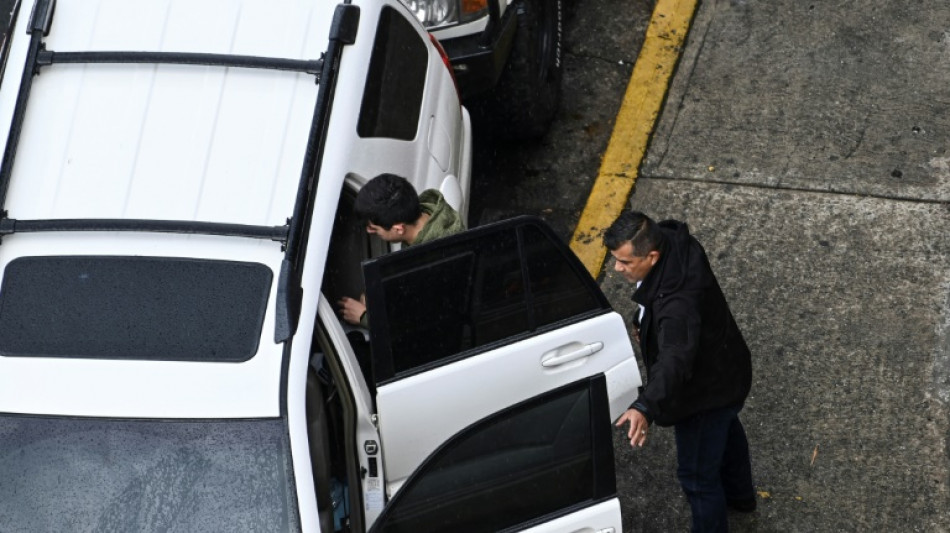
Bodyguards a status symbol amid Venezuela's crime and poverty / Photo: © AFP

 Brazil's Lula turns 81, vows to work '24 hours a day'
 Boeing releases cautious growth plan as shares fall sharply
 Exiled Russian dissident Navalnaya warns dictators becoming 'more cunning'
 Bayern 'risk' reaps huge reward for Ballon d'Or winner Kane
 Record turnout as Israeli voters deliver verdict on Netanyahu
 Iraola says Isak 'feels the trust' after Liverpool scoring streak

 French media protest manhandling of journalists at far-right party rally
 EU seeks deportation powers for beefed up border agency
 Two charged with UK security offences over airbase plot: police
 Maresca defends Donnarumma, Guehi after Man City defeat
 Nordic leaders call Putin as local truce begins in Ukraine

 Osaka unveils crane outfit in Tokyo before win over Paolini

 Ronaldo in line for Portugal return after fallout with coach

 Norway media take legal action to block Meta from using content

 Bayern praise 'humble' Kane after Ballon d'Or win

 Colts retain Daniel Jones as starter despite continued offensive struggles

 Madushanka wrecks Pakistan as Sri Lanka press for final slot
 Destructive Abhishek 113 leads India to series win over New Zealand

 Norway, Finland leaders hold 'frank and substantive' talk with Putin
 Wall Street faces earnings and Fed tests after turbulent technology-led week

 Ukraine, Russia say US-brokered truce holding in ravaged city

 Police form SIT after vehicles in Rahul Gandhi convoy collide on expressway

 Delhi grants minimum monthly pay and DA to about 4,000 MCD health workers

 Ather Energy shares climb 14% after quarterly profit and expansion plan

 Gold ETF flows turn negative after 13 weeks as bullion loses 4%

In a rich neighborhood east of Caracas, a bodyguard flashes his rifle as a private armored car with dark tinted windows speeds away under his intimidating watch.
In Venezuela, one of the most violent countries in the world, having an armed escort has long been a shield against kidnapping, and worse.
Today, it is increasingly also a display of status.
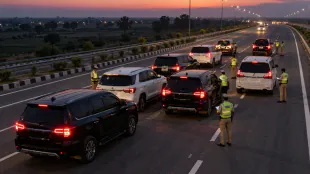
In the well-to-do neighborhoods of the capital, two-car convoys of armored 4X4s without number plates are a common sight, disregarding speed limits and red traffic lights.
They zigzag through traffic with blaring sirens and flashing red and blue lights, almost like police fleet.
Some are accompanied by a motorcycle for a quick getaway, if needed.
Who is the precious cargo?
Members of Venezuela's moneyed class -- public officials or entrepreneurs, especially those colloquially referred to as the "enchufados" (plugged-ins) for their profitable business dealings, often illicit, with the government.
- 'A need for status' -
Venezuela is among the globe's top seven most violent countries, according to a World Bank report based on 2018 data.
Last year, criminals committed 8.5 murders every day, according to the Venezuela Violence Observatory, an NGO.
But the murder rate is slowly declining, from a high of 63.3 "intentional homicides" per 100,000 people in 2014 to 36.7 per 100,000 in 2018, according to World Bank figures.
Kidnapping -- one of the main causes of an explosion of private security guards and armored convoys about eight years ago -- is also on the decline, partly due to tougher police and military action against criminal gangs.
And in a country where violence has become a part of life, "the bodyguard today represents less a need for security, more a need for status," criminologist Javier Gorrino told AFP. "The more guards you have, the higher your economic and political level."
- Bag carriers -
Outside restaurants and shopping malls, it is common to see dozens of bodyguards waiting by their bosses' cars.
Some accompany their clients to the shops or hairdresser, even carry their bags.
With civilians legally prohibited from carrying firearms since 2019, the booming security trade has been a boon for police and soldiers who work part-time as bodyguards, using their service pistols -- which is legal.
They can earn "six, seven times their salary," according to Gorrino.
At the tender age of 21, Angel Pinto has left behind a paramedic career to become a bodyguard.
"I come from a family of police officers," he told AFP, and therefore "felt comfortable" with the transition that allowed principally "to earn more."
Sarkis Sako, an instructor who has been working in private security for 14 years, said a bodyguard can earn between $300 and $500 a month, compared to a beginner cop salary of about $114.
For the privilege, a bodyguard "has to be prepared to give his life for his client," said Sako, who teaches hand-to-hand combat, target shooting and other skills.
A basic protection service, with two bodyguards, will cost a client about $3,000 a month, said Sako, in a country where three in four people live in extreme poverty.
The official minimum salary in Venezuela is about $30 a month.
L.Janezki--BTB