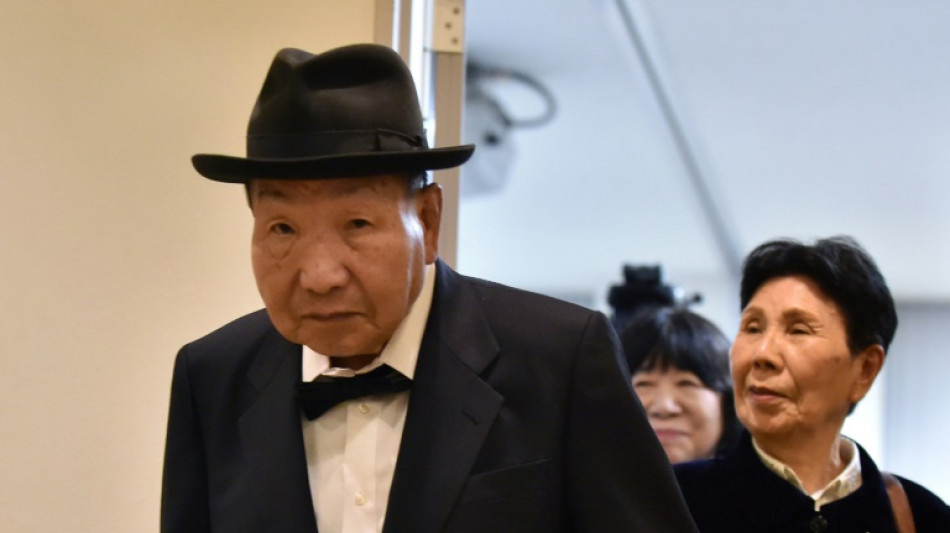
Death penalty sought again for 88-year-old in Japan murder saga / Photo: © AFP/File

 Southampton boss Eckert given suspended ban over 'Spygate'

 Russia warns of 'false' information as second plague case reported

 IEA ready to release more oil reserves if necessary
 HSBC 'consults' over UK unit job cuts amid AI adoption

 UK court quashes five ex-traders' Libor rate rigging convictions
 XM Receives “Global Customer Experience Leader Award 2026” at the TrustFinance Performance Awards

 Stocks slide as oil climbs on Mideast flareup
 Heavy casualties in Ukraine after Russian strikes

 French wine harvest set to hit historic low

 Kyiv 'cannot agree' to EU membership limiting food exports: minister

 Arteta targets more Arsenal glory after signing new deal until 2030

 Russell hit with Singapore grid penalty for taking new power unit

 Spotify expands audiobooks to more than 180 markets

 French-Japanese duo wins chemistry Nobel for solving molecular 'mystery'

 England's Nations League surge helps heal World Cup wounds

 Mayor of opposition stronghold Izmir defects to Erdogan party

 Mertens beats Gauff to set up Swiatek clash at China Open
 Benin full of pride at role in Messi's last dance

 France suspends stun grenade use at student protests ahead of PM speech

 Indonesian court hears 'negligence' complaint against state over fires, haze

 Rubio in Greece to urge against Western civilisation 'decline'

 Micron workers at Taiwan plant vote in favour of strike

 In 'The Social Reckoning,' Jeremy Allen White takes on Facebook's 'frightening' ambition

 Chip industry activists call for South Korea to recognise cancer cases

 Famine-scarred southern Madagascar braces for El Nino
Japanese prosecutors again sought the death penalty in the retrial on Wednesday of an ex-boxer who was the world's longest-serving death row prisoner until his release in 2014, local media reported.
Iwao Hakamada, now 88, spent 46 years on death row -- a stretch recognised by Guinness World Records -- after being convicted in 1968 of robbing and murdering his boss, the man's wife and their two teenage children.
He was freed in 2014 and a retrial was ordered after a court said investigators could have planted evidence, sparking relief among his family and supporters who included other boxers and rights group Amnesty International.
However, prosecutors argued at the retrial in Shizuoka, south of Tokyo, that Hakamada's guilt could be proven "beyond reasonable doubt", the Asahi Shimbun daily said.
Defence lawyers are seeking an acquittal for Hakamada, whose case has become a famous saga in Japan.
The retrial began last year and the court is expected to announce the verdict in the months ahead, Japanese media said.
Japan is the only major industrialised democracy other than the United States to retain capital punishment, which has broad public support.
Hakamada's supporters say his decades of detention, mostly in solitary confinement with the ever-present threat of execution, took a heavy toll on his mental health.
Hakamada said in a 2018 interview with AFP he felt he was "fighting a bout every day".
- Prolonged battle -
He initially denied the charges but then confessed, following what he later described as a brutal police interrogation that included beatings.
His attempts to retract his confession were in vain and his original verdict was confirmed by the Supreme Court in 1980.
But Hakamada continued to maintain his innocence. His sister Hideko, now 91, has tirelessly pleaded for a review of the case.
A district court in Shizuoka granted a retrial in 2014 after a prolonged battle and issued a stay for Hakamada's incarceration and the death penalty.
Tokyo's High Court overturned the lower court ruling four years later.
But the legal back-and-forth wasn't over: in 2020, the Supreme Court ruled that the Tokyo High Court must reconsider its decision and the High Court ordered a retrial last year.
Hakamada's plight has attracted deep public sympathy, with even national lawmakers forming a special group to offer their support.
Hideko took the central role in her sickly brother's defence during the retrial.
One key piece of evidence used to convict Hakamada was a set of blood-stained clothes that emerged more than a year after the crime.
Supporters say the clothes did not fit him and the bloodstains were too vivid given the time that had elapsed.
Just nine percent of Japanese people were in favour of abolishing the death penalty in a 2019 government survey.
Death sentences are always carried out by hanging in Japan. There were 107 prisoners on death row as of December.
Inmates are often informed of their impending death at the last minute, typically in the early morning just a few hours before it happens.
Some "may be given no warning at all", Amnesty International said in a report.
K.Sutter--VB