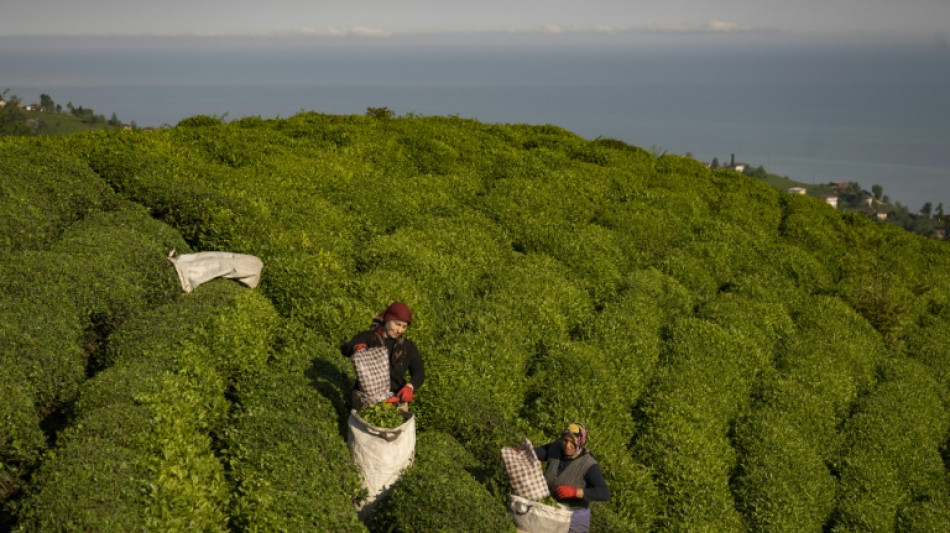
Fear brews in Turkey's landslide-plagued tea hills / Photo: © AFP

 Southampton boss Eckert given suspended ban over 'Spygate'

 Russia warns of 'false' information as second plague case reported

 IEA ready to release more oil reserves if necessary
 HSBC 'consults' over UK unit job cuts amid AI adoption

 UK court quashes five ex-traders' Libor rate rigging convictions

 XM Receives “Global Customer Experience Leader Award 2026” at the TrustFinance Performance Awards

 Stocks slide as oil climbs on Mideast flareup

 Heavy casualties in Ukraine after Russian strikes

 French wine harvest set to hit historic low

 Kyiv 'cannot agree' to EU membership limiting food exports: minister

 Arteta targets more Arsenal glory after signing new deal until 2030

 Russell hit with Singapore grid penalty for taking new power unit

 Spotify expands audiobooks to more than 180 markets

 French-Japanese duo wins chemistry Nobel for solving molecular 'mystery'

 England's Nations League surge helps heal World Cup wounds

 Mayor of opposition stronghold Izmir defects to Erdogan party

 Mertens beats Gauff to set up Swiatek clash at China Open

 Benin full of pride at role in Messi's last dance

 France suspends stun grenade use at student protests ahead of PM speech

 Indonesian court hears 'negligence' complaint against state over fires, haze
 Rubio in Greece to urge against Western civilisation 'decline'
 Micron workers at Taiwan plant vote in favour of strike

 In 'The Social Reckoning,' Jeremy Allen White takes on Facebook's 'frightening' ambition

 Chip industry activists call for South Korea to recognise cancer cases

 Famine-scarred southern Madagascar braces for El Nino

Every time it rains heavily in Turkey's spectacular Black Sea tea growing region -- where it rains a lot -- Zikrullah Komurcu starts to worry.
Last August he was almost swept away by a mudslide when a tea garden above his home in the village of Abdullahhoca began to slide down the mountain during a downpour.
The house above his was destroyed with part of the field ending up in his kitchen.
"It's a miracle that no one was killed," Komurcu told AFP, an electricity pylon still perched dangerously over his mud-splattered home.
The tea-growing province of Rize in Turkey's northeast has been repeatedly hit by major landslides over the last 50 years.
Nearly twice as wet as Ireland, with 2.2 metres (86 inches) of annual rainfall, the Turkish disaster agency AFAD said last year alone there were 355 serious landslides there affecting homes.
And it is going to get worse, experts warn, with climate change making the Black Sea warmer and rainstorms even more violent, putting still more pressure on the soil.
- Dangerous monoculture -
Hakan Yanbay, of the province's chamber of geological engineers, said the "uncontrolled" construction of roads cut into the sides of mountains to link its scattered villages has exacerbated the problem.
They undermine the stability of the soil of the mountainous region, 80 percent of which is made up of steep hillsides.
Yanbay blames the spread of tea plantations over the last century for much of the soil erosion. Long encouraged by the state, they now take up a staggering 90 percent of the region's agricultural land.
While no one has died in a landslide in Rize in nearly three years, three workers were swept away in one in neighbouring Trabzon province in March -- 40 kilometres (25 miles) from Abdullahhoca.
But painful memories of other disasters that have claimed 130 lives in Rize since the 1960s are never far from the surface.
"We are going to prevent the floods and landslides that we have been experiencing in the Black Sea region for years," Turkish President Recep Tayyip Erdogan -- whose family comes from Rize -- vowed in April.
After six villagers were killed in floods and mudslides in 2021, Erdogan called for a ban on "five- to 10-storey buildings being put up on hillsides".
The president was scathing about the damage being done. "Look at what nitrogen fertilisers are doing to the tea gardens," he said on a visit to Rize after that disaster. "They turning the soil into mud," he added.
- 'Man-made disasters' -
But three years later "no serious measures have been taken", insisted Tahsin Ocakli, the only opposition MP in the province dominated by Erdogan's AK party.
Ocakli, who has demanded a parliamentary inquiry, said that "these events, which are now happening several times a year, are no longer natural catastrophes but man-made disasters."
The Rize chamber of agriculture raised the alert about discounted nitrogen fertilisers being sold in February, warning they were likely to further undermine the soil.
But experts say the real problem is the tea plants themselves whose roots are not deep enough to stabilise the ground.
They recommended planting trees like poplars and eucalyptus whose deeper roots absorb more water.
To try to reduce the risks, the authorities have begun building drainage channels and retaining walls below some tea gardens.
A concrete barrier has been built to protect the home of Zikrullah Komurcu's nephew, who lives near him in Abdullahhoca.
Komurcu and his wife Medine are waiting for a similar one to shield them.
"Every time it rains we wonder if there will be another landslide," Medine said. "I don't sleep anymore -- we're afraid."
E.Burkhard--VB