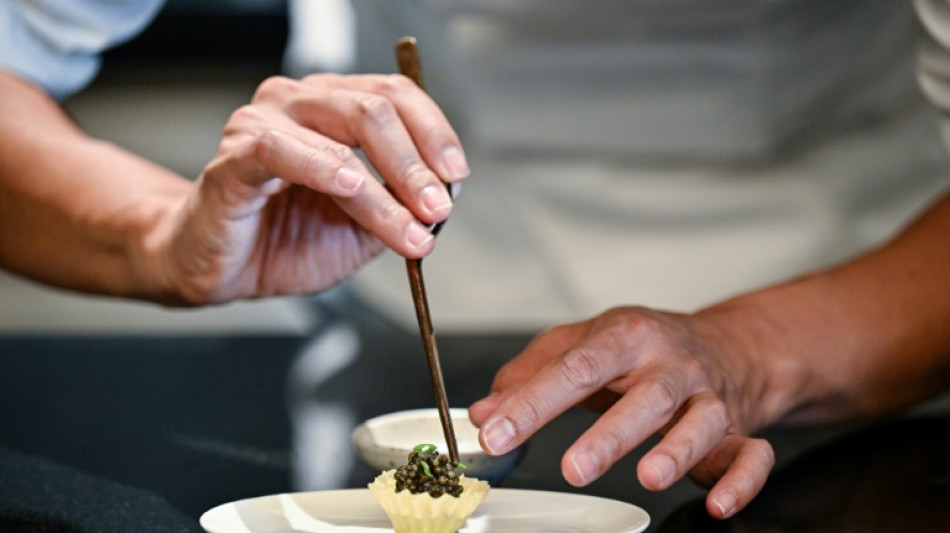
Thai... caviar? Farm produces delicacy in tropical climate / Photo: © AFP

 Iraola says Isak 'feels the trust' after Liverpool scoring streak

 French media protest manhandling of journalists at far-right party rally

 EU seeks deportation powers for beefed up border agency

 Two charged with UK security offences over airbase plot: police

 Maresca defends Donnarumma, Guehi after Man City defeat
 Nordic leaders call Putin as local truce begins in Ukraine
 Osaka unveils crane outfit in Tokyo before win over Paolini

 Ronaldo in line for Portugal return after fallout with coach

 Norway media take legal action to block Meta from using content

 Bayern praise 'humble' Kane after Ballon d'Or win

 Colts retain Daniel Jones as starter despite continued offensive struggles

 Madushanka wrecks Pakistan as Sri Lanka press for final slot

 Destructive Abhishek 113 leads India to series win over New Zealand

 Norway, Finland leaders hold 'frank and substantive' talk with Putin

 Wall Street faces earnings and Fed tests after turbulent technology-led week

 Ukraine, Russia say US-brokered truce holding in ravaged city
 Police form SIT after vehicles in Rahul Gandhi convoy collide on expressway

 Delhi grants minimum monthly pay and DA to about 4,000 MCD health workers

 Ather Energy shares climb 14% after quarterly profit and expansion plan

 Gold ETF flows turn negative after 13 weeks as bullion loses 4%

 Pakistan's last antique restorers give old treasures new life

 India braces for Cyclone Arnab with evacuations

 Steel Strips Wheels gains 36% in two sessions on growth outlook

 Cavs edge T'Wolves in overtime despite superb Edwards

 Prescott fires Cowboys to 38-21 win over plummeting Eagles

At his upmarket Bangkok restaurant, Michelin-starred chef Thitid "Ton" Tassanakajohn spoons black caviar onto a plate, adding the newly affordable Thailand-made delicacy to his reinterpreted traditional family recipes.
The luxury food, better associated with chilly northern nations, is breaking into the Southeast Asian country's fine-dining scene, with the 37-year-old celebrity cook able to economically serve the roe thanks to an innovative farm outside the capital.
Using high-tech harvesting methods, a Thai-Russian partnership is offering a more ethical and affordable product, sparing the endangered fish that provide the delicacy from their usual fate of death.
"The price is... more affordable, I would say, compared to the ones that we imported," Ton explained, as he sprinkled caviar over Thai dip "Lhon Pu" at his restaurant Lahnyai Nusara.
Using caviar also helps challenge perceptions that Thai cuisine must always be spicy with strong flavours, he added.
"I think it's opened many doors for many chefs to use it as well," he said.
- Cool fish -
Roughly 200 kilometres away at the popular seaside resort town of Hua Hin, it is time to harvest "black gold" at the Thai Sturgeon Farm, which supplies local distributor Caviar House.
Hundreds of the giant fish swim in tanks kept at a balmy 21 degrees Celsius (70 Fahrenheit) -- a world away from the chilly Caspian Sea where the species live in the wild.
"No one else has this kind of farm in a tropical climate," the farm's co-owner Alexey Tyutin told AFP.
The fish -- considered living dinosaurs -- can survive for up to 100 years and are typically up to four metres long.
Traditionally caviar producers kill the female fish to extract the eggs, but Tyutin's farm "milks" the sturgeon.
Using the fish for as long as possible helps make the venture sustainable and profitable, the 55-year-old said.
During harvesting, fish are moved to the "winter room", initially set at six degrees Celsius and increased to 15, before their eggs are extracted.
"Let's say if the fish weighs 25 kilograms, we usually expect about 2.6 to 2.7 kilograms of caviar," Tyutin said, adding that the farm estimates it may produce up to two tonnes this year.
Breeding sturgeons in a simulated environment requires vast amounts of energy -- despite the use of solar panels, the monthly electricity bill is almost $9,000.
"We are chilling down the water because the water temperature outside is 31 degrees. These fish can't tolerate it and they will die immediately," Tyutin said.
But Thailand's tropical climate has given the business a competitive advantage as the higher water temperature helps sturgeons mature at six years old compared to 11 in Russia.
- Thai pride -
While Caviar House is only selling domestically at the moment -- with a tin of the delicacy retailing for between $230 and $832 -- they hope to expand to exporting in the future.
Recent European Union sanctions against Moscow over the Ukraine invasion have targeted caviar, but the restrictions are largely symbolic as Russia is only a small exporter.
Instead, competition comes from China, which has become the market giant, producing 84 percent of the world's sturgeons, according to a European Commission report.
The industry suffered during the pandemic with high-end restaurants, airlines and cruise ships battered by travel curbs, although some fine-dining establishments adapted by decreasing portions and incorporating them into takeaway meals.
But the international caviar market is expected to record a compound annual growth rate of seven percent between 2020 and 2025, according to a 2021 report by Technavio Research.
France, Germany, China, Spain, the United States, Japan and Russia are major markets but demand is fast growing in other parts of the Asia-Pacific region.
Well-heeled Thai foodies and chefs are recognising the benefits of caviar, rich in vitamins, minerals, and omega-3 fatty acids.
"It took only a few days for Thai chefs to start ordering after we sent samples for them to try," farm co-owner Noppadon Khamsai, 43, told AFP.
"They say this is a good product and the importance is it's made in Thailand, and they're really proud to be presenting this Thai product."
L.Janezki--BTB