Cartel war rocks Mexico's Baroque jewel Zacatecas / Photo: ©

 Germany, EU, stable investment stops despite upheaval: Merz

 China brands drop Mbappe for 'offending national sentiments'
 India orders evacuations as Cyclone Arnab looms

 Dutch broadcaster pulls out of Eurovision over Israel 'sensitivities'

 Critical coal inventories affect nearly half of India’s domestic power plants

 FCNR(B) deposit drive puts sharper margin pressure on private banks

 Noel Tata requests records of September 17 Tata Sons board meeting

 Reparations calls to dog King Charles's tough Caribbean trip

 Global rates and foreign outflows remain key risks for Indian markets

 Neha Nagar says ₹3 crore can fund retirement with disciplined planning

 Vikas Satija says steady SIP flows shielded Indian equities from deeper losses

 Brewers rout Rays to reach brink of World Series sweep

 Mbappe dropped by Chinese brands for 'offending national sentiments'

 Kuwait exhibition presents Ukraine’s Islamic heritage and cultural ties

 Tech firms track Wall St rally on mixed day for Asian markets

 Jay-Z to perform at Super Bowl LXI halftime show: NFL

 Climate-threatened Fijian utopia rejects calls to relocate

 Israel to give verdict on Netanyahu in pivotal election

 $1m bounties, dawn arrests: Trump presses voter fraud campaign

 Gasping for air: Borneo residents struggle as island burns
 Doha exhibition charts a millennium of Chinese maritime ceramics trade
 New Zealand ex-PM Ardern to teach leadership in Sydney

 Ballon d'Or 'beyond wildest dreams' but Kane has plenty more to prove
 No envy, no secrets: How Spain's Gipuzkoa became football coaching hotbed

 South Korea economy grows three times faster than expected in Q3

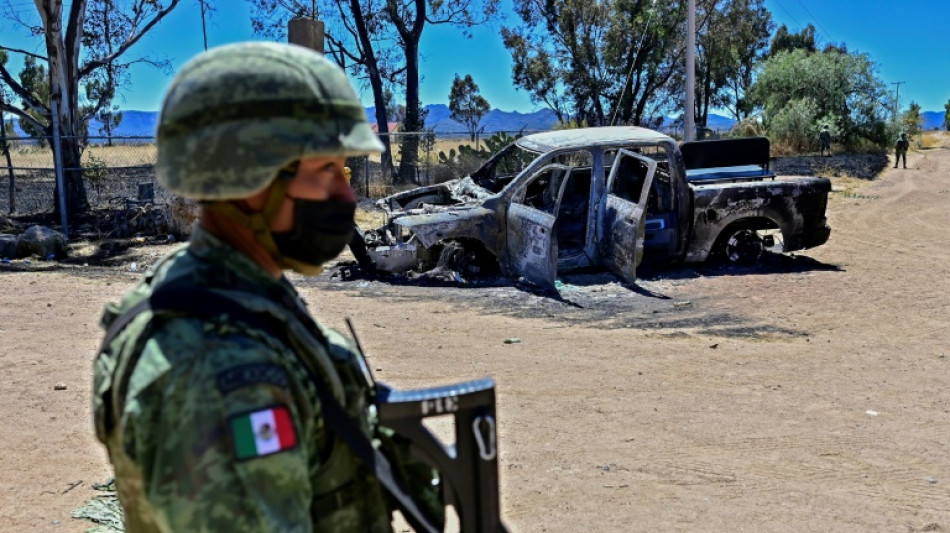
Escorted by heavily armed soldiers, a Mexican farmer returns to his ransacked ranch house near the front line of a war between drug cartels, whose acronyms are scrawled on bullet-pocked walls.
Recently recaptured by the security forces, Palmas Altas in the northern state of Zacatecas is now a ghost town, apart from a few well-fed dogs walking under a blazing sun.
A burnt-out pickup truck is left abandoned at the entrance to the village, which sits on an arid plateau at the foot of mountains.
Graffiti signed "CJNG" warns that the area is under the control of the Jalisco New Generation Cartel, whose leader Nemesio "El Mencho" Oseguera is one of the United States' most-wanted fugitives, with a $10 million bounty on his head.
On a nearby wall, the acronym "CJNG" has been crossed out with black paint to make way for the letters "CDS" -- imprisoned drug kingpin Joaquin "El Chapo" Guzman's Sinaloa cartel.
Since 2020, the two cartels have been fighting over Palmas Altas and Zacatecas -- whose main city is a colonial center known for its Baroque-style architecture -- with the state's drug trafficking routes towards the United States, as well as ports on the Pacific and Gulf of Mexico coasts.
- 'Leave or die' -
Life in the town took a violent turn for the worse in February last year, says Miguel, a farmer in his 40s whose name AFP has changed to protect his identity.
"They started kidnapping and beating people. They killed a man and his son. Fear made us leave," he says.
A year later, there were only five families left.
Then came a chilling warning: "Either you leave or you'll die."
The message was heard loud and clear -- the village has been completely deserted since February.
Miguel took refuge in Jerez, 20 kilometers (12 miles) away. Thanks to the deployment of the security forces, he hopes to be able to prune his fruit trees.
"Because alone, we cannot," he says.
A total of 2,000 people have been displaced in the region, according to the authorities.
"We want them to return home," Jerez security secretary Marco Vargas says in his office in the town, which draws tourists with its cobbled streets and ornate churches.
"We're going to maintain the forces of order to prevent possible incursions or a return of organized crime," he adds.
That is little comfort to Nancy Reyes, whose son disappeared in mid-2021 on his way to see his fiancée.
"Nobody helps us," Reyes says.
The teenager is one of the more than 95,000 people missing in Mexico.
The uncertainty is "continuous torture" for families, says Ricardo Bermeo Padilla, representative of a group for tracing missing persons.
- 'Provocation' -
Insecurity is nothing new for Zacatecas, which was a battleground between the Gulf Cartel and ultra-violent Los Zetas in the 2010s.
Since the Jalisco and Sinaloa cartels arrived to fight for control, violence has been a daily occurrence.
In January, 10 bodies were found in an abandoned sports utility vehicle in front of the governor's palace in the historic center of Zacatecas.
President Andres Manuel Lopez Obrador described the dumping of bodies in such a public place as a "provocation."
In his red-stone cathedral with its finely carved facade, Zacatecas bishop Sigifredo Noriega Barcelo confides after the Sunday sermon that he would like to speak with "people who do evil."
But, he adds, "unfortunately, there are no interlocutors. There are many groups, which divide and subdivide."
In the tightly secured city center, Mexican tourists take the cable car up to a viewing point to look down on Zacatecas, whose historic heart is a UNESCO World Heritage site.
In the evening, lovers kiss, while a clown makes hundreds of children laugh on steps next to the cathedral.
There is more to Zacatecas than the cartel war, says Rosita Franco, director of the Guadalupe Museum, inviting visitors to return for a Baroque festival in September.
Even Spain's King Felipe VI lingered while admiring the museum's extensive 16th-19th century library collection and its galleries during a visit in 2015 with Queen Letizia, she recalls.
Franco prefers not to talk about the violence that strikes as far as Guadalupe on the outskirts of Zacatecas city.
"We believe in the culture of peace. We believe that art changes lives and that art and culture are human rights," she says.
L.Janezki--BTB