'Maladaptation': how not to cope with climate change / Photo: ©

 Brewers rout Rays to reach brink of World Series sweep

 Mbappe dropped by Chinese brands for 'offending national sentiments'
 Kuwait exhibition presents Ukraine’s Islamic heritage and cultural ties

 Tech firms track Wall St rally on mixed day for Asian markets

 Jay-Z to perform at Super Bowl LXI halftime show: NFL
 Climate-threatened Fijian utopia rejects calls to relocate

 Israel to give verdict on Netanyahu in pivotal election

 $1m bounties, dawn arrests: Trump presses voter fraud campaign
 Gasping for air: Borneo residents struggle as island burns
 Doha exhibition charts a millennium of Chinese maritime ceramics trade
 New Zealand ex-PM Ardern to teach leadership in Sydney

 Ballon d'Or 'beyond wildest dreams' but Kane has plenty more to prove
 No envy, no secrets: How Spain's Gipuzkoa became football coaching hotbed
 South Korea economy grows three times faster than expected in Q3

 Al-Thawadi urges technology to deepen human connection through shared experiences
 Ballon d'Or: Harry Kane's crowning moment

 Harry Kane wins men's Ballon d'Or

 Lula win rattles Brazil markets over spending spree fears

 De la Fuente wins men's Ballon d'Or coach of year

 Trump slams 'rigged' Brazil election after ally loses to leftist Lula

 Nadal returns for Vegas hardcourt event
 Fainga'anuku named as loose forward for All Blacks northern tour
 Anthropic points to AI dangers, soaring sales in IPO filing

 Sinner to play rescheduled Saudi Six Kings in December
 Brazilian lawmaker Andre Janones, Lula's social media 'general'

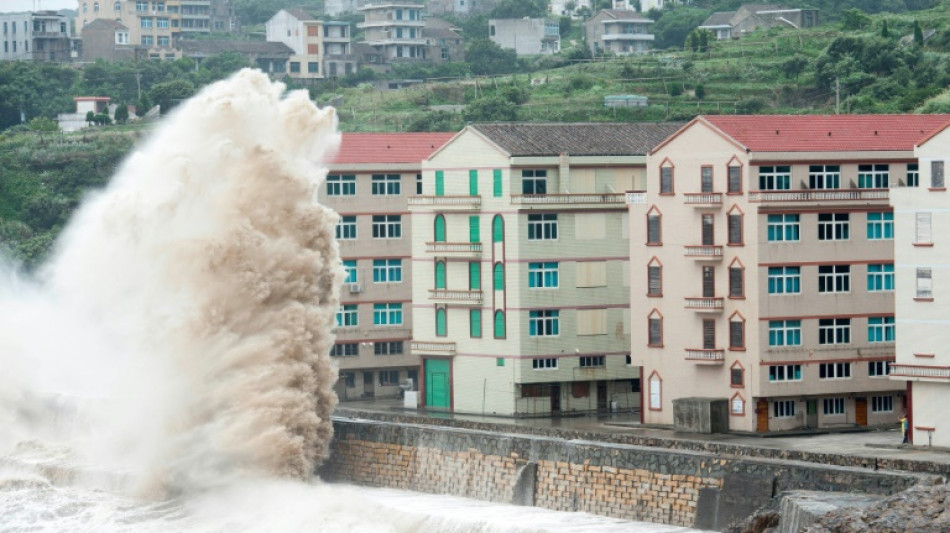
A crescendo of deadly extreme weather is outpacing preparations for a climate-addled world, according to a landmark UN assessment of climate impacts released this week.
Whether it is sustainable farming or bioengineered crops to boost food security; restoring mangrove forests or building sea dams to buffer rising oceans; urban green corridors or air conditioning to temper killer heatwaves -- the search for ways to cope with the fallout of global heating has become urgent.
"At current rates of adaptation planning and implementation, the adaptation gap will continue to grow," the Intergovernmental Panel on Climate Change warns.
At the same time, however, the 3,650-page IPCC report raises red flags about how schemes to deal with climate impacts can go wrong.
There's even a word for it: "maladaptation".
"We're finding that there are many cases in which adaptation projects don't work," said Clark University professor Ed Carr, lead author of a chapter in the IPCC report on climate resilient development. "Some have actually made things worse."
Building a dam, for example, to prevent urban flooding may help protect a small area for a limited time period.
"But if the measure you put in place has negative consequences along the rest of the river and makes things worse in the long run, that's maladaptation," said Imperial College London's Friederike Otto.
Otto, a pioneer in quantifying the extent to which climate change makes extreme weather more likely or intense, said people often fail to recognise the role bad choices -- building houses in a flood plain, for example -- play in disasters.
- Lack of data -
"Just blaming climate change alone can lead to maladaptation," she told AFP.
Sometimes coping measures have unintended consequences.
Kwame Owusu-Daaku, an assistant professor at the University of West Florida, investigated the aftermath of sea barriers erected in front of a modest fishing village near the Volta River estuary in Ghana to prevent beach erosion due to storm surges and rising seas.
The sea walls worked. In fact they worked so well that a large real estate developer -- hand in glove with the local government -- took over the land to build luxury, beach-front chalets.
"The people who lived there were kicked off the land," Owusu-Daaku said in an interview, calling the outcome an example of "maladaptation opportunism".
No only was this unfair, it is probably unsustainable too, according to the IPCC report.
Sea walls, dykes and flood-control gates "create long-term lock-in of vulnerability, exposure and risks that are difficult and costly to change," it said.
And while hard engineered structures may protect against hazards up to a certain point, they also create "an illusion of no risk".
Another source of maladaptation is lack of data.
"You can only adapt to what you know," said Mohamed Adow, founder and director of the Nairobi-based Africa Power Shift.
"In the case of Africa, we know very little. How do you create early warning systems for extreme weather without data?", he told AFP.
- Not well thought-out -
In a world where new infrastructure -- roads, buildings, sewage systems -- must serve both development and adaptation objectives, a lot of construction is probably not fit for a 1.5C world, much less one that could warm 2C or 3C above pre-industrial levels, experts say.
The Earth's average surface temperature has already risen 1.1C compared to that benchmark.
"Maladaptation happens when you try to solve one problem and wind up creating another," said Patrick Verkooijen from the Global Center on Adaptation.
"There are so many examples of well-intentioned measures that are not thought through in a holistic way."
A study of more than 300 initiatives for coping with climate change cited in the IPCC report found that one-third may have unintended and negative consequences.
A more detailed analysis of three projects in Cambodia -- promoting irrigation, forest protection and tree planting -- "found evidence that local communities' rights being violated and destruction of biodiverse habitats."
The potential for maladaptation "had been ignored by international donors as well as national authorities," the report concluded.
Other types of maladaptation are recurrent, especially in the global South.
Eighty percent of land used to grow food is rain-fed, and thus highly vulnerable to droughts made worse by rising temperatures. In parts of Africa, more frequent dry spells will likely double in length in a 2C world.
The most common adaptation response to drought is irrigation, but this potentially vital solution can cause problems of its own.
- The adaptation COP -
Extracting groundwater for irrigation can deplete aquifers, which in turn can make water unsuitable for human consumption and aggravate drought conditions.
For heatwaves, air conditioning can be a literal life-saver, especially in regions projected to see an increase in so-called deadly heat days.
"But at the societal level, it is maladaptive because of its high demands on energy and associated heat emissions, especially in high-density cities," the report warns.
And expensive: A study in the Vietnamese capital Hanoi found that some people don't use air conditioners purchased to keep cool at night because they cost too much to run.
In the UN climate negotiations launched 30 years ago, adaptation has always been a poor cousin to goal of curbing greenhouse gas emissions.
But the COP26 climate summit in Glasgow last Fall helped restore a balance, launching a two-year process to define adaptation goals and mobilise financing.
"Sharm-El-Sheikh must be seen as the adaptation COP," said Adow, referring to the next year-end climate meet in Egypt.
A major goal of the political process will be to avoid the kinds of maladaptation highlighted by the IPCC.
"We have waited so long to tackle climate change that we are already paying the price today of climate impacts," said Verkooijen.
"But that doesn't mean we shouldn't invest in adaptation for tomorrow, because the costs are only increasing over time if we don't act."
J.Horn--BTB