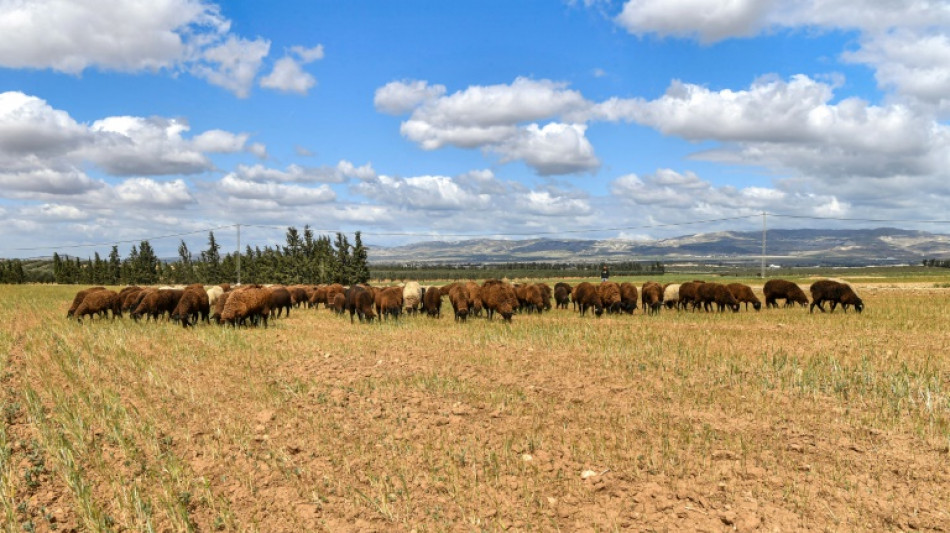
'Flash drought' frequency increasing due to climate change: study / Photo: © AFP

 Pogacar 'happy to be alive' after difficult Vuelta crash recovery
 South Africa beat Australia by 176 runs in third Test to win series

 Evacuees from Russian-occupied Oleshky expected in Ukraine

 UK PM 'open' to slavery apology but not reparations

 Kimono-clad pets blessed at Japan festival lacking enough kids

 Hakimi bags hat-trick as PSG rip Le Havre to pieces

 In-form Fernandez sets up Tokyo final against Russia's Shnaider

 Scam centres relocated from Cambodia operate in Madagascar

 Marc Marquez on front row at Malaysian MotoGP as Martin ruled out

 Injured Martin out of Malaysian MotoGP in big title blow

 US, S.Korea, Japan vow 'complete' N.Korea denuclearization

 Nations commit to get nature goals back on track

 US oil companies aim to squeeze more out of refineries

 Leclerc quickest in Mexico GP practice
 Polish riot police deployed as deposed court chief sets off crisis

 Young Canadians focus on mental health at key climate trial

 'Breath of fresh air' truce brings hope to Ukraine's ravaged Kherson

 British king reflects on colonial atrocities in Guyana

 Nations agree crucial texts in overtime at UN nature summit

 NBA Trail Blazers lose guard Morant for four weeks

 UN nature summit in extra time as nations grapple for deal

 Complaints upheld against Swiss TV commentary on Israeli bobsleigher

 Tielemans glad Man Utd sticking with Carrick

 Scottish police probe Andrew, Epstein stay at royal castle: UK media

 Medvedev into Vienna semis and books ATP Finals place

Dry-spells known as flash droughts, with a surprisingly rapid onset and often devastating impact, are becoming more frequent as human activity warms the planet, according to a study published Thursday.
Though droughts are generally thought of as long-term phenomena, some can occur quite suddenly, in a matter of weeks, when the conditions are right.
Global warming is a recipe for increasing those special conditions around the world, creating in certain areas a decrease in precipitation and increased evaporation, which dries out the soil more quickly.
For the study, published in the journal Science, researchers analyzed a combination of satellite data and ground moisture readings from a period of over 60 years (1951-2014).
"Both flash and slow droughts are increasing" as global temperatures rise, lead author Xing Yuan told AFP.
But flash droughts are increasing more quickly "especially over Europe, North and East Asia, Sahel and west coast of South America," he said.
The researcher, based out of China's Nanjing University of Information Science and Technology (NUIST), warned that the rapid onset of flash droughts gives humans little time to adapt, such as by diverting water resources or preparing for wildfires.
"The vegetation do not have enough time to adapt either," he added.
Yuan's team used climate modeling to forecast how flash droughts will change under several possible greenhouse gas emission scenarios.
Even if emissions are moderate, flash droughts will continue to become more frequent across practically all regions. Under higher emissions scenarios, the trend would be more drastic.
Yuan also said the data showed a general increase in drought onset speeds, with his team finding a "robust transition at global scale" of slow to flash droughts.
"We believe the reduction in emission can slow down this transition," he told AFP.
The concept of flash drought emerged in the early 21st century, but has received more attention since the summer 2012 drought in the United States, which set in particularly quickly and caused more than $30 billion in economic losses.
A commentary piece by two professors in the Netherlands, also published in Science, said the study's warning "should be taken seriously" as the threat "may be even greater than they suggest."
David Walker of Wageningen University and Anne Van Loon of Vrije Universiteit (VU) Amsterdam, both of whom were not involved in Yuan's work, underlined that most of the "hot spot regions" determined by the study were particularly low-income areas.
"These regions generally have more vulnerable populations and lower financial resources for coping mechanisms," they said.
The pair also added that current methods for detecting droughts, often month-by-month data analyses, must be updated to "operate on shorter time scales," due to the increase in flash droughts which "may build and trigger outcomes in just weeks."
M.Odermatt--BTB