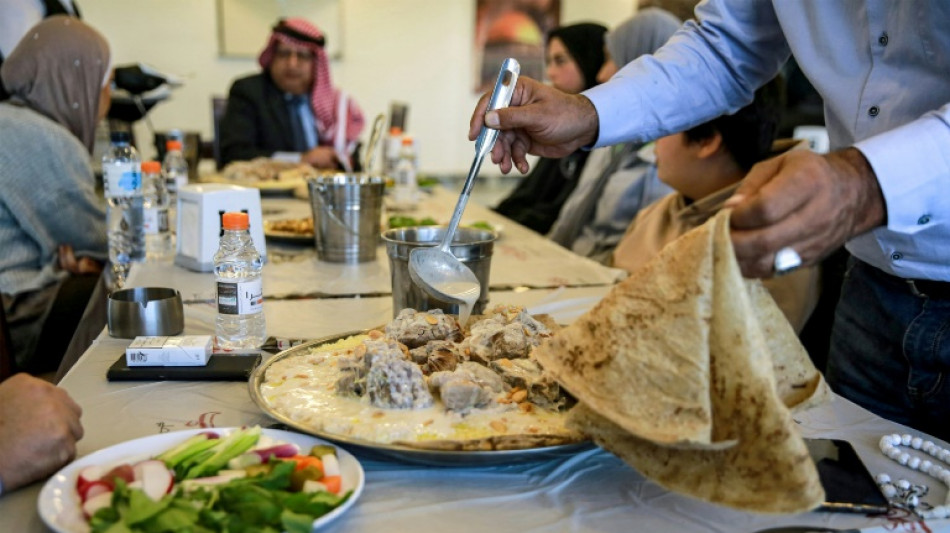
Rooted in war and symbol of peace: Jordan's national dish / Photo: © AFP

 'Very dangerous' super typhoon nears US Pacific islands

 Australia stand by under-fire Popovic after World Cup exit

 Afghan car trade screeches to a halt due to regional wars

 Pipe dreams: Bangladesh surfers chase waves at Asian Games

 England can write new Azteca history by meeting Mexico challenge, says Tuchel

 Paraguay coach says team 'fought like lions' in World Cup loss to France

 Violent crime wave beleaguers Israel's Arab youth

 Severe weather disrupts Trump's America 250 celebration

 Judge, Trout among MLB All-Star Game starter selections

 Davis-Woodhall opens up about depression after Eugene win

 France battle past Paraguay to set up Morocco World Cup showdown
 Jefferson-Wooden holds off Richardson for Eugene 100m win

 Stopping Haaland no mystery for Brazil, says Ancelotti

 Coach says Morocco 'no longer a surprise' after reaching World Cup quarters

 Tuipulotu guides Scotland past Argentina with record score

 'Proud' Marsch says Canada better side in World Cup exit

 Norway must handle occasion against Brazil, says Solbakken

 Bethell upstages 'unbelievable' Sooryavanshi as England beat India

 'No point in racing' says frustrated Verstappen after British GP qualifying

 Tour de France yellow gives Vingegaard crash closure

 Smiling Antonelli proves all-round quality with pole at British GP

 Vingegaard takes Tour de France lead with 'perfect start'

 Osaka eyes Sabalenka revenge in Wimbledon last 16

 Bethell upstages Sooryavanshi as England beat India in 2nd T20

 Antonelli outpaces Ferraris to claim pole for British Grand Prix

In Jordan, a sumptuous dish that has its roots in an ancient war has evolved over the centuries to be widely cherished as a symbol of peace and hospitality.
Mansaf -- the kingdom's national dish of lamb cooked in dried yogurt, served with rice and nuts -- is "the king of the Jordanian table", says Ashraf Al-Mubaideen, 47, who runs a traditional restaurant in Amman.
"If you want to honour your guest, there's nothing finer than mansaf," agrees his business partner Tamer al-Majali, 42, about the custom of greeting guests with huge platters piled high.
Mansaf was inscribed on UNESCO's list of intangible cultural heritage late last year, highlighting the "deep sense of identity and social cohesion" it evokes.
Long before it became a symbol of peace -- traditionally shared to mark the end of tribal feuds -- mansaf was born on the eve of battle, according to one version of history.
In the 9th century BC, King Mesha of the Moab Kingdom -- located on the eastern shore of the Dead Sea -- wanted to test his people's loyalty in a war against the Kingdom of Israel, said historian George Tareef.
"The king knew that the Torah forbade Jews from eating meat cooked with milk," and so he instructed his people to cook a rudimentary version of the non-kosher dish ahead of battle, said Tareef.
In modern-day Amman, Mubaideen and Majali's restaurant is called "Manasef Moab", a nod to the dish's ancient origins.
- 'Authenticity and heritage' -
Jordan's most popular dish -- regularly served at wedding banquets and in households for large families -- bears little resemblance to Mesha's culinary allegiance tests.
The dish underwent thousands of years of "evolution as a result of economic and agricultural conditions", according to researcher Hassan Mubaideen.
In an Amman restaurant, the 58-year-old academic -- donning a red keffiyeh scarf and tucking into a plate of mansaf -- said rice came to replace bread and cracked wheat, as a way to feed more people with less, though shows of generosity remain integral.
"There are special rituals and hospitality protocols linked to the meal -- like how you greet guests, in what order you serve them, where the head of the animal goes, and how you say goodbye," Mubaideen told AFP.
Large platters are traditionally shared between around a dozen people, using only the right hand, while the left is placed behind the back.
Customs have changed, and individual plates and utensils are now often used, as younger generations adopt the age-old tradition.
Sharing mansaf with her classmates, 14-year-old school pupil Zeina Elyan expressed pride in the symbol of "Jordan's ancient heritage" and the health benefits of the dish's whole foods.
Her teacher, Duha Saleh, 31, said she brought her students to the restaurant to teach them "the social culture" behind the dish, and the inherited values of generosity and hospitality.
"There's a pleasure to it," she said, "in how it connects us to who we are, our authenticity and our heritage."
G.Schulte--BTB