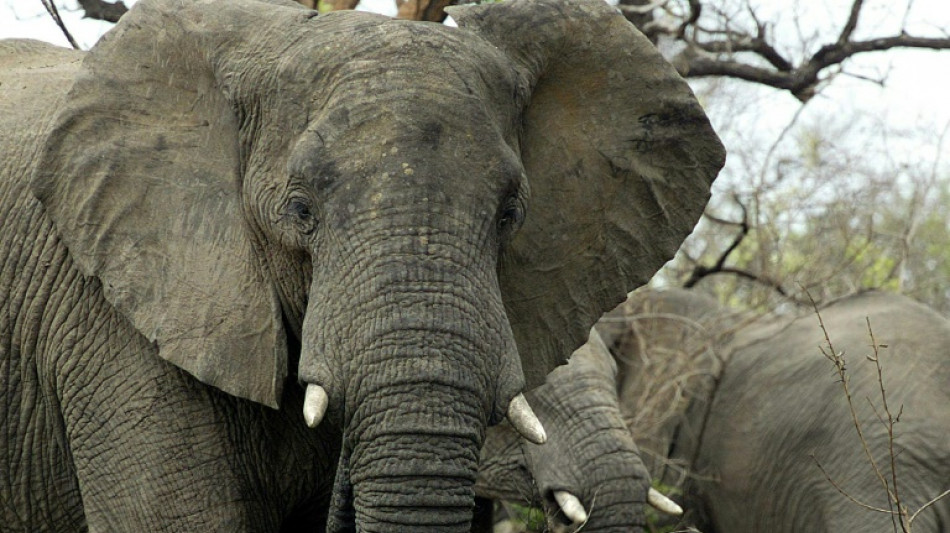
UK trophy hunting bill irks African conservationists
/ Photo: © AFP

 UK hard-right leader Farage faces new allegations over gifts

 OPEC+ raises quotas again as Middle East calms

 Azam to captain Pakistan on West Indies and England Test tours

 Revival hopes grow for long-closed Greek Orthodox seminary off Istanbul

 Trump hails US, blasts 'communists' in 250th anniversary speech

 Taiwanese film hunters rescue ageing reels from bygone era

 Trump arrives for US 250th birthday speech after storm delay

 All Blacks wing Fineanganofo's debut began 'in the toilet, spewing'

 Xhaka -- Switzerland's World Cup rock born to be skipper

 Trump pushes ahead with US 250th birthday speech after storm delay

 Australia's Schmidt rues missed opportunities as Wilson defends Donaldson

 Deschamps hails France for staying cool in World Cup win over Paraguay

 Japan ready for Ireland after 'big statement' against Italy

 Mbappe says France happy 'to get hands dirty' after World Cup win

 France beat Paraguay with Mbappe penalty to reach World Cup quarter-finals

 Ukraine denies Moscow claim of seizing strategic stronghold

 Dinusha shines for Sri Lanka on second day of West Indies Test

 Julian Quinones, Mexico's not-so-secret World Cup weapon

 Erasmus celebrates equalling record with win for weakened Springboks
 'I'm going with him': families fear for bodies of Venezuela's quake dead

 Venezuela quake death toll rises to nearly 3,000

 England unhappy with Rita Ora show before T20 World Cup final

 Morocco end Canada World Cup dream to reach quarters as France face Philly heat
 Ruthless Morocco break Canadian hearts to reach World Cup quarters

 An 'angel' in darkness after Venezuela's deadly quakes

A bid to ban the import of hunting trophies to Britain has upset conservationists in southern Africa, with some saying the bill is counterproductive and smacks of colonialism.
The law, which aims to help protect endangered animals and has the backing of celebrities including model Kate Moss and football presenter Gary Lineker, is to be voted by British lawmakers on Friday.
But many communities and government officials across southern Africa are against the ban.
"What the UK is doing is imposing their very urban, sanitised thinking on us," said Chris Brown, the head of Namibian Chamber of Environment (NCE).
Trophy hunting -- where hunters pay sometimes thousands of dollars for the right to kill usually big game animals like elephants and lions -- has long been controversial.
Critics say shooting wild animals for fun is cruel, wasteful and pushes endangered species closer to extinction.
Hunters often bring home parts of the animals as trophies, like skulls, skins, tusks or claws.
"Can anyone tell me a better definition of colonialism than white people flying to Africa and saying, 'I'm going to shoot these animals for fun, it's my right to do so'?" Eduardo Goncalves, founder of the Campaign to Ban Trophy Hunting told a meeting in support of the bill in Westminster on Wednesday.
But proponents contend that the killing of a small number of selected animals generates much needed income to boost conservation efforts and support local communities.
- 'Re-colonising Africa' -
In a letter to Britain's Minister for Development and Africa, Andrew Mitchell earlier this month, dozens of conservationists and community leaders from Botswana, Angola, Zambia and Namibia warned the law would have a negative impact.
"With reduced revenue from trophy hunting, poaching will increase because there will be less funding to pay salaries to the community game guards," the letter read.
"We feel as if this is another way of re-colonising Africa."
Thato Raphaka, a permanent secretary at Botswana's Ministry of Tourism and Environment, said southern African countries have been lobbying for the law to be dropped.
Botswana, which boasts the world's largest elephant population of around 130,000 tuskers, banned trophy hunting in 2014 but lifted the restriction five years later, following pressure from local communities.
Ex-president Ian Khama, an avid environmentalist, remains one of few voices in the region opposing game hunting.
"Hunting... is not sustainable especially if poaching is not under control," he told AFP.
It "only adds to the decline" in wildlife, he said.
- Wildlife numbers crashing -
Wildlife numbers in Africa have dropped 66 percent since 1970 according to the World Wildlife Fund.
Yet the group said that when well-managed, trophy hunting has proven to be an "effective conservation tool".
Brown, an environmental scientist, said local communities had a much better idea of how best to protect wildlife than lawmakers sitting thousands of miles away in London.
He pointed to a 2017 study ranking countries' efforts to protect big animals like rhinos and bears.
Namibia and Botswana came out top, while Britain was rated "below average" at number 123 on the list.
In Namibia trophy hunting affected about one percent of the total wildlife every year and mostly occurred on private farmland, not in national parks.
Were it to be banned, farmers would lose an incentive to live alongside disruptive animals such as lions, cheetah, hyenas, elephants and crocodiles, said Brown, who is vegetarian.
Rhino numbers in the country have more than doubled since 2005 despite a constant threat from poachers, according to the International Rhino Foundation.
Britons make up a small share of trophy hunters in southern Africa.
Most hunters in South Africa come from the United States, according to a 2021 report by animal rights group Humane Society International, with the UK not even appearing in the top 10 of the list.
But Brown said were the British law to pass, there were fears other countries would follow.
"People think they're doing the right thing for conservation, but they're actually undermining it," he said.
burs-str-ub/sn/fg
M.Ouellet--BTB