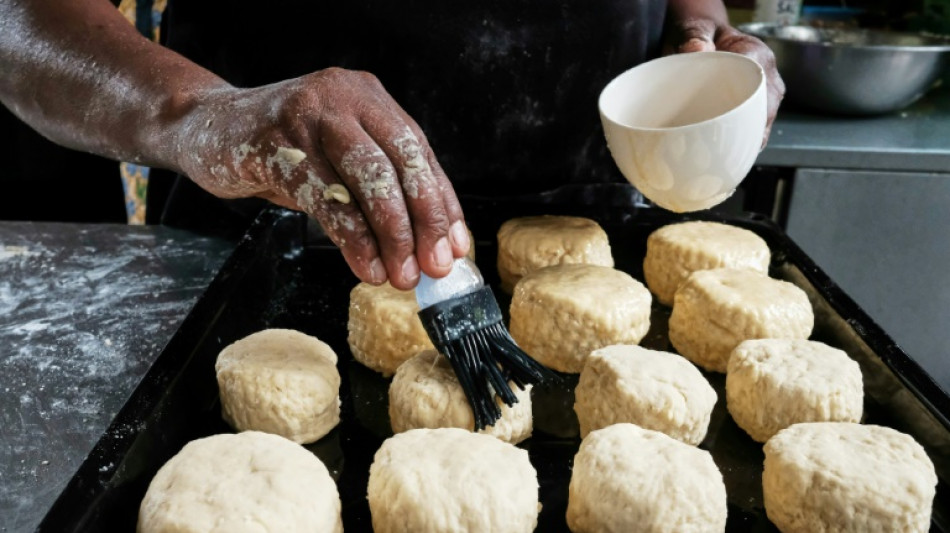
Across Zimbabwe, British scones are the taste of home / Photo: © AFP

 France show they can ditch flair and win a different way in World Cup quest

 Australia hold England to 150-4 in Women's T20 World Cup final

 Leclerc delivers Ferrari's 250th win with victory in British GP

 White supremacist march in DC just 'messy' democracy: US official

 'Country Roads' stars as unofficial US anthem at World Cup

 F1 boss Domenicali hopes to restore cancelled Gulf grand prix

 Real Madrid sign Dumfries from Inter Milan

 At the foot of Mount Olympus, a return to ancient Greek heritage

 Turkey eyes F110 fighter jet engines as Trump comes to town

 England, Mexico take centre stage in Azteca blockbuster

 'Very dangerous' super typhoon nears US Pacific islands

 Australia stand by under-fire Popovic after World Cup exit

 Afghan car trade screeches to a halt due to regional wars

 Pipe dreams: Bangladesh surfers chase waves at Asian Games

 England can write new Azteca history by meeting Mexico challenge, says Tuchel

 Paraguay coach says team 'fought like lions' in World Cup loss to France

 Violent crime wave beleaguers Israel's Arab youth

 Severe weather disrupts Trump's America 250 celebration

 Judge, Trout among MLB All-Star Game starter selections

 Davis-Woodhall opens up about depression after Eugene win

 France battle past Paraguay to set up Morocco World Cup showdown

 Jefferson-Wooden holds off Richardson for Eugene 100m win

 Stopping Haaland no mystery for Brazil, says Ancelotti

 Coach says Morocco 'no longer a surprise' after reaching World Cup quarters

 Tuipulotu guides Scotland past Argentina with record score

A sweet doughy treat from Britain has become a beloved part of Zimbabwe's national cuisine, where despite the country's colonial past, mothers and chefs alike now claim the pastry as their own.
The scone, which Brits normally enjoy with afternoon tea, is ubiquitous in Harare, the southern African country's capital.
A breakfast favourite in these parts, it can be found everywhere from high-end eateries to the market stalls of impoverished townships.
"We love scones. They are not British, they are ours, our local scones," Nyari Mashayamombe, a rights activist, says as she leaves an upmarket restaurant in Harare's Belgravia district, its garden dotted with open umbrellas.
Dense yet airy, Zimbabwean scones are the result of the intercultural mix that came with colonisation, says Mashayamombe, a red-haired 42-year-old who is also a singer and media personality.
In "fancy places like here... a beautiful scone goes as high as six bucks," she said, referring to the American dollars that have become Zimbabwe's parallel and preferred currency.
"It's worth it."
A few kilometres away at a market in Harare's oldest township of Mbare, scones are impossible to find after midday.
"We sold them all this morning. They move quickly," one vendor says.
- Yeast and buttermilk -
The main communal bakery in Mbare, a bustling working-class district, opens at dawn.
Tawanda Mutyakureva, 26, arrives at around five in the morning to his work station, measuring two square metres, where he has to bend over to spread the dough on a knee-height countertop.
Every day he cranks out around 200 scones in an overheated room with cinder-block walls, lit by two bulbs hanging from a wire.
Brandishing a cookie cutter, he works quickly to whip out one batch after another, with each scone selling for 25 American cents.
In the hot, humid atmosphere redolent of yeast, his wife -- with their baby strapped to her back -- helps him with buttering the pastries and clearing plates.
Resellers come in to buy 10 or 20 pieces that will be sold at small grocery stores.
Memory Mutero, 46, was at the bakery to buy bread, since she makes her own scones at home.
"I make scones for my three kids. It takes about 45 minutes," she tells AFP.
Her ingredients are simple: flour, salt, yeast, sugar, butter and milk.
But at the Bottom Drawer, an upscale tearoom in Harare, cook Veronica Makonese is unimpressed after tasting a scone brought back from the township.
"There is no milk in those, they used water!" the 46-year-old claims.
A white kerchief on her head, Makonese says she makes her own buttermilk for her scones, to control temperature and acidity levels, and uses only real butter to ensure the proper taste and softness.
Her boss, Sarah Macmillan, a 53-year-old Zimbabwean, says she longs for the scones she would eat as a child.
Back then, two shops in the centre of Harare, now closed, competed for the crown of best scone in the country, and Macmillan wanted her tearoom to make some that are "just as good".
Macmillan says the secret of the little cake's enduring success, in a country struggling with endemic poverty, is simple: "It's very filling and affordable."
F.Pavlenko--BTB