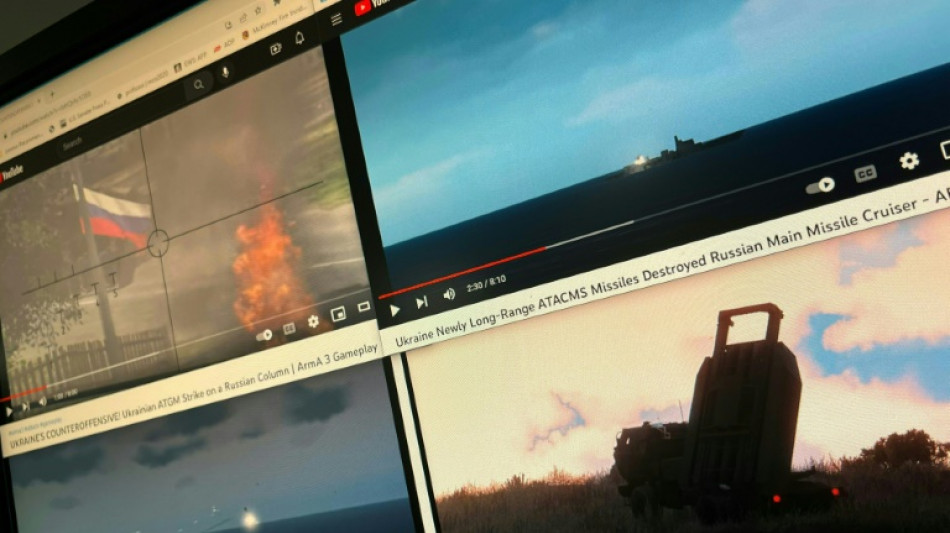
War-themed video game fuels wave of misinformation / Photo: © AFP

 Japanese forward Hachimura signs with Clippers: reports

 After designing Taylor Swift's wedding dress, Dior's Anderson returns to catwalk

 Russian strikes kill 22 in Kyiv region on eve of NATO summit

 Pogacar back in 'special' yellow after Tour de France stage three victory

 Paolini ends Eala run ahead of Wimbledon wildcard clash

 Austrian court sentences Syrian torturers to 8 years in jail

 Paolini ends Eala run to reach Wimbledon quarters

 Cobolli makes second successive Wimbledon quarter-final

 UK's Farage under the cosh over undeclared finances

 Microsoft cuts 4,800 job as it revamps Xbox

 Mertens reaches Wimbledon last eight for first time
 Rennes buy young striker Mayenda from Sunderland

 Russian strikes kill 18 in Kyiv region on eve of NATO summit

 Netflix, Disney+, Amazon appeal French investment rules

 Thousands flee new wave of European wildfires

 Norway releases first image of crown princess after lung transplant

 Stock markets diverge as tech recovery stutters

 Springboks recall Papier and make 10 changes for Scotland Test

 Indonesia, Singapore say key oil passage will remain 'accessible'

 USA face Belgium and World Cup date with destiny after Trump intervention

 Oldest quasars ever discovered add to 'perplexing' space mystery

 German factory orders unexpectedly rebound in May

 Russian strike kills 14 around Kyiv on eve of NATO summit

 USA face Belgium and World Cup date with destiny after Balogun reprieve

 Immobilised by heatwave, handicapped man sues Austria in rights court

Troops battle through burning streets. Missiles take down fighter jets. Drones pulverize tanks. The dramatic visuals have the trappings of real-life combat, but they are clips from video games fuelling misinformation.
Footage from the war-themed Arma 3 video game, often marked "live" or "breaking news" to make it appear genuine, has been used repeatedly in recent months in fake videos about the Russian offensive in Ukraine.
The frequency and ease with which gaming footage is mistaken as real, even by some media broadcasters, and shared as authentic news on social media highlight what researchers call its serious potential to spread misinformation.
"The fact that it keeps happening is a reminder of how easy it is to fool people," Claire Wardle, co-director of the Information Futures Lab at Brown University, told AFP.
"As video game visuals get more sophisticated, CGI (computer-generated imagery) can, at a quick glance, look real. People need to know how to verify imagery, including looking at metadata so that these mistakes don't get made, especially by newsrooms."
Arma 3, whose Czech-based developers promise "true combat game play in a massive military sandbox," allows players to create various battlefield scenarios using aircraft, tanks and a host of weapons.
Players often upload hours of gaming footage on platforms such as YouTube and researchers blame its easy availability for its misuse.
In the comments under one Arma 3 video titled "Ukraine's counteroffensive!" -– which simulated a missile strike on a column of tanks –- a user, who apparently took it as real, wrote: "We must ask Ukraine after this war to train NATO forces how to fight."
- 'First TikTok war' -
"While it's flattering that Arma 3 simulates modern war conflicts in such a realistic way, we are certainly not pleased that it can be mistaken for real-life combat footage and used as war propaganda," a representative of Bohemia Interactive, the game's creator, said in a statement.
"We've been trying to fight against such content by flagging these videos to platform providers, but it's very ineffective. With every video taken down, ten more are uploaded each day."
In recent years, Arma 3 videos have been used in false depictions of other conflicts, including Syria, Afghanistan and Palestine, with the clips often debunked by global fact checkers.
That includes AFP, which has debunked several videos using Arma 3 content, including one in November that also claimed to show Russian tanks being struck by US-made Javelin missiles. The clip had been viewed tens of thousands of times on social media.
Bohemia Interactive said the misleading videos have recently "gained traction" in regard to the conflict in Ukraine.
Dubbed by observers as the "first TikTok war," it is a conflict like no other as a steady stream of visuals from the frontlines -- some of it misleading or false -- pour onto social media platforms.
Given the unsophisticated nature of the Arma 3 misinformation, researchers say it is unlikely to be the work of state actors.
"I suspect that the people posting this content are just trolls doing it to see how many people they can fool," Nick Waters, from the digital forensics firm Bellingcat, told AFP.
"Secondary disseminators will be gullible people who pick up this content and circulate it in an attempt to garner fake internet points."
Bohemia Interactive said the false videos were "massively shared" by social media users, many of whom seek what researchers call engagement bait -- eye-catching posts that generate more interaction through likes, shares and comments.
- 'Different from reality' -
The Arma 3 videos, which its creator acknowledged are "quite capable of spreading fake news," were also shared by various mainstream media and government institutions worldwide, Bohemia Interactive said.
In a live broadcast in November, Romania TV wrongly presented an old Arma 3 video as battle footage from Ukraine, and a former Romanian defense minister and former intelligence chief offered their analysis of the footage as if it were real.
This occurred after another Romanian news channel, Antena 3, made the same error in February -- among the experts invited by the broadcaster to analyze its video taken from Arma 3 was the spokesman of the Romanian defense ministry.
Bohemia Interactive has urged users to use gaming footage responsibly, refrain from using clickbait video titles and clearly state that it was derived from a video game.
Researchers say their videos are relatively easier to debunk compared to "deepfakes" -- fabricated images, audio and videos created using technology that experts warn is frighteningly sophisticated and gaining ground in the criminal underworld.
"If you know what you're looking for, these (Arma 3) videos aren't actually difficult to identify as fakes," said Waters.
"As good as Arma 3 looks, it's still significantly different from reality."
The fact that many are unable to do so points to another stark reality in the age of misinformation.
"It shows that some people don't have the skills to navigate the current information environment," Waters said.
burs-ac/sw
L.Dubois--BTB