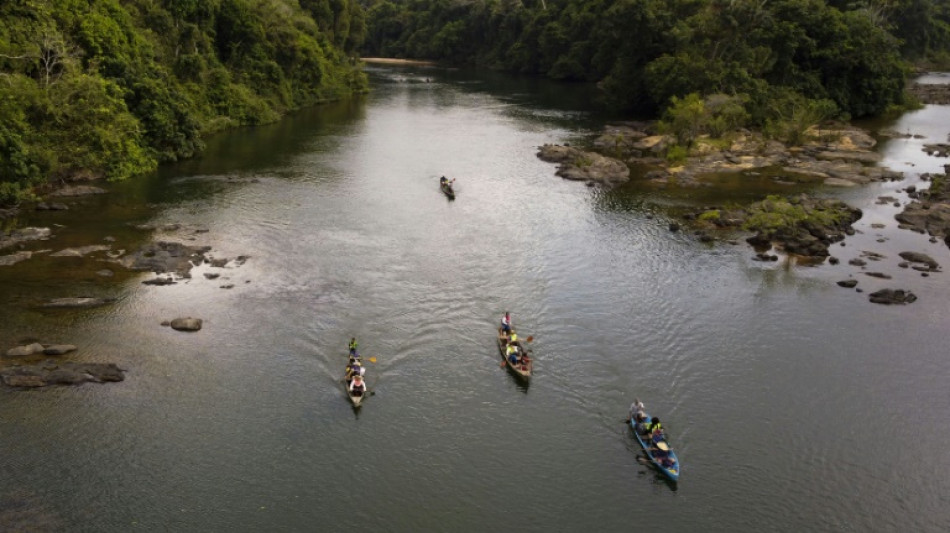
'Progress destroying nature': Brazil dam fuels fears for river / Photo: © AFP

 Packers beat Panthers 27-19 as Watson returns from hospital

 Affordable supermarket fashion offers designer-inspired autumn alternatives
 Judge throws out Australian mushroom killer's appeal, imposes harsher sentence

 Pelicans down Kings for first win of NBA season

 Tech firms take fresh hit as earnings misses fan AI fears

 Worcestershire leaders back renewed two-unitary council reorganisation
 India's animal megacentre vows reset after criticism

 Dodging fuel price hikes, Damascus drivers turn to electric cars
 Alvechurch manager praises resilience but seeks improvement after Anstey draw

 Crypto platform Binance confirms major hack, more than $2.5bn frozen

 Sports chiefs face losing battle to keep sport separate from politics

 Nvidia's web of AI bets: smart strategy or bubble risk?

 Carrick fights for Man Utd job, Arsenal face Liverpool test

 Apple TV crime drama Nocturne brings a Scandinavian thriller to Pennsylvania

 Charity crowdfunds millions to buy historic English estate

 'Diabolical' Halloween festivities banned in Honduran towns

 Everton boss Moyes backs 'club decision' to drop Grealish for Newcastle tie

 DoorDash shares rise as Instacart slips following $17 billion takeover plan

 Japanese star Forever Young goes for rare Breeders Cup Classic repeat

 Inter Miami stay third after 2-2 draw with FC Cincinnati

 Inkle buys Finally bookkeeping unit and expands India-based workforce

 PI Industries plans Indian launch of Pioxaniliprole insecticide this rabi season

 Small-market Brewers upend big-spenders as baseball lockout looms

 ISRO schedules NVS-03 navigation satellite launch for Friday

 Antonelli struck with illness ahead of Mexico GP

Holding a dead fish, Junior Pereira looks grimly at a puddle that used to be part of Brazil's Xingu river, a mighty Amazon tributary that has been desiccated here by the massive Belo Monte hydroelectric dam.
Pereira, a member of the Pupekuri Indigenous group, chokes up talking about the impact of Belo Monte, the world's fourth-biggest hydroelectric complex, which locals say is killing one of the most biodiverse regions on Earth and forcing them to abandon their way of life.
"Our culture is fishing, it's the river. We've always lived on what the river provides," says Pereira, 39, who looks like a man trapped between two worlds, wearing a traditional Indigenous necklace and a red baseball cap.
He gazes at the once-flooded landscape, which Belo Monte's water diversion has made a patchwork of puddles dotted with stranded fish.
"We've lost our river," he says.
"Now we have to buy food in the city."
- 'Like a permanent drought' -
Stretching nearly 2,000 kilometers (1,250 miles), the Xingu ebbs and flows with the rainy season, creating vast "igapos," or flooded forests, that are crucial to huge numbers of species.
They are also crucial to an estimated 25,000 Indigenous people and others who live along the river.
Belo Monte diverts a 100-kilometer stretch of the Xingu's "Volta Grande," or Big Bend, in the northern county of Altamira to power a hydroelectric dam with a capacity of 11,233 megawatts -- 6.2 percent of the total electricity capacity of Latin America's biggest economy.
Built for an estimated 40 billion reais ($7.5 billion) and inaugurated in 2016, the dam diverts up to 80 percent of the river's water, which scientists, environmentalists and residents say is disastrous for this unique ecosystem.
"The dam broke the river's flood pulse. Upstream, it's like it's always flooded. Downstream, it's like a permanent drought," says Andre Oliveira Sawakuchi, a geoscientist at the University of Sao Paulo.
That is devastating fish and turtle populations whose feeding and reproduction cycles depend on the igapos, he says.
Sitting by the Xingu's breathtaking Jericoa waterfalls, which the Juruna people consider sacred, Indigenous leader Giliarde Juruna describes the situation as a clash of worldviews.
"Progress for us is having the forest, the animals, the rivers the way God made them. The progress white people believe in is totally different," says Juruna, 40.
"They think they're doing good with this project, but they're destroying nature and hurting people, including themselves."
- Lula under scrutiny -
Proposed in the 1970s, Belo Monte was authorized under ex-president Luiz Inacio Lula da Silva (2003-2010) -- who just won a new term in Brazil's October elections.
As Lula, 77, prepares to take office again on January 1, the project is drawing fresh scrutiny from those hoping the veteran leftist will fulfill his promise to do a better job protecting the Amazon than outgoing President Jair Bolsonaro, who presided over a surge in deforestation.
Touted as a clean-energy source and engine of economic development, Belo Monte has not exactly lived up to expectations.
According to the company that operates it, Norte Energia, the dam's average output this year has been 4,212 megawatts -- less than half its capacity.
A recent study meanwhile found its operations tripled the region's greenhouse gas emissions -- mainly methane released by decomposing forest that was killed by the flooding of the dam reservoir.
- A new plan -
In 2015, researchers from the Socio-Environmental Institute (ISA) conservation group teamed up with the Juruna to document the devastation.
They have devised a new, less-disruptive way for Belo Monte to manage water, the "Piracema" plan -- named for the period when fish swim upriver to spawn.
Researchers say the plan is a relatively small tweak to the dam's current water usage, adapting it to the natural flood cycles.
Brazil's environmental regulator is due to rule soon whether to order Norte Energia to adopt it.
The company declined to comment on the proposal, saying in a statement to AFP that it instead "recognizes the plan established in the plant's environmental licensing."
The decision is vital, says biologist Camila Ribas of the federal government's National Institute for Amazon Research.
"These are incredibly intricate, interlinked systems. If Belo Monte and other hydroelectric projects disrupt them too much, it could spell the end of the Amazon."
I.Meyer--BTB