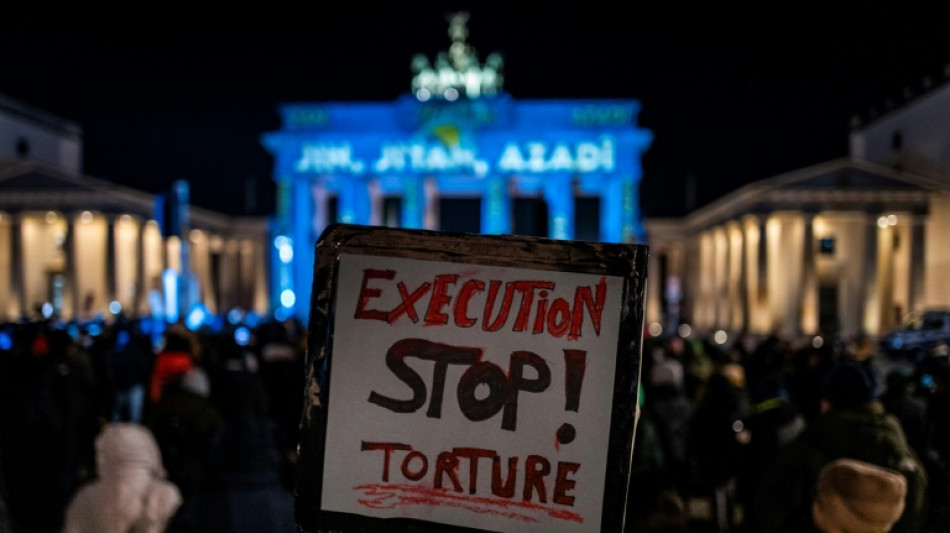
The young Iranians facing death penalty over protests / Photo: © AFP

 Paraguay govt slams lawmaker for racially abusing France's Mbappe
 US embraces Balogun World Cup reprieve as world seethes

 Spain win it late to give Ronaldo bitter end to World Cup career

 Spain edge Portugal to end Ronaldo World Cup dream, US eye quarters
 Spain win it late to bid farewell to Ronaldo at World Cup
 Trump's fireworks made Washington world's most polluted city

 Stock markets meander as US tech stocks climb

 Britain's Fery stuns Dimitrov, Paolini into Wimbledon quarters

 Russian strikes kill 24 in Kyiv region on eve of NATO summit
 Trump touts latest White House renovation: a new helipad

 Fritz powers past Bublik, into Wimbledon last eight again
 Ovechkin won't say next NHL season will be his last
 Djokovic, Sinner aim to book Wimbledon blockbuster
 Record fireworks display choked Washington in toxic smoke

 Macron in Syria on first post-Assad visit by West European head of state
 US streamers launch new legal fight against French content rules

 EU tells France to amend social media ban law
 Losses from latest French museum heist estimated at 4.5 mln euros
 Big defence spending, aid cuts: German cabinet approves budget
 Microsoft cuts 4,800 jobs as it revamps Xbox

 Don't let AI shape humanity's future: UN chief

 Pogacar wins Tour de France 3rd stage, takes yellow
 Trump confirms he asked FIFA boss for review of Balogun red card

 Folarin Balogun affair -- Who said what
 Clooney to get lifetime award at Venice film festival
A doctor, rap artists and a footballer are among around two dozen Iranians who risk being hanged as Tehran uses capital punishment as an intimidation tactic to quell protests, rights groups say.
The executions in the past week of Mohsen Shekari and Majidreza Rahnavard, both 23 and the first people put to death over the protests, sparked an outcry, especially as Rahnavard was hanged from a crane in public rather than in prison.
But campaigners warn that more executions will inevitably follow without tougher international action, with a dozen more people already sentenced to death over the protests and a similar number charged with crimes that could see them hanged.
"Unless the political cost of the executions is increased significantly, we will be facing mass executions," said Mahmood Amiry-Moghaddam, director of the Norway-based Iran Human Rights group.
He accused Iran's leaders of using executions to "spread fear among people and save the regime from the nationwide protests".
The largely peaceful protests sparked by the death in September of Mahsa Amini, who had been arrested for allegedly violating Iran's strict dress code for women, are posing the biggest challenge to the Islamic republic since the 1979 revolution.
There have been no reports of a slackening in protest activity in recent days, including after the executions, but the movement has been marked by phases of more and less intense demonstrations.
Authorities describe those facing death sentences as "rioters" who are being judged in full accordance with the country's sharia law.
But activists express alarm over the use of vaguely worded sharia legal charges against protesters, such as "enmity against God," "corruption on earth" and "armed rebellion", all of which are capital crimes in Iran.
- 'Unfair trial, torture' -
Amnesty International currently confirms 11 cases of death sentences issued against individuals over the protests, and another nine cases where individuals have been charged with crimes that could see them given the death penalty.
One young protester, Sahand Nourmohammad-Zadeh, was sentenced to death over charges -- which he denied -- that he did no more than tear down highway railings and set fire to rubbish bins and tyres, Amnesty said.
The group said it was concerned another young man, Mahan Sadrat, 22, could be executed "imminently" after being sentenced to death in a "grossly unfair trial" over accusations of using a knife to attack an individual.
Mohammad Ghobadlou, aged 22, was sentenced to death on charges of running over police officials with a car, killing one and injuring several others, Amnesty said, adding it had "serious concerns" he was subjected to torture and other abuse in jail.
Saman Seydi, a young Kurdish rapper, was sentenced to death on charges of firing a pistol three times into the air during protests, adding it had received information he had also been subjected to torture to extract forced confessions.
Before his arrest, Seydi had posted material on Instagram in support of the protests, while his rap songs had also been critical of the authorities.
Hamid Ghare-Hasanlou, a doctor, and his wife Farzaneh Ghare-Hasanlou were on their way to the funeral of a killed protester when they were "caught up in the chaos" of a fatal assault on a member of the Basij militia, Amnesty said.
Hamid Ghare-Hasanlou was sentenced to death and his wife to 25 years in prison, with the court relying on incriminating statements from his wife which Amnesty said were coerced and later retracted by her in court.
Her husband was tortured in custody and hospitalised with broken ribs, it said.
Those who face the death penalty after being charged with capital crimes include Toomaj Salehi, 32, a prominent rapper who was charged "solely in connection with critical music and social media posts," Amnesty said, adding that he had been tortured in detention.
The professional footballer Amir Nasr-Azadani, 26, is in a similar position after being charged over the deaths of three security officials in November in the city of Isfahan, it said.
The world union of professional footballers FIFPRO said it was "shocked and sickened" by the reports he faces death.
- Executed 'at any moment' -
Campaigners are seeking to highlight all individuals facing the death penalty in the hope that increased scrutiny on specific cases can help spare lives.
But they warn the executions are often sudden.
Rahnavard was hanged just 23 days after his arrest and shortly after a last meeting with his mother, who was given no inkling her son was about to be put to death.
Activists were also unaware of Shekari's case until his execution was announced by state media.
Amnesty said Iranian authorities are issuing, upholding and carrying out death sentences in a "speedy manner" and there is a "serious risk" that people whose death sentences have not been made public could be executed "at any moment."
"The executions of two people connected to the protests in Iran are appalling, and we are extremely worried for the lives of others who have been similarly sentenced to death," the office of the UN high commissioner for human rights told AFP.
It added that Iran had "ignored" its pleas not to carry out the executions.
H.Seidel--BTB