Nicole weakens to Tropical Storm, threatens NASA launch / Photo: © AFP

 Hong Kong court set to sentence activist Joshua Wong in security case

 Australia raises benchmark rate to highest level in 18 years

 'The Remarried Empress' Cast Discusses Bringing Fantasy Royal Drama to Life

 Asian stocks retreat as AI worries outweigh steep oil-price drop

 Hamad International Airport stages emergency drills during WATAN 2026

 Global failure to punish attacks leaves journalists at continuing risk

 Researchers Warn 'Bookkeeping Trick' Masks Beef Industry's Methane Emissions

 Climate Change Intensified Atlantic Hurricanes, Study Finds

 Qatar solar expansion opens scope for technical performance gains

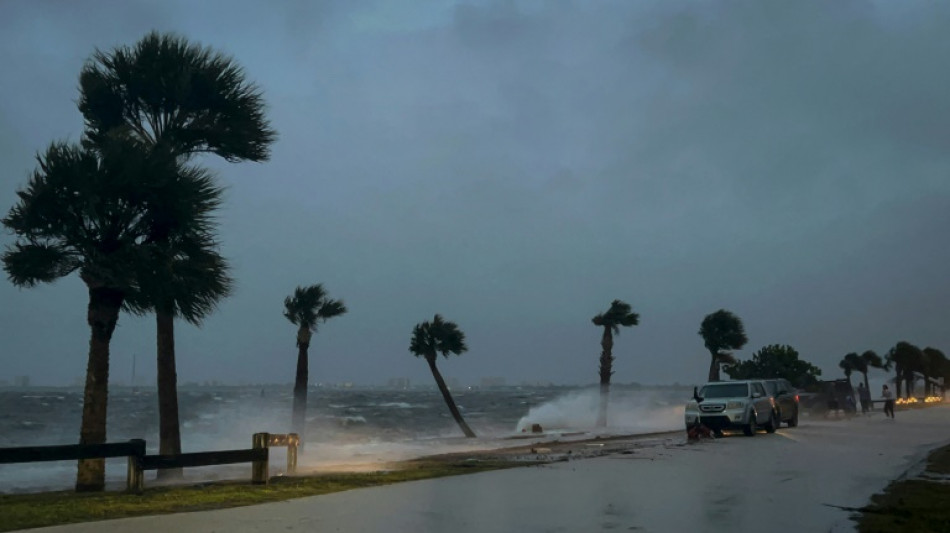
Tropical Storm Nicole slowed after making landfall in the US state of Florida, meteorologists said Thursday, with high winds raising concerns that a long-delayed NASA rocket launch could be disrupted.
The storm, a rare occurrence this late in the year, sparked mandatory evacuation orders just weeks after Florida was battered by Hurricane Ian.
But just an hour after Nicole made landfall as a Category 1 hurricane it was downgraded to a Tropical Storm, the US-based National Hurricane Center (NHC) said in a statement Thursday.
The NHC said Nicole was packing sustained maximum winds of up to 70 miles (110 kilometers) per hour and heading towards Georgia and South Carolina, which would also be affected.
The storm could also possibly hit Ohio, Pennsylvania and New York later in the week, it said.
Nicole passed over the Bahamas on Wednesday, with the level of destruction not immediately clear.
A tropical storm warning was issued for Florida's eastern coast from the city of Boca Raton to the boundary between Flagler and Volusia counties, the NHC said.
"Strong winds, dangerous storm surge and waves, and heavy rains continue over a large area," it said.
Forty-five of the state's 67 counties were under a state of emergency, Governor Ron DeSantis said, while four counties were under mandatory evacuation orders, according to the state's Division of Emergency Management.
More than 100,000 customers in the affected areas were without electricity, according to PowerOutage.us.
In preparation for the storm's impact, DeSantis said 16,000 people had been recruited to respond to power outages and 600 national guardsmen had been activated.
The death toll from Ian, one of the most powerful storms ever to hit the United States, stands at more than 100 in Florida alone.
- NASA launch delay -
Nicole has also raised concerns that a long-delayed NASA rocket launch could be disrupted again.
The storm is heading towards NASA's Kennedy Space Center, located near Florida's eastern city of Orlando, having already disrupted plans to launch the agency's most powerful rocket next week.
The Artemis 1 mission had been due to launch on November 14, but NASA said on Tuesday it would be delayed to November 16.
A backup launch date has been set for November 19.
NASA said it would leave the giant 322-foot (98-meter) SLS rocket on the launch pad, where it had been placed several days before.
Experts have voiced concern that the rocket, which is estimated to cost several billion dollars, could be damaged by debris from the hurricane if it remains exposed.
After two launch attempts were scrubbed this summer because of technical problems, the rocket had to be returned to the Vehicle Assembly Building to protect it from Hurricane Ian.
The uncrewed mission aims to bring the United States a step closer to returning astronauts to the Moon five decades after humans last walked on its surface.
C.Meier--BTB