Bangladesh evacuates hundreds of thousands ahead of cyclone / Photo: © AFP

 Hong Kong court set to sentence activist Joshua Wong in security case

 Australia raises benchmark rate to highest level in 18 years

 'The Remarried Empress' Cast Discusses Bringing Fantasy Royal Drama to Life

 Asian stocks retreat as AI worries outweigh steep oil-price drop

 Hamad International Airport stages emergency drills during WATAN 2026

 Global failure to punish attacks leaves journalists at continuing risk

 Researchers Warn 'Bookkeeping Trick' Masks Beef Industry's Methane Emissions

 Climate Change Intensified Atlantic Hurricanes, Study Finds

 Qatar solar expansion opens scope for technical performance gains

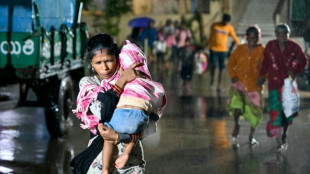
Hundreds of thousands of people were being evacuated Monday from the path of a cyclone careening towards densely populated, low-lying Bangladesh, according to officials.
About 33,000 Rohingya refugees from Myanmar, controversially relocated to a storm-prone island in the Bay of Bengal, were also advised to remain indoors.
Cyclones -- the equivalent of hurricanes in the North Atlantic or typhoons in the Northwest Pacific -- are a regular and deadly menace on the coast of the northern Indian Ocean where tens of millions of people live.
But scientists say climate change is likely making them more intense and frequent, and Bangladesh is already rated by the UN as one of the countries most affected by extreme weather events since the turn of the century.
Cyclone Sitrang, packing gusts of 88 kilometres (55 miles) per hour, was forecast to make landfall near the southern Bangladeshi town of Khepupara by Tuesday morning, the weather office said.
Most worrying for authorities was the predicted storm surge of up to three metres (10 feet) above normal tide levels, which could inundate areas home to millions of people.
Officials in the coastal districts of Patuakhali, Bhola, Barguna and Jhalakathi told AFP that up to 400,000 people would be evacuated from vulnerable villages and islands into shelters.
"We have a plan to evacuate some 250,000 people. There are 703 cyclone shelters in the district and many multi-storied buildings. We will complete the evacuation by tonight," Patuakhali district administrator Kamal Hossain told AFP.
The Red Crescent Society has mobilised tens of thousands of volunteers to use loudhailers to alert people and help villagers evacuate, spokesman Shahinur Rahman told AFP.
The newly formed silt island of Bhashan Char, where Bangladesh has been relocating Rohingya refugees to alleviate camp overcrowding, was also expected to be hit by heavy rains and strong winds.
"The Bhashan Char shelters are protected by a 19-feet high embankment. Still, we asked people to stay at home," a senior security officer told AFP from the island.
- India -
In the neighbouring eastern Indian state of West Bengal, several thousand people were also being evacuated as a precaution, with more than 100 relief centres opened, officials said.
"A special squad is making round-the-clock vigil along the coastline of the state," West Bengal government minister Arup Biswas said.
"Fishermen have been asked not to venture into sea. Ferry services have also been suspended," he said.
In 2020, Cyclone Amphan, the second "super cyclone" ever recorded over the Bay of Bengal, killed more than 100 people in Bangladesh and India, and affected millions.
Last year, more than a million people were evacuated along India's east coast before Cyclone Yaas battered the area with winds gusting up to 155 kilometres (96 miles) an hour -- equivalent to a Category 2 hurricane.
The 1970 Bhola cyclone, one of the world's worst natural disasters, killed several hundred thousand people in Bangladesh -- then known as East Pakistan -- and India.
In recent years, better forecasting and more effective evacuation planning have dramatically reduced the death toll from such storms.
R.Adler--BTB