How only a few tree species drive Amazon forest recovery / Photo: © AFP/File

 Brazil's Andrade returns to take vault gold at worlds

 Lula, Bolsonaro hold final rallies ahead of Brazil election

 Ukraine has 'stable connection' to Starlink: govt

 French protests kick off amid heavy security blanket

 250,000 rally in Madrid demanding state pension guarantees

 UK police says 'claims' over Meghan Markle's dad not sent to other law enforcement

 Top-ranked Rybakina to face Fernandez for Ningbo title

 Late India charge seals thrilling second T20 win over New Zealand

 Seen and heard at France protests

 White says Fiji can have 'massive' World Cup after beating Japan

 England thrash France 82-0 to keep Rugby League World Cup hopes alive

 Security high as France braces for new protests

 White makes winning start as Fiji edge Eddie Jones's Japan

 Lula, Bolsonaro strike calmer tone in final Brazil election debate

 'How is it possible?': Students protest Indonesian haze

 Israel launches major West Bank operation after soldiers killed

 Typhoon Champi knocks out power to thousands in Taiwan

 As Israeli election nears, campaign turns ugly

 Oscar hopeful 'La Bola Negra' offers lessons about communicating, directors say

 Trapped: Soaring fuel costs hurt Maine lobster industry before midterms

 Marc Marquez beats brother Alex to Australian MotoGP pole

 Ebola vaccine trial begins in DR Congo

 Travelling man Wade equals Prem try record

 Rescuers search for seven people in Nairobi building collapse

 Sacha Baron Cohen revives the 'problematic dinosaur' Ali G in new film

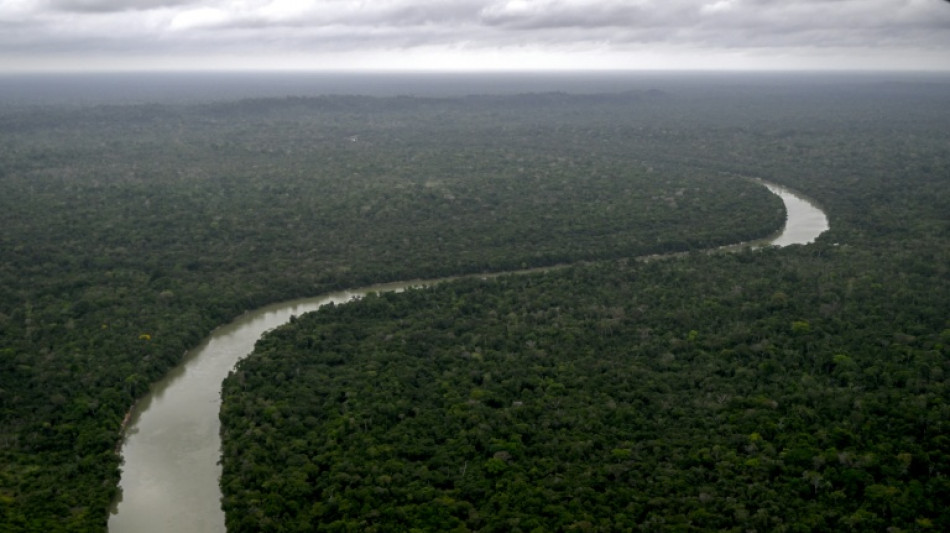
When a destroyed section of the Amazon rainforest begins to recover, nature deploys only a few tree species, which can withstand poor soil conditions, blazing sun, and grow rapidly, a Brazilian study has shown.
Out of thousands of tree species in the Amazon, a small group of 15 to 25 species do most of the work in regenerating forest and storing carbon when farmers and landowners leave, Fernando Elias, a researcher at the Emilio Goeldi Museum of Para, told AFP on Saturday.
"It's fantastic because the forest is resilient. These species give the forest a new chance" after the "complete rupture" with the environment that happens when trees are felled, said Elias.
"Once you remove a forest, you're not just removing biodiversity, you're not just removing the carbon that's there. You're removing the forest's ability to regulate the climate."
Elias was the lead researcher on the study published last month by the peer-reviewed scientific journal Global Change Biology, which aimed to understand secondary forests that emerge in razed areas of the Brazilian Amazon.
Elias said these pioneer species "have the capacity for rapid colonization" to create conditions for the arrival of species that only occur in mature, primary forests, such as shade -- essential for most forest species.
Temperatures under the canopy of these core species can be reduced by up to six degrees Celsius, Elias said.
The pioneer species produce a lot of leaves which fall to the ground, increase organic matter and lead to "the beginning of forest recovery."
Spanning nine countries, the Amazon's billions of trees store vast amounts of carbon and are a key buffer against global warming.
- How forests bounce back -
According to the study, the Amazon has an area of secondary forests the size of Uruguay.
Secondary forests emerge in abandoned pastures, farms that went bust, or when a landowner has a legal requirement to restore land.
Studying how they bounce back is key to understanding how to restore lost forests.
The authors used data from these recovering forests in four regions of eastern Amazonia, representing more than 25,000 trees and palms.
Some had been regenerating for as little as one year, and others up to 60 years.
Among the dominant trees were Cecropia palmata, with a pale gray trunk and huge hand-shaped leaves, and Inga alba, whose long pods contain an edible sweet white pulp.
Palm species like the towering Inaja and the babassu palm, long valued by rural communities for its oil-rich nuts, were also major players in regeneration.
"If we know which species dominate carbon stocks and dominate the functioning of these ecosystems, we can direct restoration efforts toward them in a way that, for example, makes restoration faster," said Elias.
According to data from Brazil's National Institute for Space Research (INPE), an area roughly the size of Spain has been deforested in Brazil in the past four decades.
Under President Luiz Inacio Lula da Silva's administration, deforestation last year plunged to its lowest levels in a decade. He wants to eradicate forest loss by 2030.
Brazil has pledged to restore 12 million hectares (46,300 square miles) of land under its Paris Agreement commitments.
The research was conducted as part of the Sustainable Amazon Network -- an international effort to study how deforestation and other human activities are changing the world's largest tropical rainforest.
H.Kuenzler--VB