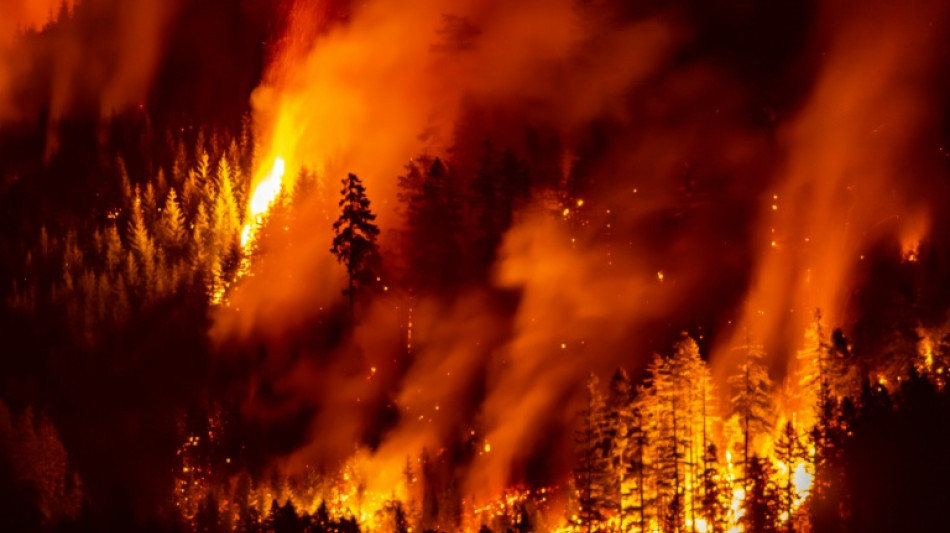
Canada tries to adapt to a future of wildfires / Photo: © AFP

 Monaco hold Lille as both move to top of Ligue 1

 Isak extends hot streak as Liverpool sink Brighton
 Brazil chooses between Lula and Bolsonaro in nail-biter vote

 Le Pen begins presidential campaign after violent protests across France

 UDST opens Fall 2027 admissions to students in Qatar and abroad

 Historic Ramallah olive press joins modern production with local tradition

 Hebron operation forces 373 Palestinian families from their homes

 Kuwait legal department reviews new commercial concealment law

 Poland’s WB Group plans $100 million India investment for drone production

 Insurance deductibles and no-claim bonuses require a careful claims decision
 Credit-card shortcuts can turn impulse spending into lasting debt

 Chicago Fire rally past Atlanta United 3-2 to hold fourth place

 John Catlin wins Hong Kong Open and secures first Masters invitation

 Serbia on track for high turnout as students challenge ruling party

 Pakistan keep England to 241 despite Duckett ton

 Ukraine war divides Bulgaria as voters elect president

 Shock and grief in a Jordanian village after church attack

 Top-ranked Rybakina crushes Fernandez to win fourth title of season

 UK PM calls for 'honest discussion' about EU free movement

 Far-right leader Le Pen kicks off tilt at French presidency amid nationwide protests

 Naomi Osaka could quit tennis if daughter asks her to

 Last MotoGP race at Phillip Island cancelled due to weather in Marquez setback

 Sri Lanka seeks faster green energy shift after oil shocks
 Riyadh airport resumes flights following Houthi attacks

 'Call of Duty' North Korea invasion edition tops sales charts in South
Faced with another summer when wildfires have scorched millions of hectares of land and blankets of smoke have disrupted daily life nationwide, Canada is trying to limit the annual devastation.
Yet, despite procuring new water bombers and deploying forest management strategies to protect populated areas, experts caution that intense wildfires will remain a fixture of Canadian life.
"We're going to have to live with this," said Normand Lacour, who spent decades at Quebec's wildfire prevention and detection organization (SOPFEU).
Canada is home to about a quarter of Earth's boreal forest area and average annual temperatures in the country are increasing roughly twice as fast as the global average.
That makes conditions in Canada particularly "conducive to intense and very extensive forest fires," University of Ottawa geography professor Patricia DeRepentigny told AFP.
Canada's last three wildfire seasons have been among the 10 worst on record, including the devastating summer of 2023 when 18 million hectares (44.5 million acres) were torched, an area nearly as large as Syria.
This summer is not currently on track to approach that historic toll, with 4 million hectares burned so far, but the damage has been widespread.
In the western province of British Columbia, 15,000 people have been ordered to evacuate their homes, while residents of major eastern population centers like Toronto endured some of the world's worst air quality last month.
- Changing methods -
Canada's emerging response is broad-based.
The federal government has invested CAD$317 million (US$227 million) over five years "to establish a new national aerial firefighting surge capacity," Ottawa announced in May.
The money is being used to lease 10 aircraft capable of confronting wildfires, to be dispatched to provinces facing intensifying blazes.
Ottawa is also backing a CAD$150 million program that aims to clear flammable material such as vegetation from populated areas.
Provinces have also beefed up their firefighter capacity, including in Quebec where SOPFEU staffing levels are up 40 percent.
But, when it comes to protecting people from wildfires, "Canada is not in an excellent position," said Ryan Ness, the director of adaptation research at the Canadian Climate Institute.
There are "too many communities that are in areas that are exposed to wildfires that continue to develop," he told AFP.
- Fire clouds -
Canada is also extremely vulnerable to "fire clouds," or pyrocumulonimbus clouds, immense blazes that create their own wind and even lightning that can spark fresh fires.
The phenomenon, a consequence of the more frequent heat waves caused by climate change, was once rare in Canada, but that is changing.
Fire clouds were recorded 140 times in Canada in 2023, compared with once or twice a year historically, DeRepentigny said.
Fire clouds are unpredictable and can spread at staggering speeds. Battling them is a near-impossible challenge.
"There's not much we can do when this happens, apart from pulling crews out of the field and repositioning them behind the fire," said SOPFEU meteorologist Claudia Vaillancourt.
N.Schaad--VB