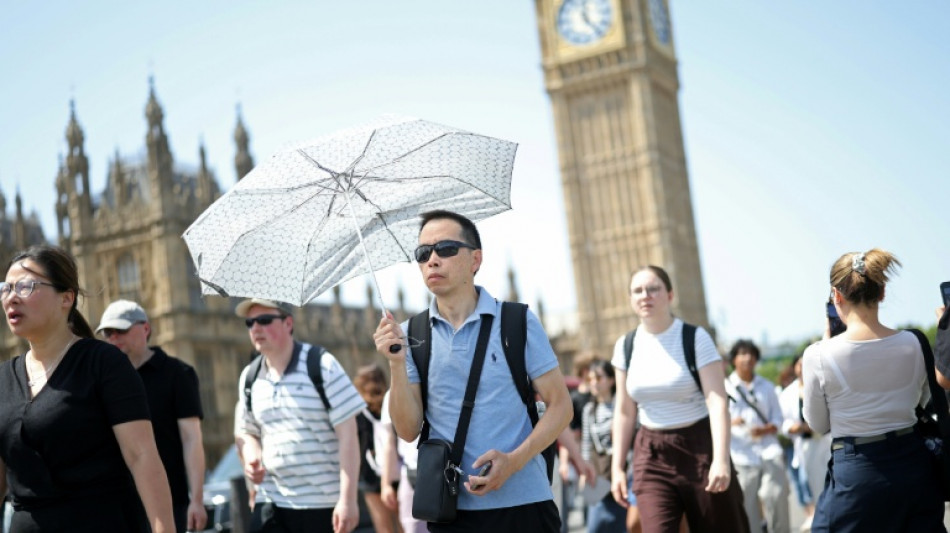
UK climate now hotter, sunnier: weather agency / Photo: © AFP

 Hong Kong court set to sentence activist Joshua Wong in security case

 Australia raises benchmark rate to highest level in 18 years

 'The Remarried Empress' Cast Discusses Bringing Fantasy Royal Drama to Life

 Asian stocks retreat as AI worries outweigh steep oil-price drop

 Hamad International Airport stages emergency drills during WATAN 2026

 Global failure to punish attacks leaves journalists at continuing risk

 Researchers Warn 'Bookkeeping Trick' Masks Beef Industry's Methane Emissions

 Climate Change Intensified Atlantic Hurricanes, Study Finds

 Qatar solar expansion opens scope for technical performance gains

The UK climate is profoundly different compared to typical British weather last century, with constantly rising temperatures and frequent extreme events, the nation's meteorological office said in a report Wednesday.
"The observational evidence demonstrates that what we regard as our 'normal' climate in terms of the hottest and coldest spells of weather we would typically expect... has very significantly changed from what it was through most of the 20th century," the Met Office report said.
The UK experienced two unprecedented heatwaves in May and June with monthly records in England set at 35.1C and 37.7C respectively.
The UK meanwhile experienced its hottest recorded year in 2025, with an average temperature of 10.1C. It was also the sunniest year since 1910.
Britain's spring and summer combined saw a mean maximum temperature anomaly of plus 2.1C, the Met Office report said.
Total sunshine was 125 percent of the 1991–2020 average, "by far the warmest and sunniest such period on record".
Britain's coast has not been spared either. Waters bordering the UK experienced 297 days of marine heatwave conditions in 2025 -- the most since 1982 and far exceeding the previous record of 178 days in 2023.
Beyond these annual records, the report points out that the UK climate has warmed by about 0.25C per decade since the 1980s.
The last four years are among the five hottest recorded since 1884.
This trend has been accompanied by more intense extremes: the number of days above 30C and nights above 18C in Greater London has more than quadrupled compared with the between 1961 and 1990.
"A lot of our infrastructure, our housing stock, our agriculture, our health systems... are based on a climate that is no longer represented by the recent observations we are continuing," Mike Kendon, climate scientist at the Met Office and the report's lead author, told a press briefing Tuesday.
Some companies have taken note of this development.
Food-to-clothing retailer Marks & Spencer recently announced investments in equipment capable of withstanding temperatures of up to 45C.
Eurostar will upgrade air conditioning systems aboard its highspeed cross-Channel trains to withstand temperatures of 55C from 45C currently.
R.Kloeti--VB