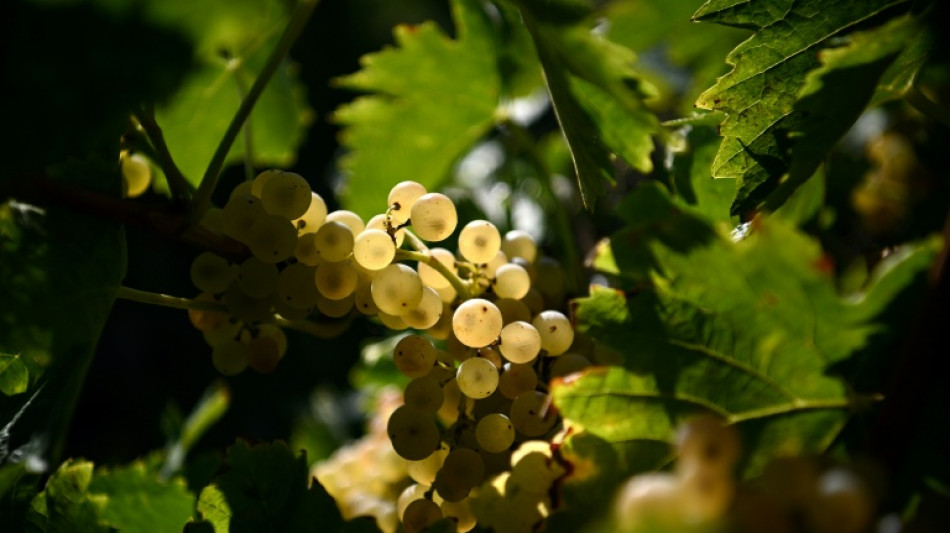
French wine growers plant trees to protect vines from climate / Photo: © AFP

 US House targets data centers as midterm backlash grows

 French ex-minister Dati goes on trial in Renault-Nissan corruption case
 'Being Heumann' captures joy in fight for disability rights

 Retired great Nadal to play in exhibition matches

 IR-MED and Dice Technologies Announce collaboration to Evaluate and Advance Pressure-Injury Prevention Platform in Japan

 Watts, Pitt, Cruz to light up Spain's top film festival

 Sweden expels Iran embassy employee over anti-Jewish threats
 Toogood Gold's Table Mountain Sits in the Shadow of a Nevada Gold Rush

 MEXC July–August Security Report: 38.66M USDT in Risk Funds Intercepted, Futures Insurance Fund Hits 792M USDT

 'Breathing toxin every day': Indonesians choked by haze feel helpless

 Stocks edge higher ahead of US Fed rate call

 Philippines ex-leader Duterte makes first in-person ICC appearance

 2027 Formula One calendar includes Monaco sprint race

 Palestinians are the real victims, Thunberg tells Ed Sheeran

 Hashim Thaci: From 'George Washington of Kosovo' to Hague convict

 Amnesty says Iran committed 'crimes against humanity' in crackdown on 2022 protests

 EU to ban social media for under 13s, curb access until 15

 Philippines ex-leader Duterte makes first appearance at ICC

 EU chief pitches 'associate member' status for Canada

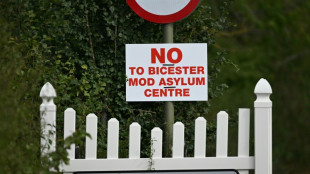 English village votes to 'secede' from UK over asylum centre plan

 Wildfires push endangered Sumatran elephants to brink: Indonesian NGO

 Stocks head higher as traders prepare for Fed decision

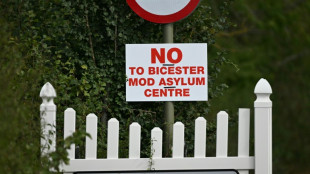 English village votes to 'secede' from UK over asylum centre
 Hong Kong unveils plan to align economy with China's goals

 Brazilian voters the latest to eye Bukele security model with envy

In the wine-making heart of the northern Rhone hills in southeastern France, one of Pierre-Jean Villa's plots is a curiosity.
Unlike others stretching far around, the vines in this particular spot are interspersed with maples and fruit trees designed to stimulate the grapes -- and protect them from the ravages of climate change.
Slowly, French winegrowers are experimenting with "vitiforestry".
It is a new word for an ancient practice: growing vines alongside trees, something Italy and Greece have never stopped doing.
"Here, at the start of the 20th century, there was an orchard and a vegetable garden as well as vines," said Villa, standing on the plot that slopes down towards the Rhone, with the Alps on the horizon.
"The idea is to recreate a bit of what used to be done before. We've even brought back sheep and bees."
- 'Decent' grape yield -
As "a man of the land", Pierre-Jean says he is now struck by seeing "earlier harvests, heatwaves, drought or rain arriving with a suddenness and violence we didn't see before".
Like his neighbours, he had previously grown vines the traditional way. It was his son Hugo, a graduate of agricultural school in Montpellier, who had the idea of using trees to counter the harmful effects of climate warming.
Lying close to the officially designated wine regions of Condrieu and Cote-Rotie, the land that now holds the trees lay fallow just a decade ago.
On it, the father and son embarked on their "technical and family" project.
Helped by experts from the neighbouring regional park, they selected local species of tree and determined their layout with the right balance of shade and humidity.
As a result, for every 15 rows of prized Syrah grapevines, there are 400 apple, pear, peach, hazelnut and quince trees growing in dense rows.
While it is too early to draw firm conclusions, Pierre-Jean Villa believes the plot "came through rather better" than others during a 20-day heatwave in August 2025, with a "decent" yield.
- 40C heat -
Christian Dupraz, research director at the National Research Institute for Agriculture, Food and Environment (Inrae), agreed.
"When we had 40 degrees Celsius last year, our agroforestry vines coped perfectly."
In 1997, Dupraz launched his own "iconoclastic" test plot in the Herault region to bring trees back among crops.
His findings: trees limit damage to vines from spring frosts -- the bane of winegrowers -- and provide shade as well as helping the plants release water.
Vines were originally creepers growing on trees, Dupraz pointed out. Now with trees present, "temperatures on leaves and berries are reduced. That can save a harvest," he said.
"If we now regularly have more than 40C in summer, it will no longer be possible to grow vines in full sun."
- Long-term gains -
Trees are being planted to help vines in regions ranging from Bordeaux to Languedoc and even Champagne.
Regional authorities are offering subsidies, and customs authorities defined a legal framework for the activity in 2024.
Today, two to five percent of vineyard areas are involved, to varying degrees, the French Agroforestry Association estimated, calling it a "growing trend in the face of climatic hazards".
Bernard Farges, president of the National Committee of Wine Joint-Professions (CNIV), was more cautious, however.
"The expected gain is long-term. Given the difficulties (in the sector), some people have other priorities."
Yet with a tendency for growers in difficulty to abandon their vineyards, "there is room for trees," said Dupraz, the Inrae expert.
At Pierre-Jean Villa's estate, other growers have come to look at his young vitiforestry plot -- including ones from the key southern winemaking region of Bordeaux, faced with a warming climate.
"It's my finest achievement. My whole region is here -- the environment, the granite sands, the vine stakes," he said. "The fruits of my childhood."
M.Schneider--VB